

When Jessi Gutch moved from London to Folkestone, a small town 30 miles from Calais, albeit separated by a cold North Sea, she was, she admits, quite prepared to be provocative. She wore a t-shirt that had ‘will trade racists for refugees’ emblazoned on it.
The town, like the rest of Kent (the closest UK county to the European mainland) had voted overwhelmingly to leave the EU during the Brexit referendum. What’s more, the Kent coast was, and remains, the main landing place for the hundreds of illegal boats carrying refugees, many of whom are fleeing oppression in their home countries.
But Gutch didn’t wear the t-shirt for long. She had committed to living in Folkestone and after a while the sartorial statement was beginning to wear thin. And of course, the longer she was there, the more she got to know her fellow Folkestonians. She may have disagreed fundamentally with some of their right-wing political opinions, but a proper analysis of the town and its residents would require an approach that was altogether more nuanced and – as we see in her feature documentary – kind.
“I wanted to just talk to people and not make this into a kind of hero-villain thing. I was going to go into this more open-minded with people, starting from a place of compassion rather than starting from a place of judgement,” she tells Business Doc Europe.
So she gathered a diverse group of locals to discuss the very business of existence, and most importantly the notion of identity. What does it mean to be British? Or perhaps more accurately, what does it mean to be English?
Heba is a Syrian Muslim refugee whose father and brother were killed in her homeland, and is now holding on to her traditional values within the UK even as she watches the blossoming of her sister’s radical feminism.
Dan, aka Dita, a non-binary drag performer, champions inclusivity while feeling increasingly detached from a working-class background characterised by a disapproving father (although dad increasingly shows a willingness to accept Dan/Dita’s lifestyle choices). They (Dan/Dita) are fighting for a future England “that is not determined by traditional ideas about ladies and gentlemen,” they say.
Josie, who was one of the only Black kids growing up in Folkestone, looks to depict and interpret the complexities of the town, and the dire struggles of the refugees, through art. She wants to do battle, she says, against the prevailing narrative of the Good Commonwealth folk who “earned” their place in the UK, despite the centuries of colonialist oppression their forebears had to suffer.
Cheeky chappy Nathan, a barber, karaoke enthusiast, and die-hard fan of Only Fools & Horses (a very popular UK comedy series) voted leave during the referendum, and asks why we, as a nation, are rushing to help people beyond our borders but fail to address our own domestic problems.
Fishermen Freddy and Harry struggle to stay afloat amid financial hardship. Now they spend a lot of their time accompanying cross-Channel endurance swimmers, in the process observing migrant boats coming the other way towards the UK shoreline. “What do you say to the world when it passes you by in a small boat?” director Gutch muses from the fishing boat.
And then, there’s ex-military Neil, an ardent Brexiteer and local councillor. He is affable and friendly but is the only person that Gutch feels she hasn’t worked out. Her quest, she underlines, was “to cross over the community divides, societal divides, political divides,” but Neil remained a mystery, despite him saying that he learned much from their interactions, and their joint recognition that a friendship had developed between them.
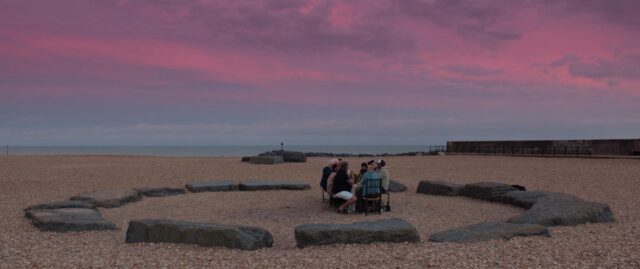
At the end of the film, Gutch gathers all of her characters and cooks them dinner on the Folkestone beach. The scene is heart-warming, and underlines both the power and beauty of dialogue as people converse with civility and grace.
A country is like a table upon which you break bread, Gutch describes the scene, quoting Turkish writer Ece Temelkuran. “I think there is something about the sharing of a meal, even though it seems so simple,” she says of the communal experience. “I think there is something about the ‘unknown’ and the ‘unseen’ that builds up in people’s minds in a way that is actually not reflective of what they would feel if it was someone right in front of them.”
“Also the fact that it was the beach,” she adds. “The beach feels like one of the last spaces where I feel like everyone is kind of equal. There’s no dominance over anybody on the beach…I know a lot of people on that table hadn’t even met a refugee. And there was just something so… [she is temporarily lost for words]…I don’t know. I do think people are just good.”
To a great degree, the film isn’t about the notion of Britishness, rather Englishness, which is an altogether more prickly issue, given how legislation, policy-making, colony-building and war-mongering have historically derived from Westminster, in London, the capital of England. There’s no love lost between the Scots, the Welsh, the Irish and the nation of England. And one suspects that whatever international antipathy we may feel is directed more at England than the UK as a whole. Gutch herself admits that she will identify more as a Londoner or a European than as English woman.
“I kept more and more thinking that maybe part of the problem was very specific to Englishness, which is that there are those of us who hate the history of empire, and feel a real sort of repugnance around a lot of these things,” she says. “It [Englishness] has also been co-opted in such an awful sort of way and we all associate it with this right-wing sort of stuff. It just became more and more apparent to me that we [the English] don’t have a story that some of us can feel kind of proud of, and that that’s a problem.”
That said, there is a funny sequence when a Serbian couple turn up at Nathan’s shop and marvel at his collection of [very English] Only Fools and Horses series memorabilia, and pose accordingly in the main character’s sheepskin coat and flat cap. Astonishingly, given the programme’s stop-the-nation popularity it was one that Gutch had never seen. “In hindsight, I’m not sure why I didn’t. I think I’d better go and watch a few episodes so I know what’s going on,” she tells BDE, shamefacedly.
A particularly satisfying moment for the director came when the participants sat down to watch the finished film for the first time, and when the respective opinions of each were screened publicly. For Gutch, it restored her faith in the robustness both of her participants and in potential audience reaction to a film with which they will be asked to seriously engage.
“It was really interesting to me because I think I maybe worry that people will be perhaps somehow more vulnerable, more sensitive than they are, and actually what I learned is that people can handle tension and disagreement,” Gutch says. “Particularly in that space where we watched it together, that was another thing that really galvanized me around [the feeling that] it should feel a bit uncomfortable for an audience.”
“I find with documentaries and documentary audiences that often it will be an amazing film, but the audience will be full of people who have made up their minds about the subject already and so you get that sense of ‘aaaagh, these aren’t the people we need to be here.’ I’ve tried to lean more into the discomfort of it. Hopefully change can happen if [you can instil] a bit discomfort in the different people watching it together.”
Blue Has No Borders is produced by Charlie Phillips (I am Charlie Ltd) and Nikki Parrott (Tigerlily Two). Sales are handled by Charlie Phillips.





