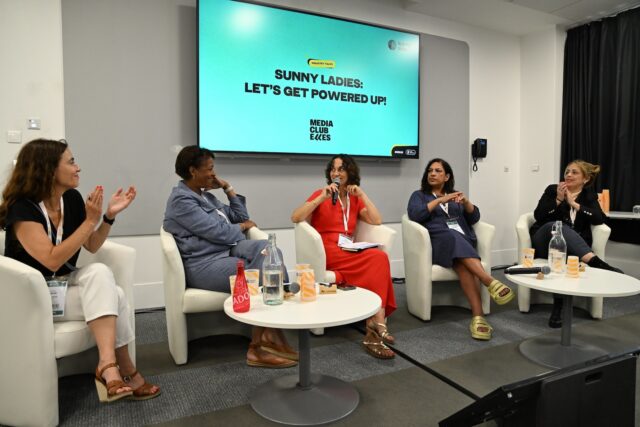
Four documentary changemakers from diverse backgrounds united during Sunny Side of The Doc Sunny Ladies: Let’s get powered up! session.
Joining moderator Caroline Behar, Head of International Co-productions and Acquisitions at France Télévisions, were a quartet of women who shared insights from the top of their game: Dawn Porter, Director of Trilogy Films (America), Shaminder Nahal, Head of Specialist Factual at Channel 4 (UK), Andrea Rawlins, Director and Producer at Capa Presse (France) and Rafaella Costa, CEO of Manjericão Filmes (Brazil). Each panelist kicked off with what inspired them to become documentarians, and how they got to this point in their careers.
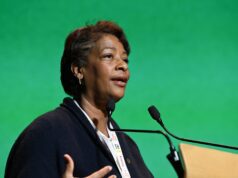
Founder of Trilogy Films, Dawn Porter is an award-winning documentary filmmaker whose work has appeared on ESPN, Netflix, HBO, PBS and Discovery. She began her working life in an entirely different profession.
“I practised law for seven years before becoming a filmmaker. I was attracted to film because of its emotional power and ability to connect. And then very recently, I’ve been particularly interested in the woman’s point of view in famous historical events,” Porter said.
And in today’s climate, it’s a crucial calling, she suggested. “You know, in America, we’re having a really tough time. I think we have always known that storytelling is critical, but right now, it’s probably more important than ever.”
Porter has been responsible for several films that give voice to women’s issues, including 37 Words which chronicles the battle to gain equal rights for women in education and athletics; Trapped, which follows clinicians and lawyers struggling on the front line of abortion rights, and The Lady Bird Diaries, an all-archival documentary film about one of the most influential and least understood First Ladies, which recasts her crucial role in LBJ’s presidency.
Of the Lady Bird Diaries clip that she presented to the audience, she said, “So it turned out Lady Bird was a journalist, and she kept very exquisite notes about what she was seeing… and when we found the footage, she would recount meticulously what was happening on that day, yet her name was not mentioned in the subject matter and the archivist didn’t think it was important to put her name in the directory.”
It’s a project that underpins her philosophy about women in history. “I’m showing you this clip to make the point that if you are looking for the women, they are there, but you have to ask the right questions,” she urged.
For Shaminder Nahal, Head of Specialist Factual at Channel 4, the call came early. “At about the age of 11, I started to get really interested in newspapers. And in those days, everything was an actual newspaper, and my favourite was the Sunday Times. Every Sunday, I would read the whole thing, every word, and weirdly, I had a little notebook that I’d make notes in.”
“Then I got really excited about the stories of these great journalists who had these fabulous lives. They’d go trotting around, maybe to a bit of conflict here, a bit of conflict there, then go to a tapas bar and then have a brilliant night out meeting fascinating people, drinking sherry or whatever, and I thought, God, that sounds like such a brilliant life!”
Nahal began to realise, though, that these people were mainly white men of a ‘certain club.’ Luckily, she was undeterred. “I could still imagine me with my little plaits doing these deep forensic investigations about things.”
She got herself a place on the BBC Trainee scheme, and after a stint in the backwaters of South-West England – “some of them had never seen a black person… that was quite an education…” – she worked her way up from BBC News to Channel 4 News, ending up in TV journalism.
As the climbed the ranks, she understood how her position gave her the power to set the agenda, and she wasted no time in tackling the subjects that her male counterparts passed on.
“It was at the time when there was a big debate about whether women should wear the burqa. We had a hundred women all in burqas telling right-wing commentators why they thought they had got the wrong end of the stick. Another news story was a scandal about women with leaking breast implants. I got a hundred of those women in the room to tell the Health Minister why she should do something about it.”
Other projects include Black to Front which Nahal commissioned after the murder of George Floyd. Understanding that this moment was going to be a turning point, she decided she had to do something, and she came up with a plan to turn the whole of Channel 4 black for the day.
“So every programme that we had in the schedule for that whole day, including all the adverts, were created with only black people on screen.” It was a controversial move, she told us, with accusations of tokenism levelled at the initiative, but ultimately it had a lasting effect in shifting perspectives, and changed C4 commissioning guidelines, which now mandate a percentage of black and brown staff in key roles on production.
Fast forward to 2025, and Nahal is a tour de force in the documentary world. Her most recent commission, Groomed: A National Scandal lifted the lid on a grooming gang which operated over 20 years, exposing police and social services failure which still continues to this day.
“Obviously there’s sexual abuse in every community perpetrated by every race or creed but this particular form of gang grooming was mostly by British men of Pakistani origin and therefore a lot of the criticism is that the girls were ignored because a lot of the authorities were trying to be politically correct … the accusation is that they turned a blind eye because they didn’t want to stoke a race war.”
Her concern was that making the programme would play into the hands of the right wing. However, Nahal knew it was a story that had to be told but, “I found that quite a difficult thing to rationalize in myself, but in the end I thought, I care more about the women who have still not got justice than I do about being accused of being right wing… I suppose as an Asian person myself I felt quite confident and powerful about being able to deal with that criticism.”
Again, the story helped to move the dial, and weeks after the film was released, Shaminder told us that the government announced a national inquiry into the scandal.
Director and producer Andrea Rawlins is equally no stranger to tackling difficult, sometimes taboo, women’s issues. She explained how almost 30 years ago she pitched up at prestigious Parisian press agency, Capa Presse.
“There were mainly men, and the noble issues were wars, politics and investigations, which of course you need to cover to talk about the world around us. But, all the social issues; rape, feminicide, LGBT rights, denial of pregnancy, young teenage mothers, they were considered as minor issues.”
Since then, Rawlins has spent her career exploring issues of adolescence, sexuality, precariousness and violence, particularly sexual and gender-based violence and harassment.
“I believe that the personal is political. I mean, when there are so many rapes, so many feminicides, you can’t just treat them like true crime, which was, at that time, the way we used to treat those subjects. And so I started, I did at first a report about a house that treated little girls that had been victims of incest.”
Despite opposition, and a lack of understanding from her boss, she stood her ground, and, “little by little, they realized that there was an audience for this because it’s part of our society and you really need to denounce it because those issues, once again, are political,” she stressed.
Rawlins’ latest project, Chemical Submission: Shifting the Shame sees Gisèle Pelicot’s daughter, Caroline Darian, use her mother’s trial as a central thread to delve into the stories of other victims. ‘Each case sheds light on what has, until now, been the blind spot of sexual violence,’ the film notes tell us.
Rawlins explained how she gained access to the story. “When I called her, at first she said, ‘look you’re the 20th producer to call me. I’m not interested.’” However, once she learned of Rawlins’ track record, she agreed to get involved.
Her approach to her participants, who are often traumatised and fragile, is one of absolute care and sensitivity. “I’ve always believed in the collective, and my documentaries are collective. The women, sometimes men, that participate in my documentaries are not characters for me. They are actors in the social political way. I always say 80% of the documentaries I direct are made before filming. I spend months and months and months speaking chatting with all the characters.’
Through this process, Rawlins establishes exactly what they want to say, their boundaries, the places they don’t want to go. “The idea is to empower them and not to fragilize them because media makes you very vulnerable, so I always want to make sure they’re doing it for the right reasons,” she underlined.
The fourth panellist, Rafaella Costa of Manjericão Filmes, is another filmmaker who uses her craft to shed light on challenging issues, and when she wasn’t able to tell her own stories, she took matters into her own hands. Her inspiration came from a childhood spent going regularly to the cinema, and as the daughter of activists who both worked in education she was always exposed to the politics of the day.
She went to university to study law, but soon the draw of cinema lured her away, and she eventually found herself work as an executive producer with some of the big channels in Brazil. It wasn’t enough, though, to be working on other people’s ideas, so Manjericão Filmes was born.
“I created Manjericão, my own personal company, because I need to put my voice out there, to put forward my ideas,” she said. A portfolio of fearless investigations ensued, and her latest project, The Archaeology of Torture uncovers some of the darkest secrets in Brazil’s history.
In concluding the session, moderator Caroline Behar asked, what sorority meant to each of the panelists?
For Rafaella Costa, the answer was simple. “I love to work with women, for me it’s essential in order to tell all the stories that I am producing. Working together, we are stronger together.”
Shaminder Nahal was keen to advocate for women in the industry as much as she can. “There’s a real issue still with women directors in the British industry and that something that we still really want to change… and we’ve all got to do it together.”
Andrea Rawlins’ response spoke to her democratic approach to her work. “I think the collective is key. We are stronger together, I can’t say anything more than that.”
Dawn Porter echoed all these sentiments. “To me I think of sisters, which makes me think of strength and support, and I’m very happy to be in the sorority of women making these films.”