In Action Item, selected for both Karlovy Vary Proxima and FID Marseille International Competitions, four adults in their twenties, all suffering from burnout and depression, give voice to their feelings, framing their anxiety not as something which derives from the individual, rather from the systemic conditions we all encounter and are forced to operate within.
It is a malaise shaped by the relentless demands and pressures both of society and the marketplace, and of the social media we consume throughout our working and private lives, Berlin-based Slovak director Paula Ďurinová suggests. “[My film] challenges the narratives of self-optimization, revealing burnout as more than an individual crisis,” she writes in her film notes. “Between resistance and care, between memory and action, Action Item uncovers what has always been there – anxiety as a public secret.”
“As long as something remains a ‘secret’ and is not generally articulated, then it’s hard for people to recognise that it’s more than their own individual experience,” she further explains to Business Doc Europe of the need for collective discourse and recognition of the problem. If we can recognise wholescale anxiety, she underlines, then we can combat it.
Ďurinová doesn’t include her own experiences with depression in Action Item (although we hear her voice in conversation at one point). “I felt very connected with Eliana [one of the protagonists] and to some extent I perceived her story as some sort of alter ego, but then I needed to detach myself from this because I thought sometimes I’m projecting my own experiences.”
Furthermore, the whole point was to underline the benefits of the group dynamic. “I wanted to move beyond this personal, invisible experience, and while searching for a wider perspective… shift from a single protagonist to a group of people reflecting together.”
Action Item is free-form in terms of its cinematic style. “I’m interested in films that create a space for reflection with no necessarily strict end-point,” she says. “With this film, I wanted to create a pause that allows for processing.”
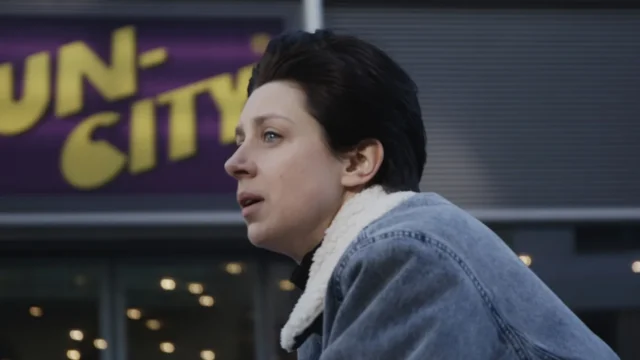
In the first minutes we follow Eliana as she cycles through Berlin, talking of her struggles with anxiety. We then zoom in on pixilated images of protest and police violence (taken from the streets of the German capital and expanded on later in the film). Then we see a group encounter that is gentle and probing and non-performative, with each participant allowed the space to describe their experiences of depression. In another poignant scene, the same group members (Jasmine, Sam, Alžběta, and Eliana) stand apart from each other in an open space, alone with their thoughts or their mobile devices, a little reminiscent of the woodland book readers at the end of Truffaut’s Fahrenheit 451.
Ďurinová further stresses in the film the need for personal, psychological adaptation to the changes that society produces in us. “Just as our bodies retain traces of lead, arsenic, mercury and other industrial toxins, our psyches absorb the values and violence of our cultures,” we hear in voice-over. If we can allow our sense of self to be flexible and adaptive, the film suggests, then we can “work with these seemingly toxic influences, slowly dissolving and redistributing them until they become something new.”
Of course, this may also provoke profound personal change within us, Ďurinová suggests, hence the powerful theme of resistance that emerges within the film. Any emerging tendency towards protest will be a logical consequence of our recognising the unreasonable societal pressures placed upon us.
“Reclaiming agency was a recurring theme in both the conversations with the protagonists and in filmmaking,” the director says. “Berlin now also carries experiences of unhinged police violence [such as during recent pro-Palestine demonstrations]. I combined intimate encounters with found footage of protests and riots, depicting people supporting each other and resisting collectively—and, this way, essentially reframing the power dynamics.”
In the film, Ďurinová refers to a ‘click’ moment, whereby our emotional response to unreasonable systemic societal pressure becomes one of “justified” anger, rather than anxiety or depression. “A type of anger which is less resentful and more focussed, a move towards self-expression and a reactivation resistance,” she says.
“This scene when the police violence comes, I was looking for a way to integrate that emotion of anger,” she adds to BDE. “I was often thinking I had something destructive [inside] – something that I shouldn’t feel – but living in Berlin these last almost two years, there was a lot of anger for sure that I felt.”
“The film is dealing a lot with memories of anxiety or burnout and how they are inscribed in our bodies and minds, but also [inscribed] in the space of the city,” she continues. “So It was very important for me to also include these moments where the city is a witness to this police brutality that has basically become a part of the daily imagery that we also experience on the streets in Berlin, but also within social media.”
In her film notes, Ďurinová further underlines her intentions for her new cinematic work. “The circular and repetitive aspects of depression, anxiety or burnout guide the film. Each new experience carries the memory of the previous one and, at the same time, anticipates the next. With Action Item, I wanted to create a certain suspension of time and space in which we can reflect on past crises and depart from them to look for a wider context.”