

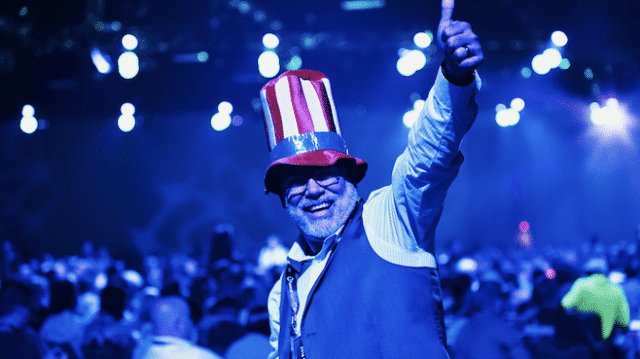
Not so long ago, Norwegian filmmaker Audun Amundsen spent several years in the jungle living with an Indonesian tribe for his documentary Newtopia. In his new film, he immerses himself in an altogether different world. Click The Link Below, a premiere at New Zealand’s Doc Edge and sold by Sideways Film, profiles some of those internet marketing gurus who promise immense and instant wealth and success to those who buy their often eye-wateringly expensive online courses.
Are they hucksters selling snake oil or is there real value in their wares?
That, Amundsen suggests, isn’t really the right question. He didn’t make the movie to satirise social media ‘masters of the universe’ like Tai Lopez or Russell Brunson. Instead, he wanted to understand what made them tick – and maybe to earn some extra money for himself to give him more independence to make his own documentaries.
“My primary interest is storytelling and producing and directing documentary films. That is my motivation. At some point, I realised I needed more funds to do this – and so I started looking online at how I can make money and make myself economically free.”
Amundsen quickly decided, though, that “having money as motivation is not a very good motivator.” He realised that he should keep his focus on his filmmaking rather than his online fund raising. Otherwise, he would be “chasing two rabbits at once” and he wouldn’t catch either of them.
The Norwegian director even briefly tried to turn himself into an online guru for other documentary makers. However, he quickly realised that it was “very difficult” to guarantee an income stream – and that it was taking up too much time. “You have to put a lot of effort into these things…”
During shooting of Click The Link Below, the director’s attitude toward his subjects changed several times. He paid good money (more than $7,000) to enrol on an online course with Akbar Sheikh, an online entrepreneur who’d once been homeless but had turned himself into a millionaire.
Amundsen’s relationship with Akbar, whom he eventually met face to face, was a complex one. There were times when he had become very sceptical about the digital millionaire’s promises of immediate business rewards, but the two men got on well.
“That was a hard balancing act. The thing is, what started to interest me more and more was discovering that Akbar is also a human being trying to do his best. Things can look different behind the facade from what you see on your phone all the times.”
The director realised that when the influencers were online, they were stimulating an algorithm designed to generate as much traffic as possible. They were using “more shocking and extreme content because that was what the algorithm was optimised for.”
He also learned that the influencers were “very different online from what they are in person.”
“He [Akbar] was also nervous about how he was going to be portrayed. In that sense, I think he was very brave to participate in the film. I could have tried to expose all these people as scammers and taken a one-sided view of it but I decided not to do that because I am more into human stories. Polarising content is something you see more on YouTube. I think documentaries should be different and more complex where you can see different topics from various angles.”
Amundsen claims that he is the same “open and curious” documentary maker whether he is helping his shaman friend Aman Paksa in Mentawai, Indonesia, or speaking to millionaire influencers in the US. “That is also why they trusted me without knowing truly what was going to happen with the film. I think it was also a natural stepping stone for me to do this film.”
Newtopia was about a family living without money or electricity, and how they were adjusting to modernity. At one stage, Amundsen spent three years living with them. This was back in 2008 when social media and smartphones were beginning to explode. When he came back west, Amundsen himself was “taken by surprise” by the way digital technology was changing the world.
“I realised I had missed a part of what was going on in the rest of the world. That’s also when I started with social media – and all these gurus were popping up on my social media. And I needed money! When I came back from the jungle, I had almost nothing.”
Amundsen was successful in selling Newtopia online. ‘Some people bought it for $200,” he says with a note of surprise of a movie that had already shown at festivals and been broadcast widely. He used the cash to help the people from Mentawai back in Indonesia.
“That was a big motivation for me, to be able to sell something online and have a market worldwide and then do something good with that money for the people in the film.”
Amundsen acknowledges that Norwegians benefit from a strong public support system for documentary. “I think we are spoiled in Norway with good institutions for funding documentary. People are always complaining…but for me personally, I really appreciate our grant system. It has done a lot of amazing things for me.”
Even so, financing docs is a continual struggle. “It is not necessarily the people who are the best filmmakers who will succeed but it’s the people who really stick with it…it’s like in some ways these [online] entrepreneurs who don’t take no for an answer. You’ve got to develop a thick skin for rejection but if you submit enough applications, eventually some people will say yes.”
Spending time with the influencers has arguably helped Amundsen. He has learned about marketing. The gurus are like filmmakers in that they use storytelling to get their points across. They’re also very observant about human psychology and behaviour. “Yeah, I think there are a lot of similarities…I think we can learn things from each other.”
Click The Link Below received funding from The Norwegian Film Institute, Mid Norway Film Centre, The Audio and Visual Fund, Filminvest (co-producer), Fritt Ord, Midgard Film Commission Norway and Sparebanken 1 SMN. It was made through GonzoDocs.
The director is a little coy about how the film will be distributed after Doc Edge but hopes to involve some of the online gurus in screenings and discussions. Given that they have millions of followers, the documentary ought to enjoy plenty of exposure.
“But I don’t want to make a commercial for these gurus,” the director is quick to add. “There are a lot of things happening online from some of these gurus that are questionable.”
Currently, the director argues, social media algorithms “are only optimised for money.” He hopes, though, that the online environment will eventually become far healthier, more about “human well-being” and less mercenary and profit driven. “That’s my goal after the film comes out, to talk more about these issues…,” he signs off.





