The late Marianne Faithfull was counter-culture’s quintessential grande dame, profane and magnetic, a poet-cum-singer with a voice both tender and rasping, but which communicated lucidly her intensively lived experience. She was audacious, uncompromising, contemplative and liberated, and as smart as they come. And, at times, broken.
In their hybrid and experimental documentary Broken English – the title is lifted from Faithfull’s album of 1979, itself a paean to pain and excess – Iain Forsyth and Jane Pollard examine the life and work of their illustrious subject. They are not alone in this quest. The first person to sign up for the doc, after Marianne herself, was Tilda Swinton, later to be joined by actor George Mackay (1917), and musical talents in the form of Nick Cave, Warren Ellis, Courtney Love, Suki Waterhouse, Jehnny Beth and Beth Orton.
There is a conceit at the heart of the documentary, sold by I Wonder Pictures (Italy), that Faithfull’s life and work is being catalogued by the imagined Ministry of Not Forgetting, a cinematic institution run by Swinton and tasked with the business of gathering data and preserving testimony.
“The loudest opposition to our purpose comes from those who believe that AI will transform this act of not forgetting, turn memory into an all-encompassing, synthetic cloud of data,” Swinton says of her Ministry’s purpose. “We chose Marianne precisely because her data set is broken. AI trained on broken data will only amplify the flaws, the biases, the inequalities, the erasures. That’s why we, real-thinking, caring, people need to disrupt the data set, bring in new material.”
So we see a lot of footage of Marianne, much of it none of us will have ever seen before. There are experts – the ‘reinforcements’ as Swinton calls them – who talk about Marianne and her works, how she was perceived throughout her career, exploring areas that Marianne herself, at times, doesn’t want to explore. And then there is the riveting restaging of some of her songs, most notably Jehnny Beth’s electrifying cover of Why’d You Do It? (as extreme an account of sexual jealousy as you will ever hear) from the Broken English album.
“Our films aren’t truly documentaries — they’re portraits. Broken English isn’t just a film about Marianne Faithfull — it’s a film of her, made with her,” Forsyth and Pollard write in their film notes. “Our film lives in a liminal space, shaped by memory but churned through the mill of the imagination.”
Marianne always had a reputation for irascibility, for not suffering fools, which was understandable given the condescending, sexist and, at times, plain rude questions posed by interviewers over the years. This was not, however, a side of her that manifested itself during the production. Quite the contrary. Yes, Marianne was very ill and had nearly died of Covid, but she was determined to have fun.
“She really liked to shock and she really liked to puncture things with humour,” co-director Pollard tells Business Doc Europe. “These were characteristics that were quite important to weave into the lexicon of the film as well, so that it breathes with that personality.”
“She’s talking about Andrew Oldham [manager of the Rolling Stones in the 1960s and the person credited with ‘discovering’ Marianne],” remembers Forsyth. “And she said, ‘I’ll show you, you cunt,’ That was in the first session we were shooting with her. And I think that was a little test of us. Can I get a ‘cunt’ in here or not?”
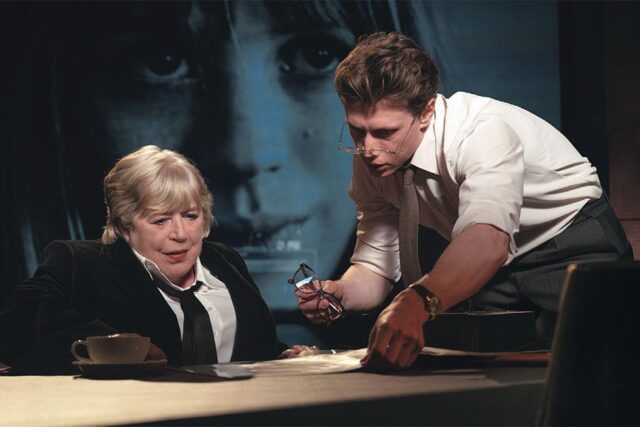
The film was made over three years, playing out on an elaborate futuristic set where Marianne watches footage of herself from the 1960s, continually offering comments and annotations, sometimes clarifications. She is aided in this process by actor Mackay, the whole process overseen by Department controller Swinton. The two actors never met on the set, despite communicating within the scenes, mainly via CC monitors. Pollard tells how there was a two-year gap between their respective work periods on the film.
Mick Jagger played a significant role in Marianne’s early life (as did Bob Dylan, albeit to a lesser extent). In Broken English they are acknowledged but aren’t placed centre-stage. The directors’ intention was “to try and frame [the Jagger relationship] within the whole life rather than [go with] this sort of obsession we tend to have with Marianne Faithfull and Mick Jagger being the story,” says Pollard, adding how, “oddly, she seems to have stayed closer friends with Keith {Richard].”
Forsyth and Pollard have worked together since they were 21, when they met at art school. “We kind of rocked each other’s world in a weird [way]. Our brains seemed to do better when together. Our ideas went further when together,” says Pollard.
On Broken English, it was “a really great strength to have two people doing the same job,” adds Forsyth. “But it’s a very casual arrangement. But it does tend to be more [Jane] talking to people in front of the camera. I tend to be more talking to people behind the camera. And that seems to work most of the time.”
‘There so many advantages. And of course, there are disadvantages. Being in a couple and doing the same thing, you don’t get paid twice,” he says.
Marianne died in January 2025, before the film was completed. Even though she played an active role in its construction, to what extent could she perceive how the end-product would eventually look? “Marianne saw a lot of the scenes assembled, she saw lots of cuts of things. What she never saw was a full assembly of the film,” says Forsyth.
“I think she was always, you know, suitably wary of it,” adds Pollard of the unique approach she and Forsyth took in telling the story. “And we are [wary] too, you know. That’s good. I think it’s healthy that there’s a two-mindedness about it. Is it working? Is it freeing up in the way that we hope it will? Is it achieving the results that we’re looking for?”
“But it’s such a clever question – would she recognise the film?” Pollard continues. “Consistently over the years, she has been lucid and witty and unsuffering of fools, and has stood up for her own work…I think she’d have really enjoyed the way in which all of these versions of her over the years participate actively in the film.
”At one point Marianne sees footage she never knew existed, of her rehearsing a performance of Kurt Weill’s The Seven Deadly Sins. “She was encountering an impressive version of her former self, and you see how happy she is,” Forsyth ends.