

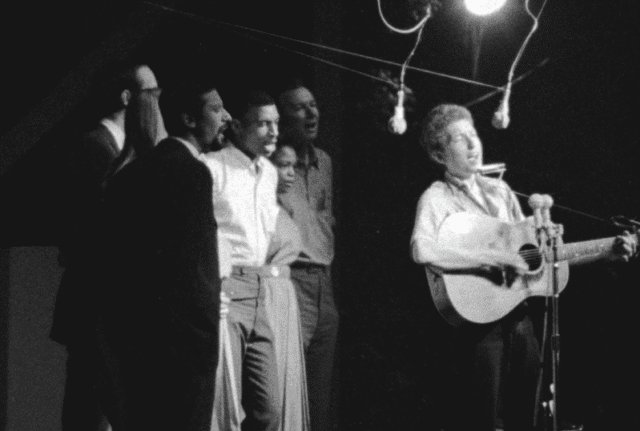
Folk was always radical, even before Bob Dylan electrified it. The language of the genre was pluralistic, rebellious and respecting of no borders. And at its epicentre was the Newport Festival, Rhode Island, where protest was voiced and political change demanded. And where great music was played all day and all night.
Director Robert Gordon and producer Joe Lauro’s feature doc Newport & the Great Folk Dream, sold by New York-based Submarine, looks at three momentous years in the history of the festival – 1963 to 1966.
At the beginning of this period, audiences were clean cut and engaged and, by and large, they sat still. By 1966, counter-culture was becoming mainstream, hair was longer and folk were dancing near-naked in the rain.
Back in the early days, the festival wasn’t all about the likes of Joan Baez and Peter, Paul and Mary, although these were prominent performers. Newport was as much an African-American celebration of music as a white gathering. There was the great blues finger-picker Mississippi John Hurt; John Lee Hooker with his sexually-charged Boom Boom, and the black activist combo The Freedom Singers. But there was also Johnny Cash looking dark and dangerous, Dave Von Ronk lamenting his Cocaine Blues, and a rediscovered Dock Boggs, now looking more like a kindly small-town bank manager, but nevertheless a folkster through and through. There was blues and there was bluegrass, and there was Cajun. And there were banjos, fiddles and mandolins, and there was even shuffle-foot dancing. Thankfully, there was little by the way of happy-clappy.
“I had certain preconceptions about folk music that the footage dispelled,” director Gordon, an avowed music geek, tells BDE of the filmed material compiled by Murray Lerner and George Pickow some 60 years before. “Seeing the diverse expressions of so many different kinds of culture reminded me of what folk music really is, which is the voice of a lot of different kinds of folk. It’s not just a person strumming a guitar and singing personal lyrics.”
Everyone back then was paid the same appearance fee of $50. This was insisted upon by the festival’s eminence grise Pete Seeger, also described in the film as the ‘king’ of Newport. What’s more, in 1963 there was a great feeling of hope, unity and integration. For festival co-founder Theodore Bikel, the festival reflected an “America composed of immigrants from all lands, each with a heritage of his own.”
“If you are singing another man’s song you are already stopping yourself from shooting at him,” he adds in the film, itself a reflection of the dire race relations in the US over this period.
1964 saw a huge growth in folk’s popularity. The festival’s budget grew, and the new line-up included artists from as far afield as Egypt, Hawaii and Senegambia, each playing their own Indigenous sounds. The event had become, even in the early 1960s, truly international and multicultural, long before the likes of WOMAD, Glastonbury and Burning Man were established.
“Over the years, the meaning of folk music has become kind of diluted into just kind of soft rock or something,” says Gordon. “But this was the reminder that Newport was an expression not just of American hill country, but of cultures worldwide.”
Artists were still paid the same, but a pecking order had emerged when it came to accommodation. If Pete Seeger was the king of Newport, then Bob Dylan and Joan Baez were the event’s respective crown prince and princess, each of whom got to stay in the swankier, more exclusive hotels.
That said, it was in the less salubrious room-houses of downtown Newport where the real nocturnal action was taking place, where jamming continued all night, black and white folk rocking it shoulder to shoulder.
But there was soon to be a schism. In 1965, when Bob Dylan met up with Mike Bloomfield of the electrifying Paul Butterfield Blues Band, he was determined to up the ante and amplify his own sound. As we see in the film, Dylan played a plugged-in version of Maggie’s Farm, to the horror and indignation both of festival organisers and a large portion of the seated public who duly booed Dylan off the stage, convinced he had sold out. He left Newport, not to return for another 37 years.
Many consider Dylan’s performance as his “fuck you” response to folk orthodoxy? Do the filmmakers agree?
“I think it’s more complicated than a ‘fuck you’ moment, if you will,” responds producer Lauro. “Maggie’s Farm is a song in the folk tradition, itself built upon a song called Down on Penny’s Farm. And so, I think, rather than saying ‘fuck you’ to the folk crowd, I think he’s in a way trying to tell that audience that they’re being closed-minded… that folk music can be expressed in other ways – in the same way that Hamza El-Din plays folk music from Egypt (traditional oud player who played Newport in 1964).”
The acoustic guitar may have represented “virtue” (as producer Joe Boyd says in the film), but the 1960s was a period of “mind expansion and about a new inclusiveness,” Gordon adds. “If folk music was going to continue, then it was going to have to change with the world. And that’s what I see as the point of the film, that there’s the acceptance that even traditions change.”
The office of Bob Dylan was both “supportive and helpful” throughout the seven years of production, as was the family of the later Pete Seeger. “His {Seeger’s] daughter handled all of that and they cooperated along the way, sending us photos and really just interested in getting the story out there. Not so much monetarily, but the family lived up to [Pete’s] reputation throughout the process of making this film.”
The Venice selection has been a game-changer for the film and its makers. “It’s given us a lot of attention that would have been difficult to really get on our own, including a Rolling Stone piece. But it’s all down to the merits of the film. That’s it. The word is out. And, yeah, we are getting offers for festivals. And hopefully we will have a streamer that will believe in the film and want to buy it from us.”
That said, theatrical is a core requirement for true audience appreciation, Gordon and Lauro argue. “It’s a 4K transfer from the 16-millimetre negative, so the images have astounding integrity,” says Gordon. “This music [needs] the concert setting, and a theatre is closer to a concert than a home viewing… In Venice, we will play to a 1400-seat theatre, and that’s the size of some of the Newport stages!”
Another game changer for the film has been the recent Dylan biopic A Complete Unknown, starring Timothée Chalamet. “I personally loved it. I went to see it twice,” says Lauro. “What I really liked is that when I looked at the audience [I thought] here’s a film that has the character of Pete Seeger, the character of Woody Guthrie, and there’s nothing but 20-somethings in the theatre. I’m thinking – they would never have gone to this film if it wasn’t for Chalamet.”
“I also saw it twice,” adds Gordon. “And I keep meaning to send [director] James Mangold and Timothée a thank-you note. Like Joe said, they multiplied our audience in a way we could never have done. The timing was perfect and it was just dumb luck that it worked out for us.”





