

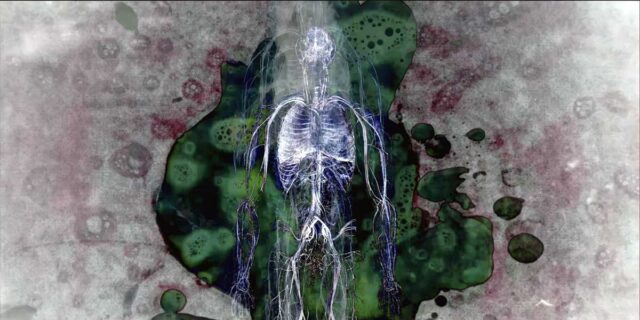
Peter Mettler’s new documentary, While the Green Grass Grows, world-premiering September 7 in TIFF Docs, may be epic in scope, but it has love at its heart. Throughout the film he seeks answers to the repeated question: is the grass always greener on the other side? His odyssey takes him far and wide, even while the pandemic is raging, but the tenderest moments within the film are the ones spent with his mother before her death, and those accompanying his grieving father who is, himself, approaching the end of his life.
In the chapter titled ‘My Grandfather Was A Tree’ we meet anthropologist and writer Jeremy Narby, a natural optimist, who discusses the human condition vis-a-vis the microbial world of plants and volatiles. Bacteria rule the world, he underlines. Our bodies are made of the same stuff as the cosmos. There is no separation. What’s more, plants are like generous grandparents, he adds. They like to give, they can’t say no.
In the ‘Truth or Consequence’ chapter, Grant is a man who experienced a Damascene conversion one day when out on a walk. He felt a sudden surge of love which “obliterated everything,” he says in the film, adding that a conventional interpretation of events would be that he found God. But the concept of God implies something separate, he ponders. He feels no such separation. “It is all God, there is no me,” he stresses, and therefore the question of the ‘grass being greener’ is of little relevance to Grant. “In our culture you’re always supposed to want,” he says. “My problem is that I’m content with what I have.”
The notion of time is continually examined in the film, represented at times by the coursing river waters, sometimes gentle, at other times violent, such as at the Rhine Falls in Switzerland. We twice hear Mettler’s mother opining how, “you can make up the future, make it up and believe in it.”
The director reflects to Business Doc Europe on the liminal aspects of the repeated ‘grass is greener’ question, how it can be applied as much in temporal terms as in geographical terms (or indeed in pure life and death terms, as we see in the film’s final chapter).
“This idea of recording in the present, that immediately becomes a document, a reference to the past, but it’s intention is to be used in the future,” Mettler articulates the ephemeral, shifting nature of time. “So in its own way, it [filmmaking] is this odd kind of time machine.”
“[The film] evolved into something quite profound, and led to an appreciation of the cycles of living and dying, and the understanding that I’m completely part of that. We’re all part of that. There’s no getting around it,” he adds.
In Cuba, we see the director working with local filmmakers, some of whom accompany him to the Ojo de Agua river source, each giving their own answer to the ‘grass is greener on the other side of the fence’ conundrum. For Eamonn, the fence is there because you need a defining line to give you direction. Lyana doesn’t need to find the greener grass elsewhere or within the lives of others. “I want to find the greener grass in my own life,” she says. Meanwhile, film student Julia (also the name of Mettler’s mother) discovers a troupe of curious kids literally on the grass on the other side of her own fence, whom she then proceeded to film. What came into view in her camera was the very thing that signposted her way forward. “The reality that enters our imagination and comes out as expression, is our only truth,” observes Mettler in the film.
Mettler explains the film’s uncompromising length. “The main drive for making the film at the outset was to work in a diary form, in a chronological form, because I wanted to let life make the film,” he says. “The diary process is one of observation that is responsive… I am very interested to see what that brings in terms of storytelling, in terms of narrative, in terms of looking into things more deeply and, let’s say, more associatively…I really wanted to be responsive to the world unfolding, so that’s why it has length.”
The film seems a guaranteed shoo-in to leading creative doc fests over the coming doc season, but would a streamer deal be forthcoming for a film of seven hours duration, I persist. “I would love that,” Mettler reacts. “That’s one of my main objectives with the whole thing, to work in this way but to also have other people work in this way, and to have some kind of platform where people can, quite freely, diaristically take in their worlds, comment on them, be artistic with them, but have a kind of freedom that is [born of] personal engagement. I think it would be amazing to have a platform like that, and to see different filmmakers work in that context. I was kind of starting that notion a little bit in Cuba with the people that were there. So yeah, that’s a dream. If it comes true we’ll see.”
The chapters with Mettler’s aged mother and father are both moving and heart-warming, and the sense of gratitude the director feels towards his clever and adventurous parents, who (penniless) migrated from Switzerland to Canada after WWII, is palpable.
“Filmmaking is a tool I could use all my life and explore anything, and I went down that road,” he says. “It’s not like they were encouraging me to do that. It was a little bit the antithesis of what they were hoping for, but you know the main thing with my family is that there was love there, and they sometimes begrudgingly or reluctantly let me go my way. My dad was always, ‘how are you ever going to survive, because you won’t get paid? These films are really hard for survival.’ For years I was very lucky getting enough grants, getting enough prizes to just make it through, but I feel privileged that I was still in their cocoon and still in their love.”
Mettler can also thank his folks for instilling a particular aesthetic in dual-identity their son. “The juxtaposition of Swiss European culture against North American culture was this constant shift in perspective that fuelled a lot of how I make films I would say,” he suggests.
“The juxtaposition, the angle from another perspective, being the stranger in your own country. Because when I’m in Canada I feel very Swiss. When I’m in Switzerland, I feel very Canadian. I don’t feel purely either one, but I love them both,” Mettler signs off.
While the Green Grass Grows is produced by maximage GmbH (Switzerland) and Grimthorpe Film Inc (Canada). World sales are handled by maximage GmbH.





