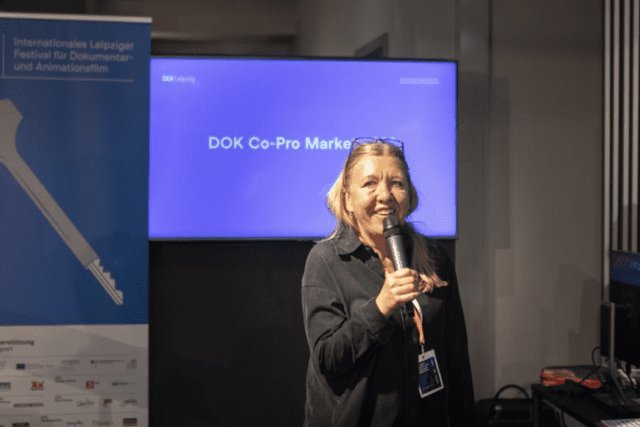
2025 marks Nadja Tennstedt’s fifth edition at the helm of DOK Leipzig industry activities.
“I came here one year after Christoph Terhechte [Festival Director] had started. I followed Brigid O’Shea, who had really built up the industry programme for quite a few years. But our values, I think align,” she notes how she has continued to grow DOK Leipzig’s industry programme.
Like O’Shea, Tennstedt is a passionate supporter of diversity within the industry – and this passion is reflected in every part of the programme. This year, there are talks and events on ‘Documenting Queer Realities: Representation on Screen’ and ‘Documentary as Resistance,’ looking at the challenges facing filmmakers in countries where freedom of expression is being crushed by authoritarian regimes.
The DOK Co-Pro Market (27-28 Oct) is more heavily subscribed than ever, a clear sign of its increasing importance to the industry. This year, a record number of 391 projects were submitted (of which 30 were chosen and five scouted at partner events).
“I hope it’s because people want to co-produce and find partners here in Leipzig,” Tennstedt responds as to why the event is so heavily subscribed. “But I think the market is pretty fractured and people need to find a lot of partners. Co-production markets [in general] are very important to them, not just ours. It’s not so easy any more to finance projects with [just] one or two co-production partners”
Leipzig is a little different from other co-production markets. There aren’t pitches in front of decision makers in what can sometimes be a frenzied, hothouse atmosphere. Instead, the event consists of carefully curated meetings between potential partners.
“It’s a very intricate process, how we are scheduling those meetings. We send out the project book in advance to the market.” Tennstedt says. “We are also excited that Babette Dieu has started at DOK Industry and coordinates the Co-Pro Market for the first time this year.”
Funders, broadcasters and sale agents are given the chance well in advance to target projects they want to focus on. Filmmakers likewise are able to suggest who precisely they want to meet. “That’s how we schedule over 900 meetings that take place over the course of two days.”
Festival director Terhechte recently observed that, after the pandemic period, when filmmakers were preoccupied with family matters and inner thoughts, “numerous documentaries and animated films have returned to looking outward.”
Has there been a similar trend in the market?
“What Christoph says about looking beyond oneself, looking at a broader picture, rings somewhat true for us as well. We still have a lot of personal documentaries but they usually open a window to bigger questions,” the Head of Industry reflects, citing titles like Zijian Zeng’s Anything but Love, Hazal Hanquet’s My Aunties, and Basma Rkioui’s Azal, all of which begin as personal stories but then expand to embrace broader geo-political themes.
Another trend Tennstedt has noticed is the unusual number of films dealing with water as a theme: “water in terms of flooding, in terms of the basic element for life but also as a threat.” She mentions such projects as Hussein Eddeb’s The Birth of Derna, Carlos Yuri Ceuninck’s Gongon, Setsuya Kakinuma’s Welcome to Our Bathhouse, and See You Soon(WT) by Martin Prinoth.
Projects, though, are very diverse. Films come in all sizes, big and small. Budget ranges stretch from €120,000 to over €1mn.
This year, alongside familiar faces, various companies will be attending for the first time. These include, on the world sales side, Pluto Films (Benjamin Cölle, Rebecca Hartung), Be for Films (Lisa Lejeune), Mediawan Rights (Kilian Kiefel), and new outfit Odd Slice Films (Martina Droandi).
Among funders making a first trip to Leipzig is the IFFR’s The Hubert Bals Fund (Ayumi Filippone), and distributor jip film & verleih (Jutta Feit).
Meanwhile, Sata Cissokho, Incoming Head of the World Cinema Fund & EFM Toolbox Programmes at the Berlinale, is also due to attend.
DOK Leipzig has always paid particular attention to the eastern European industry. This has meant a strong focus on Ukraine since Russia’s full-scale invasion three years ago. Tennstedt and her team have regularly been hosting events as part of ARTE’s Generation Ukraine initiative, which is aimed at supporting the Ukrainian filmmaking industry by co-producing 12 documentaries that “explore Ukrainian reality in the throes of the ongoing war.” This year, there will be special case studies looking behind the financing and production of two of these Ukrainian titles, Olga Gibelinda’s Queens of Joy (also part of the Audience Competition) and Dmytro Sukholytkyy-Sobchuk’s Silent Flood.
Of course, there is much more to Leipzig’s industry offering than just the co-production market. Other strands include DOK Preview Germany, DOK Preview International, DOK Short n’ Sweet, the Animation Lab and the DOK Archive Market.
As ever, several titles in the main selection of the festival have come through the Co-Pro Market or through other industry strands. These include The Woman Who Poked the Leopard by Patience Nitumwesiga in the German Competition, (DOK Co-Pro Market 2021), audience award contender Cutting Through Rocks by Sarah Khaki and Mohammadreza Eyni (DOK Co-Pro Market 2019), and the Panorama Central and Eastern European titles, Imago by Déni Qoumar Pitsaev (DOK Co-Pro Market, 2020) and What does the Mud Whisper? by Dea Tcholokava (DOK Co-Pro Market 2022).
When festival director Terhechte strengthened the animation side of the festival, Tennstedt and her team responded by boosting their own animation activities. This year, for example, sees another three-day Animation Lab workshop in collaboration with CEE Animation, an initiative that gives professional documentary producers the chance to “explore the international landscape of the animation industry.”
“We really see DOK Industry as a platform working very closely with the festival,” the industry head points out.
Tennstedt was instrumental in setting up the DOK Archive Market, now in its fourth edition. “I had done something similar in Berlin at the EFM,” she remembers of her previous work running DocSalon, the documentary film platform at the Berlinale’s European Film Market (EFM), Working with archive experts Elizabeth Klinck and Monika Preischl, she has helped the event grow in significance.
“We are welcoming back 13 archives who’ll be at the Zeitgeschichtlichen Forum, meeting producers and other prospective clients,” Tennstedt says attendees which includes such prominent players as Getty Images, Rai Com and the Bundesarchiv.
This year will see the launch of The IMAGO Archive Award at the co-production market for a project that sources archive material and uses it in “interesting and creative ways.” The new award provides €1500 in cash to the winner as well as access to materials from IMAGO.
Tennstedt also works hard to ensure pathways into the industry for a younger generation, for instance through the Industry Toolkit for First Timers, which allows delegates to attend sessions on do’s and don’ts led by industry experts.
“That has been a very important feature of DOK Industry for many years. It is really meaningful for us to be helpful to newcomers…newcomers at the start of their professional lives and also newcomers to the German market. We are trying to give these professionals a way to find a first network here in Leipzig,” she explains how DOK Industry continues to cater to all sides of the industry.