You probably don’t know it, but without silver your cell phone wouldn’t work. There wouldn’t be mirrors, electronics, cameras or artificial intelligence either. This doesn’t mean those who mine the silver are getting rich. In Potosi, Bolivia, the Indigenous people have been exploited for 500 years and are still being killed in pursuit of the precious metal.
“Over 8 million people are believed to have died here since silver was discovered in 1545. They were enslaved. They were forced,” we are informed by Polish director Natalia Koniarz in her feature documentary, Silver, selected for Ji.hlava Opus Bonum Competition, and executive produced by Oscar winner, Pawel Pawlowski. Koniarz is a graduate of the Krzysztof Kieslowski Film School, where she also teaches and is researching her PHD.
The project, produced by Maciej Kubicki, started in unlikely fashion. Koniarz and her partner, cinematographer Stanislaw Cuske (whose credits include Jonathan Glazer’s The Zone Of Interest), ended up stranded in Chile and Bolivia during the Covid pandemic. They slept everywhere in a tent and travelled by bike. (This period was chronicled in Koniarz’s award-winning short, Postcards From The Verge, which screened in IDFA and Trento). Their journey eventually took them to Cerro Rico, the famous ‘silver’ mountain in the Andes, outside Potosi.
They lived there alongside the miners and their families for several months without any plans to make a film. But then they realised the extent of the suffering around them. “We started to shoot.”
There were certain ethical challenges from the start. “As someone from Europe working in a postcolonial context like Cerro Rico, I felt a deep tension between witnessing and representing. There were moments I questioned whether I had the right to be there at all, filming people whose daily life is marked by historical and systemic exploitation,” Koniarz expresses her dismay at the idea she was being voyeuristic or taking advantage of the community.
However, after spending so many months living alongside the locals, she felt close enough to capture “the texture of their reality. Being there and telling this story helped me understand where I stand in relation to it.”
There was no power, no water. The locals saw that the filmmakers were living the same circumstances as they were and gradually began to trust them. Koniarz and Cuske were allowed to accompany the miners deep down beneath the surface of the earth and to film them as they used dynamite or hammers to get closer to the silver.
“We didn’t have extra lighting. We were just using what they [the miners] have,” Koniarz describes their trips underground. Cuske would be holding the camera while she carried all the other equipment on her back. They’d go down 300 metres below the surface.
“We were just following what was happening, learning ourselves how to recognise the stones and how to react. Obviously, it is a deep mine. There is 100km of tunnels.” And safety precautions were rudimentary.
This is an observational documentary that avoids narration and interviews. The miners’ work was relentless. Sometimes, they’d be working two or three shifts a day. They had little time to make small talk to the filmmakers – although they tolerated their presence.
“I knew from the beginning that I didn’t want to use voice-over. I was trying to tell the story from their perspective…to make the steps in their shoes.”
She describes the film as being structured like a mosaic, full of fragments and “moments” pieced together to create a picture of the miners’ lives. “We wanted the viewer just to enter this reality…the film doesn’t tell you what to think.”
This is a very tight knit community. Families are crammed together in small houses, sharing rooms and beds. Everyone keeps dogs. “They are there because they are protecting the women and children.”
The kids have little sense of the outside world. When she first arrived, they would ask her strange questions. Did she know what a chicken was? Did she know about God?
“They started to tell stories about the devil who lives underground and about the veins of the silver that were the veins of his blood.”
There is a lot of violence and abuse. The director faced a dilemma. She wanted to help the kids but not to make them dependent on her. “Very tricky,” she muses. “At the beginning, I think we made a lot of mistakes because of the different cultural codes. Most of my work was just to understand their position…to find how they really see, for example, the topic of death.”
There is even one scene when the filmmakers follow a miner as he meets a prostitute in a strip bar. He doesn’t seem to mind their presence at all. “It wasn’t weird that we were inside the room.”
Koniarz went back to Poland with her initial footage, found a producer, and applied for funding and then returned to the Bolivian silver mine for another seven months.
And, no, before she began work on the documentary, the filmmaker didn’t know much about silver. She thought it was mostly used for jewellery “which was very naive.” She had no idea that “nano-silvers” seem to have the ability to store information and even to learn. “It sounds like an impossible thing but I discovered it through research later and it shocked me. It (silver) will be crucial for human development.”
Bolivians cherish Cerro Rico as one of their country’s great landmarks. The mountain, though, has witnessed huge suffering. “Its past built the foundations of global capitalism. Its present feeds the technologies of tomorrow,” the director notes.
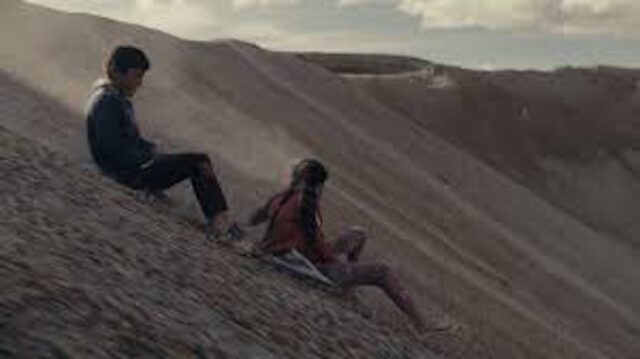
The documentary has its lighter moments – the kids sledging down the mountain or playing with kites – but it would be a big stretch to describe the community as happy. There is little socialising. Adults are so busy working that they have little time for anything else.
“They are very, very tired and life is so heavy,” Koniarz observes. “All of them have a sense of humour and they laugh sometimes – but the heaviness is always with them. It never disappears for a moment.”
Four of the documentary’s potential protagonists died during the months when the filmmakers were there.
Locals can’t hold onto much of the profits from the silver either. As Koniarz notes, “foreign corporations process the metal, multiplying its value — a process that captures wealth outside Bolivia’s economy.”
The director hopes her film will awaken the outside world to the grim conditions in which the silver on which we are all so dependent is still mined. “There is an impact campaign…we are going to support the education for kids in the mine,” she says of the legacy she hopes the documentary will leave.
World sales for Silver are handled by KFF Sales & Promotion.