It all started with some mould. When Lithuanian director Aiste Žegulytė was working on her film Holy Destructors(a world premiere in IDFA Envision Competition), she was driven by her fascination with change and decay, “this destruction of nature which is at the same time creation,” as she puts it.
While filming her previous feature, Animus Animalis, she had already met mycologists and mould scientists – and she already knew then that her next film would be about “that life cycle through micro-fungi.”
Mould fungi eventually led her to the art restorers who feature in the film. “I had no idea how many different fungi are found on paintings and even human mummies,” she says.
The fungi don’t share their secrets easily.
“The most difficult part was definitely filming the ‘invisible to the eye’ world of micro fungi. Not everything went as we expected, but it was very important to film the fungi themselves. We wanted to sort of make friends with those species,” the director explains how she immersed herself in the world of microscopic spore-producing structures. “Our goal was to film each species of fungi from the spore to its reproduction and then germination again. Microfungi reproduce differently, some through spores, others – like Rhizopus stolonifer (black bread mould) – sexually.
“I am very glad that on this journey we had the wonderful micro photographer and mycologist Dr. Patrick Hickey with us, with whom we managed to make the inhuman characters of our film more empathetic.”
It was easier filming in the human world – or would have been if the Covid pandemic had not hit midway through production.
“We had to adapt to new conditions, some things didn’t happen, or happened differently than we expected. But what fascinates me about documentaries is that everything is alive and one failed plot leads to a completely unexpected, very exciting adventure.”
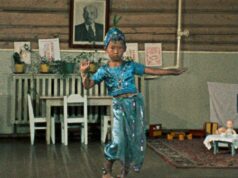
Holy Destructors, which world-premieres November 15 at IDFA, opens with some very poignant archive footage – family films of weddings, children playing, sledging, skating, dimple-chinned babies, expeditions to the beach, kids on swings or riding ponies or on bikes. What gives this material its pathos is both the elegiac music on the soundtrack, the knowledge that the figures we are looking at are probably all long since dead, and the way that film itself is decomposing.
“It was important for me to create a metaphor of how mould eats our memories, our visual memory. So I was looking for mouldy tapes, and unexpectedly found some super beautifully mouldy archives from a documentary chronicle of my dad’s hometown in Lithuania,” the director says.
During the making of the film, Žegulytė’s father died unexpectedly. She wanted to film the funeral with 8mm, then bury the tape and scan it but realised that would all take far too long. Instead, she looked in the archives for funeral processions.
“In our film, there are many processions – movements that helps us survive the pain, a ritual for saying goodbye to what must pass. Personally, for me, old medieval processions somehow remind me of cinema, the movement of a film tape. Then I continued searching for film archives, because I wanted to start telling the story of my film from it. Quite by chance, our mycologist Patrick from Edinburgh shared with us some very beautiful family archives dating back to the 1920s and even older. We scanned those tapes, and our mycologist’s family memories were captured on film, along with the microfungi he filmed.”
Thanks to work done by the editing director Danielius Kokanauskis, the film also includes footage of Holocaust victims, most of which was filmed before the Holocaust began.
“We wanted the film to have a hint of that, as a sign of respect and a reminder of that terrible tragedy that we should never forget. Especially since it could happen again, with another Hitler-Putin advancing into Europe.”
The very first frame of film is an old, flickering image caught on a primitive movie camera on a glass plate. “It is the frame from which our cinematic history began,” Žegulytė suggests.
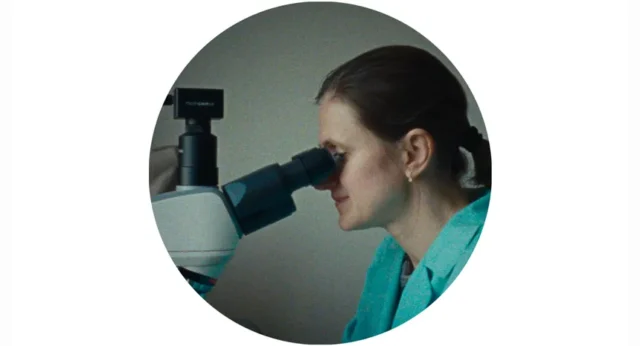
The shooting style is idiosyncratic. Often, we see images framed in a circular fashion, as if we’re looking through a keyhole or a microscope.
“First, my cinematographer Vytautas Katkus and I thought a lot about how to convey the idea of eternity in this film, that almost everything consists of cycles that seem to repeat themselves, and never stop,” she says. “And how to emotionally convey that eternal human struggle with time. And Vytautas suggested the circle format, it’s like the opposite of the square, which is death – the end. And only later, when we started filming the fungi and looking at them, did we realise that we had created a microscope metaphor. It’s as if someone is observing human cultures, as tiny beetles, through a microscope.”
“By using this circular format, we aimed to reinforce the feeling that people are like micro-fungi. I wanted the feeling that something non-human is watching humans. Micro fungi might be observing us,” the director reflects.
This is not a film that should be watched on your laptop, TV or cellphone. Žegulytė would much prefer that audiences experienced it in the dark, sacral quiet of a movie theatre. “Sound is very important as well, the entire language of cinema, its components. I really don’t like the quality of films that are often found in galleries, for example when the sound is broadcast through one speaker and you can’t see the colours at all because the sun is shining outside the window.”
Perhaps surprisingly, the director doesn’t describe herself as an especially religious person – “maybe it’s not the time for that yet” – but her language has a definite mystic flavour.
“I have never been and I am not an atheist,” she declares. “The human spirit is very important to me. I feel that humans have a soul, that there is an afterlife, and that there is a Creator-God. And a human being is a tiny microscopic particle in the vastness of space. When it comes to Christianity, I find it to be very important for humans as a fundamental, cultural thing that gives meaning to life. Spirituality is important to me, especially when it seems that only material and money are important. The entire history of culture is inevitably connected to religion, for better or for worse.”
Art lovers will find much to savour in the documentary. Part of it was filmed at the Gemaldegalerie in Berlin, using the medieval paintings there. The main painting featured, The Funeral Procession of Love, is from the Louvre Museum in Paris.
“This painting with the little cupids carrying the body and Venus watching from above, was the way the cinematographer and I were going to film this film,” she says. “Jonas Sunklodas and I coloured our film based on this painting. We wanted the human world in the film to be like a medieval picture, and the mushroom world to be more vivid, like the future.”
Some of the filming was also done in Lithuania, at the Vilnius Art Gallery. “Through the paintings, we wanted to move into the past, when European culture was being formed. At the same time, all medieval paintings spoke a lot about death and the afterlife. That’s why we also filmed the Dance Macabre fresco. I wanted to take the audience through the paintings, as if to transport them to the Middle Ages, to smell our shared cultural memories. It seems to me that the Middle Ages smell like mould….”
Some of us may be disgusted or frightened by mould, dirt and all the signs of life deteriorating and crumbling around us. Žegulytė sees things very differently: “To me, decay seems simply inevitable, but in that quiet sadness I am looking for a beauty and hope. To be present and accept all of this,” she concludes.