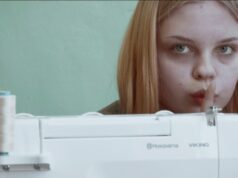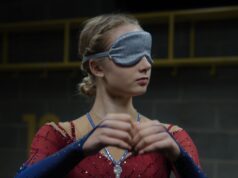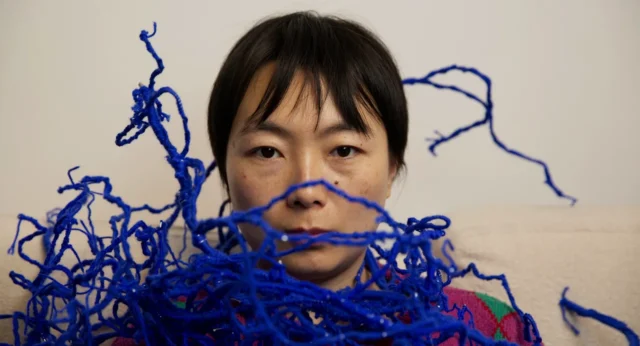
Mo Tan finished her studies at the famed film school of Łódź, Poland, in 2018. That’s where Confessions of a Molebegins. After graduating, she tells the camera that she sees two possible futures for herself: becoming one of China’s best film directors, or moving back in with her parents and getting some uninteresting job. “But I think I will just go for the first plan!” she laughs.
And then we find ourselves in China. We never get to know Mo vis-à-vis her friends and colleagues in Łódź. Which also means that we can’t notice any possible changes in behaviour when she’s back with her Chinese family.
Nevertheless, these first scenes seem to herald a clash between modern Western and traditional Chinese values. Especially since Mo, once in China, immediately gets bombarded with questions – often sounding more like reproaches, even orders – about why she isn’t doing more to support her parents financially, and why she isn’t married yet?
There is a lightheartedness to these earlier scenes though, thanks in part to some stop-motion animated interludes. Some of them, particularly the one depicting a toothache, reminded me of the fleshy physicality wthin the works of that other Eastern European stop-motion animator, Jan Švankmajer.
The personal and bodily nature of the animated tooth also hints at a darker side to the story. But first we get to meet Mo’s boyfriend, who suddenly appears out of nowhere. Judging by all the face masks, we are passing through the Covid years, eventually emerging at the other end. Enough time for romantic liaisons to develop, of course, but it’s still strange that her partner just pops into existence.
It gradually becomes clear, however, that Mo isn’t documenting her relationship, just as she wasn’t documenting her social life in Poland, or even – although they are in many scenes with her – her relationship with her parents.
She is filming her own inner turmoil, featuring others only insofar as they illustrate her despair. “I don’t even remember when I began to feel deeply disgusted with myself,” her voiceover notes.
And so we get to meet her boyfriend, but we never get to know him. We just see endless clips of him acting like an indifferent jerk. Given the approach of the documentary, however, we may want to withhold judgement. There may be more to him than meets our eye. After all, just like her arguing parents, he still allows her to film it all. Which suggests a certain level acceptance of Mo’s character and needs.
This is an acceptance which Mo Tan doesn’t seem to truly feel for herself. Neither for her mind, nor her body. Which is how we arrive at the film’s title, Confessions of a Mole.
As soon as Mo is back in China, people start discussing the mole on her face. A ‘tear mole’ they call it, because it appears under her eye. Not a good omen, according to a soothsayer consulted by Mo’s mother. “They say a woman with a tear mole below her eye brings misfortune to love,” Mo sighs in her voiceover.
Cleverly, Mo turns this mole into a metaphor for her life and social position. She uses it to highlight social superstitions, referring to the classical story of Wang Zhaojun, one of the mythical Four Beauties, who was ostracised from China precisely because of a mole. The mole also becomes a symbol for Mo’s struggle with her own body, from a previous eating disorder (which she also filmed) to the shocking discovery of early-stage breast cancer – as if the small black dot on her cheek had suddenly migrated to her breast.
Still, Mo approaches the situation with creativity and – quite literally – black humour. She presents the cancer as a person dressed in black, sitting on the couch next to her, quite immune to her attacks. Even at the hospital, Mo keeps filming. Which, somewhat surprisingly, the staff don’t object to.
Similarly surprising, the police allow her to continue filming after she and her boyfriend have been stopped for fighting in public, with the cops measuring and photographing the minimal scratches they have sustained. For me as a Dutch person, not used to such procedures, this is one moment where I personally experienced a bit of a culture clash – what exactly is going on here, and how much trouble are they in?
Their endless fights, however, do not feel that way at all. Sure, traditional Chinese values play a role in their discussions, as does Mo’s individualistic streak, which may or may not have increased during her years in Poland. But gradually, the film dives into much darker and more personal territory. Mo has serious psychological difficulties – possibly because of these familial and societal pressures. Her film, however, is more an exploration of her experience than an analysis of causes and remedies. As such, it includes some of the most intense and intimate arguments I have witnessed in documentaries for quite some time, between Mo, her parents and her boyfriend, shouting and crying. Which, in their intimacy, make the film increasingly about this one troubled individual, and less about the country and culture we find ourselves in. And thereby, increasingly universal.
There is a great scene towards the end, in which Mo shows her parents the film she has made – and which we have just watched. Their parents don’t look very happy, watching themselves arguing and fighting on screen (“It feels as if we’re not wearing anything. Like we’re totally naked,” her mum says), but after a few tense moments, both parents agree to let Mo show the film – and just not in Huai’an, where “rumours can kill,” her mother states.
Personally, I hope Mo convinced her parents to attend her world premiere at IDFA. And that the audience applauded them all for their courage – so that everyone, audience and makers alike, can experience that embracing a ‘mole’, a blemish, a weakness, can also be celebrated, and can make everyone involved stronger as a result.
Wyznania pieprzyka / 一颗痣的自白
China/Poland, 2025, 92 minutes
Director Mo Tan
Production Beyond Frozen Films
Producers Shanshan Li
Script Mo Tan
Cinematography Mo Tan
Animation Anita Kwiatkowska-Naqvi, Yu Jing Zhang
Editing Marcin Strauchold, Mo Tan
Sound Bogdan Klat
Music Aleksander Makowski
With Mo Tan, Chen Tan, Baowei Cao