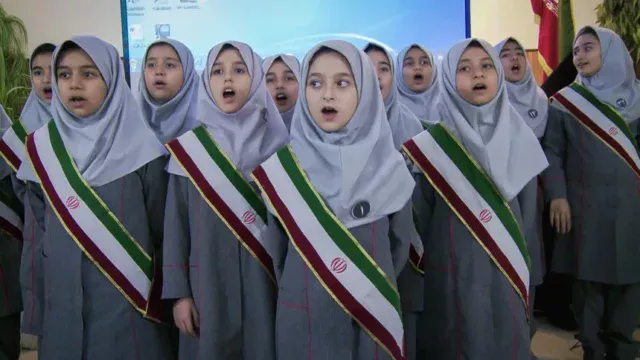
In All My Sisters, two sisters’ coming of age in Iran is beautifully documented by their uncle. The subsequent film speaks of family, loyalty and compassion, but also of oppression and resistance.
One of the most cinematic scenes in this sensitive film is where the two sisters, Zahra and Mahya, watch themselves as children in the back of a car driving through the streets of Tehran. As we look at the young women from behind, it is as if they are making that trip once again, looking at the lights, buildings, and people passing by.
This is what filmmaker Massoud Bakhshi intended when making his film: he wanted his nieces to observe and comment on the material he had shot over almost two decades, starting in 2007, incorporating their reflections into the film.
Bakhshi edited a selection of the countless home movies, taking into account Islamic sensitivities — he doesn’t show their hair, or bodies once they’ve reached a certain age. It shows how the girls grow up in a loving family with opportunities for personal growth and self-expression, but also with religious restrictions. They are encouraged to play, learn, be creative, and speak their minds, but at the same time they have to do their prayers, dress appropriately and read the Quran.
Sometimes the filmmaker pauses the film to ask his now-adult nieces how they feel or what they think about what they are watching. Sometimes, you just see them watching a scene, clearly moved, laughing, crying or making jokes.
The first part of the documentary focuses on the girls growing up together, looking after each other, having minor disagreements, exploring their curiosity and imitating the adults around them. However, as they grow older, losing their carefreeness becomes inevitable. Religious rules start to have an impact on their lives. The girls have to go shopping for headscarves, blissfully unaware of the implications, having fun trying on their purchases, not realising how these immaculate white pieces of fabric will in the near future hide their imposed shame and sins.
In all of this, the surrounding adults stay practically invisible, apart from their very religious grandmother, who tries to instil the fear of Allah into them. The filmmaker also skilfully incorporates political developments in the country through news fragments playing on the radio or television in the background.
The confrontations with their grandmother, who symbolises the Iranian religious authorities in her unquestioning acceptance all its propaganda and rules, become more intense over the years. Once they reach adolescence and start to educate themselves through their peers, their uncle and the internet, they begin to challenge the rules imposed on them. They want to fight for their rights in their own ways, while always supporting each other. They also instil their values in their younger sister Maleka, whom they both adore.
The protests against the regime following Mahsa Amini’s death deepen the cracks in the close-knit fabric of the family. Emotional discussions with their grandmother culminate in an atmospheric sequence in which the three girls stand on a rooftop terrace overlooking Tehran, where a demonstration is taking place. From the streets below, the slogan ‘Woman, Life, Freedom’ can be heard. Mahya and Zahra join in, teaching their baby sister the words.
Bakshi has created an intimate and personal documentary about what it is like for intelligent young women to live in a religious state without forcing a moral message on us. Mahya’s music envelops the final part of the film in an even greater sense of melancholy, as if quietly mourning the loss of innocence.
Austria, France, Germany, Iran, 2025, 78 minutes
Director Massoud Bakhshi
Production Alexander Dumreicher-Ivanceanu for AMOUR FOU Vienna, Bady Minck for AMOUR FOU Vienna
Producers Alexander Dumreicher-Ivanceanu, Bady Minck, Éric Lagesse, Mohammad Farokhmanesh
International sales Pyramide International
Script Massoud Bakhshi
Cinematography Massoud Bakhshi
Editing Hayedeh Safiyari, Jacques Comets
Sound design Janis Grossmann-Alhambra, Jennifer Spiesen
Sound Massoud Bakhshi
With Zahra, Mahya and Maleka Habibi