A few years ago, San Antonio-based producer Laura Varela made a documentary [As Long as I Remember: American Veteranos] for PBS on how Chicano soldiers in Vietnam used art to help deal with their traumatic combat experiences. By chance, April Rodriguez, the sister of Cpl. JV Villarreal, a Mexican American Marine from Texas who was killed on assignment in Afghanistan in 2010, saw the film. JV’s sister had video material that her brother had shot in Afghanistan and that had been given to her by his “Marine brothers.”
“The men who made it back home still had the footage. He [JV] had started getting some premonitions because it was a very deadly deployment. A lot of men had gotten injured – and so he made sure to share the footage,” the producer explains how JV went to great lengths to preserve the videos he had shot.
April came to Varela’s office with this material. She was looking for a filmmaker who might be able to do something with it. The producer realised immediately that this was “going to be a very big project,” and promised she’d try to make it work. This set in motion the Oscar-qualifying documentary American Sons which eventually had its premiere at South by Southwest Film Festival.
American Sons is a disarming and deeply moving film. Much of its voice-over comes from JV himself, in the footage he shot in camp and on patrol in Afghanistan in the weeks leading up to his death.
It’s as if JV is telling his own story from beyond the grave. “It’s something that you rarely get an opportunity to have access to – to have someone that was so charismatic, that represented where we were from, our community, and that was different than other narrators of other documentaries,” Gonzales says of his narrator.
Gonzales had also been very struck by the front-line pictures of JV taken by war photographer, Scott Olson, who had been embedded with the Marine unit when the young soldier lost his life.
“He [Olson] was able to capture the MEDEVAC team taking JV away from combat, taking his remains away. I had seen those photos first, and that really blew me away,” Gonzales remembers. “The photos were what really drew me in.”
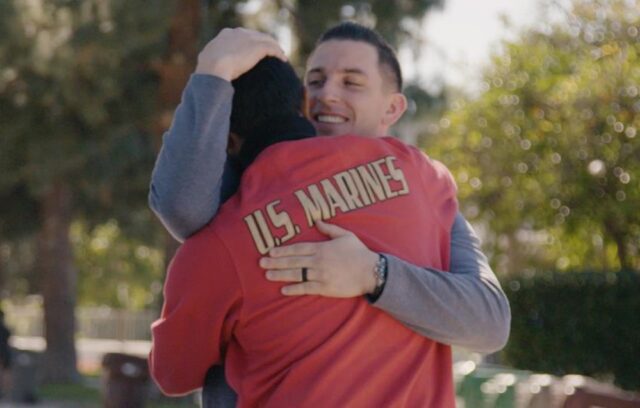
Watching the film, viewers are bound to be struck by the intense camaraderie between the Marines. They were a tight-knit group while on combat duty. If anything, the ties between them have strengthened even further since then.
The film focuses on a few of JV’s best friends, among them Corporal Ty Klinman and Sergeant Andrew St. Cyr, who keep his memory burning.
“Well, obviously, the Marines are one of the smallest armed units in the US. However, they are the first ones in. We’ve heard how it is ingrained in them, the brotherhood and history of the Marines,” Varela reflects on the ties forged between the soldiers.
“Especially in wartime, you know you are going to be put in a dangerous situation. Having an opportunity to come together with others similar to you, probably with similar backgrounds,” Gonzales observes. “But then to be put in training that forces you to build relationships, and then to be put into a combat situation – if you don’t have those relations, then it is life and death.”
He adds that, in this particular peer group, JV was the main unifying factor. Everybody liked him and responded to his humour and charisma.
“There are several guys that are friends today that would never have been friends in any other world had JV not brought them together.”
At memorial services and reunions, the filmmakers couldn’t help but notice how close the soldiers had also now become to JV’s mother – and how their support helped her cope with his loss. “The love they had for him now extends to his family,” the director notes. “By being together, they have the opportunity to heal from what they have gone through but also to be a part of JV’s world.”
Gonzales has interviewed many of JV’s old colleagues. Their continuing devotion to him is apparent. Some are openly nostalgic about the tour of duty in Afghanistan despite the horrors they witnessed and endured.
“It goes back to what Charles Dickens said in A Tale of Two Cities. It was the best of times, it was the worst of times. That’s really what they are experiencing. Even though it was horrible, it was also the greatest experience they’ve ever had…the love you have for someone who you’re willing to die for and who is willing to die for you, we cannot imagine,” Gonzales reflects on the double-edged nature of the Marines’ combat experience.
The tragic side is the way army veterans are treated when they return home from their tours of duty – and the estimated 160,000 suicides of US army veterans since 2001.
“It’s my opinion that when you experience something so high, a love like that, and then after that, you’re still young, you still have your faculties, you’re still strong, you can still run through a brick wall, but then you come home and not a single person or society as a whole is treating you that way,” the director speculates as to why veterans struggle to adapt to civilian life, and why many still feel such nostalgia for wartime experiences which, at least from the outside, look so difficult and traumatic.
Showing the documentary to its participants has been a cathartic experience. The filmmakers have often found themselves passing out tissues to spectators.
“Before Q&As, we let people take collective breaths together. It’s really wonderful to screen with the men and the families,” Varela observes. The filmmakers made sure the soldiers and the families had the chance to see the movie “on their own terms” in advance of the official South by Southwest premiere.
“Our audiences are primarily military audiences, especially when we screen here in Texas,” Gonzales says. “We have a lot of veterans who are in the audience but we also have a lot of families whose children are veterans, or uncles and cousins. A lot of these people haven’t really had a chance to see themselves portrayed like this.”
American Sons had support from, among other partners. PBS, Latino Public Broadcasting, Black Public Media California Humanities, and the Corporation for Public Broadcasting. San Antonio is home to several military bases and veterans’ organisations also got behind the project.
The plan now is for an impact campaign to help take the film across the country and (as Gonzales puts it) “to educate and engage with Veteran communities.” He talks of using the film to create “healing and reconnection,” and to address the “suicide crisis” among the soldiers.
Marines are known as the toughest, most self-reliant soldiers in the US military, but the documentary shows them at their most exposed, vulnerable and emotional. “It’s a very unique experience which I think is going to do a lot of good for people,” the director says of how the film is opening up discussions about the “human” side of Marine life. Varela adds that this is also a story “about youth and the loss of innocence…”