

When Mark Cousins frames the upcoming European Film Awards ceremony as a meditation on why we love cinema, he is not indulging in sentimentality. He is responding to a moment of structural crisis—one defined by shrinking audiences, nervous institutions and an industry increasingly unsure of its own values.
“We have to remind ourselves of our central belief: that we love this art form, and that it’s unique,” Cousins says. “In 1895, something genuinely new came into the world – a new form of art, a new kind of consciousness.”
Scheduled for 17 January in Berlin, the ceremony, curated by Cousins, is conceived as a “live film-essay,” a deliberate attempt to move away from what he sees as the growing emptiness of formula-driven cultural rituals. Rather than rejecting the awards format outright, Cousins aims to work through it—retaining the act of giving prizes while puncturing its predictability.
“This is almost like taking our vows again, our cinematic vows, reminding ourselves why this art form is so extraordinary,” he explains.
While prizes will remain the ceremony’s structural anchor, Cousins has designed the evening as a sequence of approx. twelve short interventions—visual, musical and conceptual pauses intended to re-centre attention on cinema itself. Some will take the form of edited montages; others will be spoken reflections or unexpected material gestures. Even the objects handed to the audience will carry symbolic weight. As Cousins puts it, “the ‘goodie bag’ people receive will be very different from usual. There will be things given out that have never been given at an awards ceremony before.”
One such moment is set to unfold immediately after the interval. “The lights go down, and we begin to hear the music from the end of The Umbrellas of Cherbourg – that beautiful final sequence with Catherine Deneuve, with the snow falling,” Cousins says. On three large screens, snowfall from across European cinema—Finland, Sweden, France and beyond—will appear in a montage celebrating cinema’s ability to render the natural world uncanny and emotional. Then comes the final gesture: “It will actually snow in the auditorium. Snow will fall on the heads of the people in the room.”
The aim, he stresses, is neither irony nor provocation for its own sake. “The aim is pleasure, celebration, joy.”
That sensibility has been shaped through close collaboration with stage director Robert Lehniger and composer Dascha Dauenhauer. Cousins describes the process as unusually intuitive, driven less by rigid scripting than by dialogue between sound, image and space. Dauenhauer’s music – partly live, partly pre-recorded – will run throughout the ceremony as a narrative force in its own right. “She’s a major talent,” Cousins says. “I think audiences will know her work already, but they’ll discover it anew that night.”
The collaborative ethos mirrors Cousins’ broader filmmaking practice, and becomes explicitly political when he speaks about documentary, a field he has been even more immersed in for the past four years while making The Story of Documentary Film, a 16-hour series whose first chapter will bow at the upcoming Sundance Film Festival.
“It asks exactly that question: what power does documentary have to change, improve or reflect our lives?” he says.
Looking back at the 20th century, Cousins is clear-eyed about the form’s contradictions. “Documentary has often told lies. It has sometimes sided with devils as much as angels.” Yet its enduring relevance lies in its capacity to hold contradiction. “What’s great about documentary is that it shows the full spectrum of humanity – warts and all.”
For Cousins, documentary constitutes a parallel historical archive. “Documentary, more than journalism even, has captured the ups and downs of the last 130 years,” he argues.
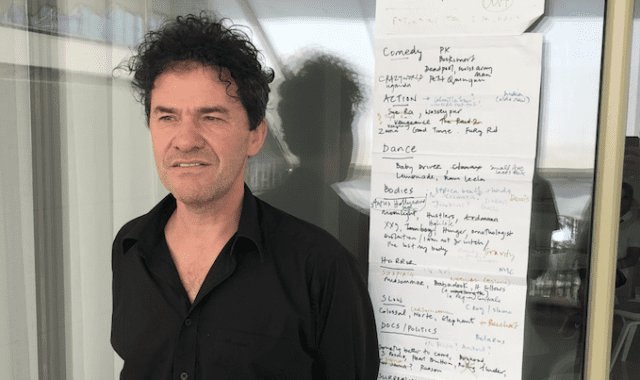
That political ambition is matched by a rigorous methodology. Cousins began the project with a vast visual map—decades across the top, countries down the side—filling in canonical works before confronting the gaps. “If there’s nothing from Egypt in the 1950s, that doesn’t mean there were no great films – it means you don’t know them yet,” he says. “So you have to investigate.”
These absences, he argues, reflect structural biases in film history and distribution. Challenging them allows the series to juxtapose well-known works with marginalised traditions, from Indian documentary cinema to overlooked European filmmakers such as Ella Bergmann-Michel. “If we can bring her into the conversation alongside Leni Riefenstahl, that would be a success,” Cousins says.
His optimism about documentary’s expressive power is tempered by concern about the industry that sustains it. “The bad news is economic,” he says. “The market is shrinking, funding is harder to find.” Cousins points to the narrowing of documentary genres on major platforms, dominated by celebrity profiles and true-crime formats. “That’s bad for the art form.”
The paradox, he suggests, is clear: more images than ever, but fewer spaces for complex, politically challenging work to reach audiences. Still, documentary filmmakers continue to produce radical films – from Hong Kong during the Umbrella protests to India under an increasingly authoritarian government – making visibility the key battleground.
“Documentary has a profound relationship with truth,” Cousins insists. In an era of AI-generated images and manipulated footage, he argues that filmmakers must operate with an ethical responsibility akin to a Hippocratic oath.
For Cousins, the European Film Awards offer a rare institutional platform to articulate these concerns publicly. A Northern Irish filmmaker living in Scotland, he frames his participation as an explicitly European act. “Europe is under threat right now,” he says, pointing to both political fragmentation and cultural erosion.
Celebrating European cinema, in this context, is not about inward-looking identity politics, but about defending a tradition of formal innovation and critical thought. That defence, Cousins argues, must also be feminist and inclusive. “If we block women, working-class people, or minorities from the means of production, we lie to ourselves.”
As the European Film Academy seeks to reposition its flagship ceremony within the global awards calendar, Cousins’ intervention promises to function as both celebration and warning. Cinema still has the power to illuminate history, confront power and produce joy—but only if the industry remembers what it is for, and who it is meant to serve.





