

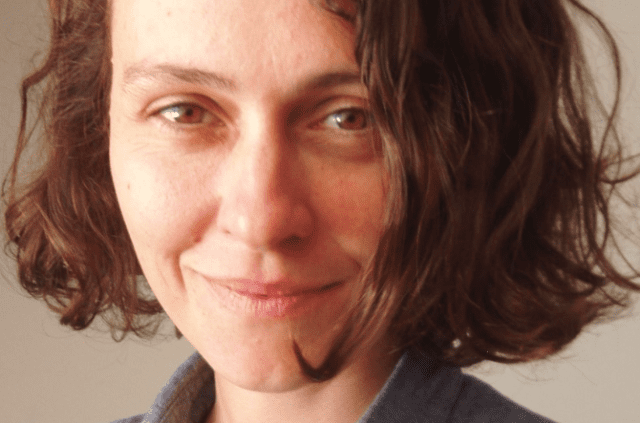
When Isa Willinger was at film school and tried to speak her idol, Ukrainian director Kira Muratova, she was initially rebuffed.
“I called her a couple of times. I got her number from a Russian journalist who had spoken to her in the past. She was reluctant to schedule the interview because she doesn’t like talking about her films,” the German filmmaker remembers.
At first, Muratova demurred politely but, by the third time Willinger called her, she began to get annoyed. She told Willinger: “I don’t like to schedule things. If you had really wanted to talk to me, you would just have come – and she hung up.”
Undaunted, Willinger took her at her word. She booked a flight to Odessa and “hoped she would be home. She was.”
Willinger (one of the rising talents included in this year’s Face To Face with German Films spotlight at the Berlinale) got her interview and eventually wrote a book about the Ukrainian auteur (whose single mindedness she clearly shares).
“Her work is extremely expressive…she’s a real avant-gardist,” Willinger explains why she so admires Muratova [who died in 2018]. “For me, finding a woman who had such a strong sense of her own expressiveness and such radicalism in her work – that was something rare, something I had not come across so often in cinema. Immediately, I felt this was a very strong position by a woman in art and cinema that I felt drawn to.”
Willinger likewise admired the Ukrainian’s humour and her appetite for the grotesque. “But I think the most important thing was that strong voice combined with a female point of view on the world.”
Her book on Muratova enabled her to “dive deep into feminist film theory and film theory in general.” It was well received but her real passion even then was for filmmaking – and she realised that the audience for academic writing on cinema was “very small.”
“Film is really a more popular medium…for me, it was always important to communicate with an audience and not just a super tiny niche audience.”
In her recent feature doc No Mercy (2025), sold by Cinephil, Willinger interviewed a series of other female filmmakers who inspire her today in the way that Muratova once had when she was still a film student. She wrangled together an impressive list, everyone from Catherine Breillat and Nina Menkes to Céline Sciamma and Monika Treut for the film. “I wanted to have them from different cultural backgrounds and different generations.”
One insight from making the documentary was that filmmakers don’t always like being in front of the cameras. “They’re used to being in charge and they don’t like to give away control to another filmmaker…there was a little bit of a reluctance there that I could feel sometimes. I am super happy that the ones we got trusted me to do this.”
Muratova once told her that women make harsher, tougher films than men. After speaking to the directors featured in No Mercy, she is partly inclined to agree.
“There are definitely different answers to this question. There was a time in filmmaking when women directors intended to be very blunt in their work. In the 80s and the 90s, during the second wave of feminism, there was a [tendency] to call a spade a spade and to talk about violence toward women – women for the first time had a voice in cinema and they used that voice to talk about things that hadn’t been spoken to so much. But these days, it’s much more subtle, and there are so many different voices and tones.”
No Mercy had its world premiere at Filmiest Hamburg and is still on its festival run. (It will screen in the spring in Thessaloniki). It’s theatrical release in Germany and Austria is set for late February and early March – and will be handled by Real Fiction in the former and by Stadtkino Filmverleih in the latter.
Willinger is already hard at work developing a new documentary project, The Red Line (working title), about artificial intelligence.
“I did a film already on AI. It came out in 2019,” the director makes it clear she’s no latecomer to the debates surrounding AI. Hi AI, as it was called, was about human/robot relationships. “Ever since then, I’ve actually in the back of my mind worked on this other film about how to keep control of AI. If AI gets super-intelligent one day, how will we keep control…what are the red lines?”
The Red Line is being produced by Sandra Maischberger, a top talk show host in Germany (and also the producer on Andres Veiel’s recent award winner, Riefenstahl).
In her filmmaking, Willinger is ready to tackle all sorts of different subjects. She is even considering a move into fiction. Her 2024 feature doc, Plastic Fantastic, looked at the global plastic crisis. Ask how she finds her subjects and she responds that she is a voracious reader. “Something that sticks emotionally, something that you are very interested in, that has a great importance and maybe the rest of the world hasn’t understood yet,” she explains what she always looks for. She is searching for “a piece of the puzzle no-one else is looking at that moment.”
Willinger studied directing at the University of Television and Film Munich, as well as American Studies, Slavic Studies and Sociology. She also has interests beyond cinema. In 2005, she was a Fullbright scholar at the New School in New York. “In eleventh grade, I already spent a year in the US as an exchange student. I have a very [strong] connection to US culture…I feel a small part of me is that American teenager still! I did want to go back.”
In New York, she was able to enrol both in sociology and 16mm filmmaking classes. Her first two short films were shot on 16mm and edited in the old-fashioned way, on a Steenbeck. And, yes, she misses aspects of working with celluloid. “It is magical because you don’t know what you are getting…everything is more complicated but also more magical and more charged in a way.”
The look of 16mm, with its graininess and depth of field, helped shape her sense of filmmaking aesthetics.
Now, she’s looking forward to being one of the participants in the 11th edition of Face To Face with German Films at the Berlinale. “I’m curious what it’s going to be like…yes, it’s a networking opportunity. It also shines a spotlight on my own work,” she reflects. “I am really looking forward to it!” ENDS
German Films will present this year’s seven FACE TO FACE WITH GERMAN FILMS talents in person as part of a panel event organized by German Films during the Berlinale on February 16, 2026.





