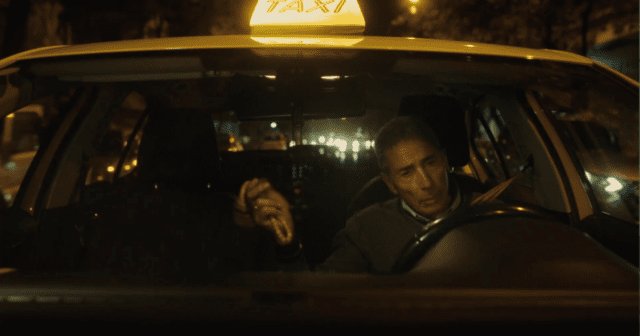
Greek director Eirini Vourloumis describes herself as a night creature, and much of her debut feature doc The Way Elsewhere (screening in CPH:DOX Next Wave section following its premiere in Thessaloniki) takes place in Athens after dark. She follows three veteran “old school” taxi drivers, Konstantinos (known as Puma), Sunny, and Giorgos, as they drive around the city.
The trio of drivers all have other sides to their lives. Puma loves nature and always goes late in the evening to park, meditate and listen to owl song beneath the Parthenon. Sunny was once a well-known actor in Nigeria. Giorgos is a charismatic crooner who could give Demis Roussos a run for his money with his syrupy love ballads.
“It started when I was covering the economic crisis as a photojournalist. I was doing that for a lot of foreign press,” Vourloumis remembers how she came up with the idea.
She has been taking taxis around the city herself since she was a teenage and has always felt an affinity toward the drivers. “I like sparking up conversations with people I don’t know and it is the perfect environment for that.”
Taxi drivers often become like confessor figures, listening and offering advice to all their passengers. What also intrigued Vourloumis is that they are “on the very front line, the first to see a city change.”
And, yes, when she was preparing the project, Vourloumis got used to waiting at the taxi ranks, trying to find the right protagonists. “I decided to start the movie in 2020 and I researched for six months. I spent a lot of time on the taxi stands, especially at the airport, because the taxi drivers there have a lot more waiting time.”
The director ended up interviewing over 50 drivers. She decided on Giorgos because she knew she wanted a singer. “I went and found him where he sings.”
Puma was another obvious choice when she heard about his fixation with the Parthenon. The first time she went with him to the Parthenon at 4am in the morning, sure enough she immediately heard the owl sing.
“I also knew I wanted an immigrant and a person of colour,” she explains what led her to Sunny. Half-Indonesian herself, she is well aware of the xenophobia that exists in pockets of Greek society.
Puma, who is now 70 and will have to quit the job he loves, has planted a walnut tree near the airport as a way of leaving something of himself behind in the city where he has been driving his taxi for over 50 years.
“Each character is also a reflection of myself,” she underlines. “I am also a creature of the night. I love love-songs. The thing I have in common with Sunny is that we are both people of colour.”
Vourloumis is much more “productive” at night. For some reason, she works better when the sun is down. She also likes going out to small clubs. “I love to dance…I am 46 and I am still clubbing!”
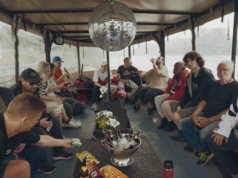
Certain moments in the documentary are pure verité, but others are highly stylised, for instance sequences when showing Giorgos performing his songs that play like 80-style Greek pop videos.
Each character has their own aesthetic. Puma is like a character out of a magical realist novel. Sammy could be someone in a Ken Loach movie.
“What we did was we would set up our camera and then go to a taxi stand and wait for people.” Certain sequences, for example the young woman passenger talking about loneliness, are staged. However, such moments are always inspired by real life. The drivers told her again and again that they’ve all picked passengers who’ve talked to them about enduring heartbreak and isolation. “I wanted to interweave that with our characters’ own pain.”
The director and her crew would be shooting throughout the night, often for as long as ten hours at a time.
Vourloumis has seen all the other taxi movies, everything from Taxi Driver to Night On Earth. “They’re all amazing films, but in terms of colour and that kind of thing, I have always been influenced by David Lynch. We tried to pick our own visual style. For example, my grandfather was a painter and he painted a lot of Athenian balconies…that first scene where you see people on their balconies is inspired by his paintings.”
Now, through living in the city for so long and making the film, the director knows Athens inside out – and can tell you all the short cuts. “It’s a crazy city to drive in. If you can drive in Athens, you can drive anywhere,” she states.
Her film stands as a homage to the city. “It’s my personal ode to the two things I love, which is Athens and taxi drivers!”
The Way Elsewhere took six years to make. ”It was extremely hard, the most difficult thing I have ever done…”
Nonetheless, she relished her first experience of making movie and is now trying to hatch a second one. This will be about Antiparos, a once idyllic hippy island that has become colonised by posh and wealthy tourists.
The Way Elsewhere is produced by Leonidas Liambey and made through Athens-based Long Runs Productions. Most of her career has been spent as a photojournalist working for the New York Times and other international media. Her work has also been exhibited at various museums.
Funding for the film came from EKKOMED, Hellenic Film & Audiovisual Center, Creative Greece. The co-producers: ERT, Frenel and there was support from iMEdD and EMST National Museum of Contemporary Art.