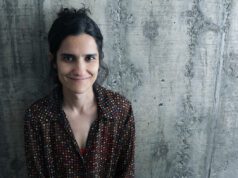
Filmmaker Jeanie Finlay grew up in Teeside in the North East of England and her parents still live there. Her mother is a sea swimmer in Saltburn. Not so long ago, she shared a photo of a protest which she had attended. In the picture, she is seen holding a placard saying, ‘why did the crabs die?’
Finlay’s mother was referring to a horrific incident in late 2021 when thousands of dead and dying crabs and lobsters were washed up on beaches in the area. Local media referred to “a carpet of death.”
“My mum is not someone who lifts banners and protests things, and so I was immediately very intrigued as to what she was up to,” Finlay explains the spark behind her new feature doc, All Rivers Spill Their Stories to the Sea, a world premiere this week in F:ACT Competition at CPH:DOX.
Finlay quickly realised she had stumbled on an extraordinary but very grim story about the wanton destruction of marine life and the knock-on effect on fishing communities. She had made her earlier documentary Sound It Out (2010) about the last surviving record shop in Teeside, and relished being back filming in her home region.
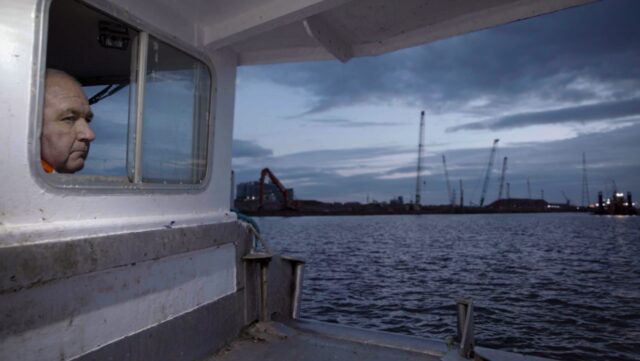
Early on in the project, she met Hartlepool fisherman Stan Rennie, who is part of the North East Fishing Collective campaign group. He’s from a fishing family that can trace its history back many generations. He is also funny, warm and avuncular on camera – and so makes a perfect protagonist for the documentary.
“I am always looking for people who know who they are, who are just themselves – and Stan was entirely himself,” Finlay says of him, “Stan emerged as an organiser within this community…he is certainly someone who brings people together. And I was very touched by the tenderness this group of men showed toward each other – it is powerful to see that on screen.”
Stan and the rest of the Hartlepool fleet are faced with a catastrophic drop in the numbers of fish, crabs and lobsters they are catching. Their strong suspicion is that dredging in the River Tees, being done as part of the building of the new Teeside Freeport, has caused the “die offs.”
Government has continued to support the dredging. Research into the causes of the environmental catastrophe has, so far, been inconclusive. Nonetheless, as Finlay puts it, “if you’re delving down into the most polluted river in England and you are taking stuff out, you had better be careful…if every single seal pup in the Tee Estuary is dead, something is horribly wrong.”
The film is seen almost entirely from the point of view of Stan and the fisherfolk.
“The reality is that local politicians stonewalled them, blocked their emails and didn’t engage,” Finlay explains why Stan and his colleagues are now so disillusioned with their elected representatives.
Even now, questions about the Freeport aren’t being answered. In theory, this initiative (a special economic zone with its own attractive tax regulations) should encourage local economic investment and create jobs. Nonetheless, in this case, the cost to the environment looks to have been disastrous.
Finlay points out that small crab and lobster fishers like Stan are “the guardians of the sea.” They’re working within a few a few miles of where they live. They always look to conserve stocks. They protect pregnant lobsters through ‘v-notching,” marking them on their tails to ensure they are neither is landed nor sold.
“They are very careful about not taking too much, ensuring there are future stocks and that the ecosystem remains balanced. The tragedy about what happened in Teeside is that all of that work was just wiped out overnight because everything died.”
Since the “die-offs,” Hartlepool’s fishing fleet has been facing wipe-out itself. Stan recently reported to Finlay that, of the prawn trawling fleet, only seven boats are left on the quay. Five of those are up for sale but no-one wants them. Meanwhile, half of the potting fleet has been sold. That means a younger generation has had to abandon fishing as a livelihood. When boats go out now, there is little hope they will catch enough even to pay for their fuel let alone turn a profit.
This is Finlay’s tenth feature doc and they have all had elements in common. “I am curious about people. I love things that are very particular to a place…I know this place and I love the way that Stan expresses himself [with phrases like] ‘sick as a chip’ or ‘next to nowt,’” she says. “I think people in the North East are born storytellers. There’s a rhythm and a humour. Even when things are at their worst, people have a great sense of humour about it…things are bleak but they’re cracking jokes all the time. There is a lot of banter.”
Finlay spent around four years on the project. She was editing from 300-400 hours. (That may sound a lot but it is far less than the 900 hours she shot for the Game of Thrones documentary, The Last Watch, when she was “embedded” on the set of the HBO series.
All Rivers Spill Their Stories to the Sea will be among the first films released through Glimmerama, the recently announced distribution arm of Finlay’s production company, Glimmer Films.
“I see distribution as a really interesting creative space to do something new. It’s just an extension of the storytelling,” she says.
“What I am really interested in is: where is the audience? How do we build a community and how does it affect the roll-out of film commercially?” the director continues. She is drawing on her experiences with Your Fat Friend (2023) which she successfully released in the UK working alongside Tull Stories.
“It was beating much more established distribution companies,” she remembers. “The good thing about that is that the money comes back to the producers, all the investors get paid and it means I can think long-term,” she says. “To not think about distribution in a really creative way feels like not to think about the full life [of a film]. “
She cites a saying she once heard form marketing guru, Sheri Moss Candler. “She said too many people in independent film worry about getting pregnant. Not enough people are thinking about raising the baby.”
Finlay took that remark to heart. Now, through the new distribution arm, she hopes to nurture her own films and help them find and inspire audiences. “Pop stars are getting all of their rights back. Why would not the same apply to film?” she continues.
She knows the reality of the market: “a tiny, tiny percentage of films will be picked up for streaming, mainly the Sundance titles, and a tiny, tiny, tiny percentage of films get into Sundance.”
What happens to the rest? Her thesis is that if they are handled with care, they can still find an audience. “With Your Fat Friend, I was told no-one wants to see a film about a fat lady. They [distributors] didn’t understand the subject matter; they didn’t understand why it had been made, they didn’t get it…but I knew there was an audience and that there was a good film – and it was a commercial success driven by us.”
Suzanne Alizart is joining Glimmerama from Doc Society, and Finlay says she has “a wealth of knowledge about rights and creative ideas about distribution.”
“Call me foolish but I feel optimistic,” Finlay says of the new venture.
As for the next movies she’ll be directing, she remains coy. All she will say is that she has support from Chicken & Egg for the development of her next film whose working title is “the incredible, unstoppable, untitled Jeanie Finlay project.”
What is the subject? “It is the story of a woman entirely forgotten from history but who everybody needs to know about,” she reveals, but won’t say anything further.