‘What we are trying to depict is this volcano as a mirror of the world… we cannot control it, so we have to be in contact with nature, and somehow co-exist together,” says Jasmina Sijercic, producer of a new documentary about the island of Stromboli, where the active volcano is a perpetual presence.
Business Doc Europe catches up with Sijercic ahead of the ParisDOC Work-in-Progress screening of The Island, directed by Sara Rastegar and Simone Pozzi, on 25 March.
The film describes a moment of transition on the island: the volcano has entered a new phase of activity and compels its inhabitants to reinvent themselves and redefine how they can live in a world itself on the brink of collapse, where stability may be nothing more than an illusion.
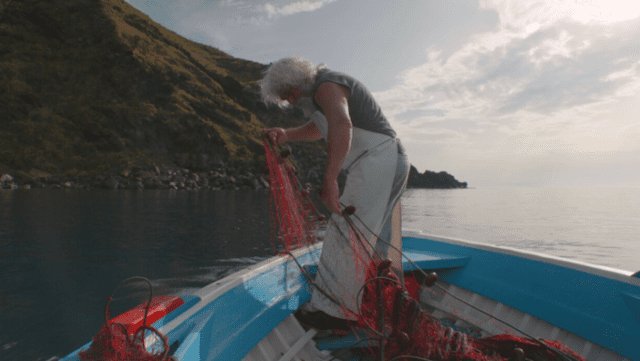
Shot over a period of seven years, we meet the islanders, from the fishermen who have lived there for generations, to the agricultural workers who remember better days, to those who rely on tourism, and the volcanologists who study and try to make predictions about the volcano, but are themselves occasionally taken by surprise.
The filmmakers draw many parallels to mythology, forged by the volcano’s brooding presence. The director’s notes set the scene: ‘Day breaks, and we step out of our cabins. A thousand-meter-high pyramid rises in the middle of the sea. The only fixed point before us. The sky is leaden, and the wind and waves continue to toy with us like a Cyclops teasing an ant. We immediately think of Odysseus’s voyages. Our sense of wonder feels almost metaphysical. We are hypnotized by the power of nature before us: two tongues of fire flow from the summit of the smoking cone and pour endlessly into the sea. It is the first time we witness the Earth’s blood spilling before our eyes, and the feeling is vertiginous. ‘
There are powerful forces at play, and, Sijercic suggests, these forces lead to a powerful, resilient people who must reconcile their lives against the backdrop of constant threat. “It’s a kind of polyphonic film with many characters,” the producer tells BDE. “And the people we met there show us in their own way how they are connected to this place, and how it is to live on a living volcano, where death is present at any moment, because every 15 minutes there is a small explosion, so it’s like it’s coughing fire.”
In gaining insights into the lives of the Strombolani, Sijercic believes that we can begin to consider our connection to our own environments. “It can fascinate, we can have different approaches to it, but I think what the film tries to do is to dive us into a reflection towards ourselves, to understand this microcosm of the place…to think about where we are.”
Much as the film encourages us to consider and reflect, it also invites us into a cinematic experience on multiple levels; it’s a celebration of the Island’s landscapes, a portrait of the island and its inhabitants, and a nod to the Rossellini film that put the island on the world stage in the 1950s – in referencing this film it also encourages us to perhaps imagine a different ending.
‘I think it’s an island that actually provokes a lot of fantasy, also cinephile fantasy, thanks to his [Rossellini’s] film Stromboli that was the shot in the 50s with Ingrid Bergman,’ says Sijercic.
Directors Sara Rastegar and Simone Pozzi note of their core protagonist: “Elvira is the incandescent heart of the film, a contemporary Pythia. She arrived in Stromboli in the 1970s, widowed and in deep despair, and chose to settle there with her two children, dedicating her life to the volcano that restored her will to live. To us, she also evokes Karen, the character portrayed by Ingrid Bergman in Rossellini’s Stromboli, Terra di Dio, as if that character had chosen to remain, to live and grow old on the island.’
According to producer Sijercic, the cinematic quality of the film is also heightened by the soundtrack, composed by Oscar-winning composer Nicholas Becker (Best Sound, Sound of Metal), which echoes the ever-present rumblings, puffs, roars and explosions. “From the beginning, we knew that also the sound aspect of the film was very important. The soundtrack is an atmosphere… not a factual real sound, but it creates its own particular voice,” says Sijercic.
Having filmed over a number of years, the filmmakers got to know their characters really well, and this has the effect of, as Sijercic puts it, “being in their back yard.” Through this intimacy, we can learn something from them, she conjectures.
“I think that the relations they created with characters are very intimate, so we get very gentle and genuine confessions from these people that really have something special in them, because they live in this place, and as if their consciousness of reality is somehow really affected by it… it’s maybe a bit like a cliche, but actually it’s not – you’re just passing, a passenger in this universe, and we should get back to some kind of symbiosis with nature,” she muses.
The film is close to completion,, in time for a summer launch, and has already benefited from grants from organisations including LaScam, CNC, Région Pays de la Loire, Procirep/Angoa, Tënk and IMC (Italian Ministry of Culture), and the team has also worked with Italian co-producer Altara. So, what are the team looking for during ParisDOC 2026?
“The ideal outcome would be to win the award and to get the post done! Otherwise, for real, ParisDOC came at a good time for us… I think what we would like is to find the right partners to launch the film, and to find festival premieres, as well as domestic distribution,” Sijercic ends.