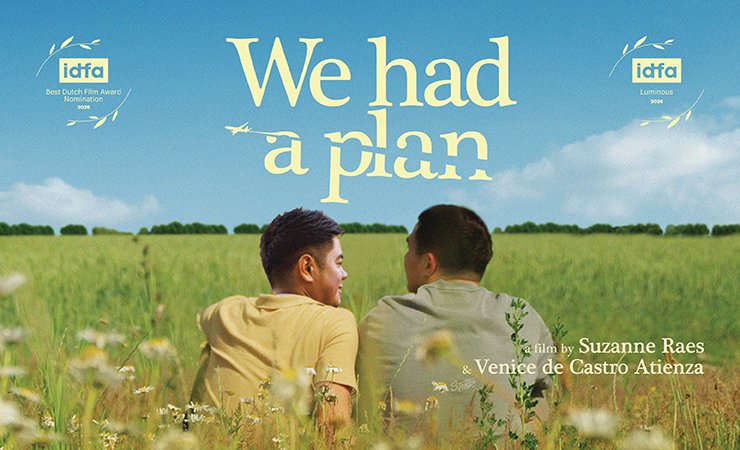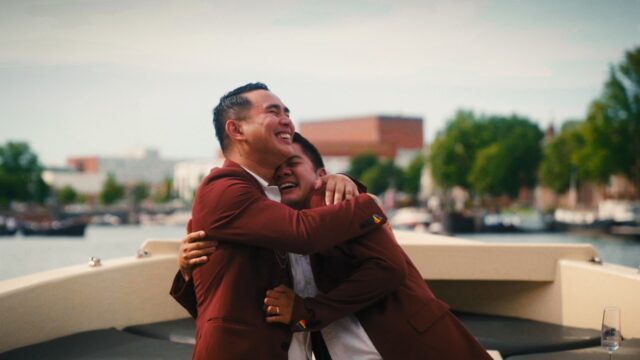
In Suzanne Raes’s new feature documentary, co-directed with Filipino director Venice De Castro Atienza and world-premiering in IDFA Luminous, Paul and Daniel return to The Philippines after a decade spent working in the shadows as undocumented cleaners in the Netherlands.
Yet their homecoming offers neither comfort nor the sense of belonging they had hoped for. Faced with the daunting task of rebuilding their lives once more from the ground up, they begin to realise that the future they long for together may still lie far from home, back in the city they left behind: Amsterdam.
But the road back to their shared dream is paved with uncertainty, sacrifice, and the ache of separation. As distance stretches between them and doubt takes root, their love is put to the ultimate test. With so much standing in the way, they must confront the most fragile and fundamental of questions: can a love that has endured so much survive the distance that now threatens to tear them apart?
The prolific Raes is no stranger to IDFA, having presented many docs there in the past, among them the wonderful The Rainbow Warriors of Waiheke Island (2009) and, more recently, the highly moving, yet troubling MS (2019). Recently, her Close to Vermeer (produced by Ilja Roomans of Docmakers, who also produces We Had A Plan) was nominated for a Golden Calf and was in the running for an Oscar® for Best Feature Documentary.
Co-director Venice Atienza’s feature debut Last Days at Sea was selected for Berlinale 2021.
Raes had known Paul for many years before he told of her his plans to return to The Philippines. “I was really amazed by him,” she says. “He showed me the apartment he bought with his friend Daniel back in Manila. He showed me the things he shipped over, as he was always really fond of King’s Day in Amsterdam [when everybody sells off their jumble and bric-a-brac].”
Daniel had been a nurse in Manila but his unregulated status determined that he couldn’t do the same in The Netherlands. “I really wanted to know what will happen next with them,” says Raes. “Because, to imagine, to be back home with your parents and your family after 12 years, seeing the houses they had bought, fully decorated with stuff they bought in Amsterdam. I thought it would be so great just to see what their life would be like.”
When they decided to go ahead, Raes and producer Roomans were determined this was going to be an environmentally sound doc, so they asked Atienza to direct in the Philippines, after being introduced to her by Filipino co-producer Alemberg Ang. “I think it clicked with Venice and me. I saw her film [Last Days at Sea], and she’s also a very great cinematographer.”
Despite the many complications and challenges, such as time delays, simultaneous shooting across two time zones, and the very length of time it can take to get from town to town in the Philippines, the pair bonded seamlessly.
“I’m used to delays all the time,” says Atienza of the cultural adjustment she had to make. “Paul and Dan would remind me – you have to tell them [director Raes and producer Roomans] we are in the Philippines. Because in the Netherlands, everything is always on time.”
“There was a line within Paul and Daniel’s lives that we were following which, for me, gave some kind of a grasp of what to do at all points,” she adds. “At the same time during the filming process, I would consult with Suzanne a lot. We would send notes to each other, of what I filmed, and then she would comment that we need more of this or that. I think it’s something that was built along on the way, but to be honest, it was a lot easier than I thought it would be.”
“We really had to find a strong partner, and that’s what we found in Venice,” Reas stresses of her co-director. “It was really a great joy for me.”
The Dutch director further points out how Atienza’s shooting style dove-tailed beautifully with that of her DOP Victor Horstink back in The Netherlands, which made framing and shot design so much easier.
She also reserves special praise her Scottish editor, David Arthur. “He’s really brilliant, a very sensitive guy. We started together for two weeks in Amsterdam, going through all the material, and then David would go on his own,” she says. The edit took eight months to complete, at time with both also present. “I really am amazed how that went. It was really a great experience, also very emotional from time to time.”
In the film, we see how Paul and Daniel are both very lovable characters, with the ante continually raised by Paul’s tendency to burst into tears, whether out of sadness or happiness. The film may also explore key themes, such as restrictions on gay rights in The Philippines, migration and striving for economic stability, but at its root is an enormous reservoir of love.
Atienza phrases it slightly differently. “Love is the skeleton of the film. But there’s a lot more inside. There are muscles, and there’s blood, and organs,” she underlines its complexity.
Raes further stresses how she was told by one viewer of the film that it is “humanising an invisible workforce,” in The Netherlands. “But still, of course, this film is about deep, deep inequalities. About injustice. About why these two guys cannot be who they want to be in the place they want to be. But then you open up this ocean of entrepreneurialism. Of kindness. Of deep love,” she adds.
“These are stories which are hidden among the domestic staff who come to your house, clean and then leave. They are stories that are unknown and untold. Until they are told,” Raes ends.
A shorter version of this article was first published in SEENL, a collaboration between EYE Filmmuseum and the Netherlands Film Fund.