The Big Boom!, a world premiere in IDFA’s Frontlight and sold by Lightdox, started in unlikely circumstances. Six or seven years ago, Swiss filmmaker Gabriel Tejedor was on holiday in Bulgaria with his family and “stopped on the way to the sea” in the town of Kazanlak.
They went for a walk in the forest and were surprised when they stumbled on the unmarked gates of what looked to be a very big factory. The next day, he noticed a poster in the town which had the same logo that he had noticed on the factory gates. That was how he realised that he had come across the weapons and ammunition manufacturer, Arsenal.
Three years ago, the director returned to Kazanlak with the idea of exploring the link between the factory and the townspeople, thousands of whom worked there. This is a small town where everybody knows everybody. Tejedor realised that it would be “impossible to hide anything” and that he ought therefore to be open about the film he was planning. He contacted the factory management who gave him permission to shoot at the annual factory party.
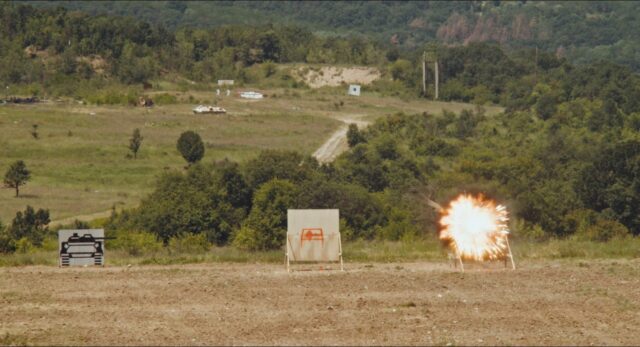
For obvious reasons, outsiders aren’t allowed to watch the weapons being produced. It’s potentially dangerous and also politically sensitive.
Many of Arsenal’s weapons are currently sold to Ukraine. There is speculation that Russia may also be a customer. “During the Iran-Iraq war, they sold to both [sides]. But I think things have changed now,” Tejedor suggests. After all, Bulgaria is a member of the European Union and EU policy toward selling arms to Russia is clear – it shouldn’t happen.
In the documentary, Tejedor continually contrasts everyday life – families wandering around, mothers looking at pictures of their babies – with guns looming nearby. “I think when you are shooting something, your eyes are always attracted by things you judge as not normal,” the director reflects. “Weapons were all around! It’s not something we constructed.”
The town has shooting ranges and arms fairs. The military are a familiar presence.
Tejedor was helped to recruit his protagonists by a top Bulgarian investigative journalist, Lora Fileva, who came from the town originally and knew its workings inside out. “I really wanted to have very different people, not only those working for Arsenal,” the director states. There’s a balance of women and men, young and old. Some of the people appearing on camera are pacifists, others are gung-ho.
Making the film forced the director to questions his own attitudes. He can’t help but speculate as to whether or not he would work for the arms factory if he was a teenager growing up in Kazanlak. “Would it be a problem to make Kalashnikovs all day long?” he asks. “Of course, I am against weapons but when war is in Europe, what does that mean? In Bulgaria, if you say you are a pacifist, that means you are pro-Russian because you want to keep the situation as it is now.”
A lot of the kids in the town take their politics from their parents. The director estimates that up to 40% of the population of the town is pro-Putin. The factory is also active in schools, making sure that the pupils know there is potential future work there for them.
Did he challenge some of the townsfolk over their pro-Russian views? “You know, I’m Swiss,” the director jokes that he took a neutral position. “I try not to judge them. They see the EU as extremely weak, that doesn’t do anything but talk and talk.” By contrast, Putin seems decisive.
It may be over 35 years since the end of the communist regime but, as we see in the film, there are still statues of the old communist leader, Georgi Dimitrov, and that gives the sense that “we are still under the eyes of Moscow.”
The Kazalnak municipality has a significant Romani population – and pockets of racism clearly remain in the town. “It’s a topic of the film, but what was interesting to me is that they [the factory bosses] needed the Roma people to work in Arsenal because they need so many people to work there…”
“There’s a lot of discrimination against the Roma people but when there is money to be made, they say ‘come in, come in!’” Tejedor adds.
The Big Boom! was made through Basel and Zurich-based Mira Film with backing from a host of Swiss supporters including RTS Radio Télévision Suisse and SRG SSR. Its Swiss release, set for early next year, will be handled by Vinca Film. “We were very lucky because we got all the funding that we needed from Switzerland.”
This is the director’s fifth feature doc but “the first one that was really well financed.” That, he believes, is because it touched a raw nerve. Questions around arms manufacture have an added topicality when war seems closer in western Europe than it has in more than a generation, and defence budgets are shooting up. The director points out that the weapons made at Arsenal are being used in a conflict only a few hundred miles away from the factory.
The Swiss are major arms manufacturers themselves and that may heighten curiosity about the film yet further. “I am 47 and I’ve never had any war close to me…[but] it’s concrete now.”
Tejedor himself has a longstanding fascination with eastern Europe. His previous films include Rue Mayskaya(2017), about a young man in Belarus ready to vote for the first time – but with President Lukashenko still on the ballot. Born Svetlana Stalin (2023) is about the Soviet leader’s daughter who ended up asking for asylum in a US embassy in India.
“It’s just life – it brings you somewhere, you meet people and these people make you meet other people,” the director insists that he didn’t set out to make films with a Slavic flavour.
“In Switzerland, there is a lot of distance between people and we are very polite [to each other]. In Russia, after 20 minutes with a ‘babushka,’ you think about Stalin and the war; you speak about very tragic things. It is intense – and that intensity is something that I love!”