

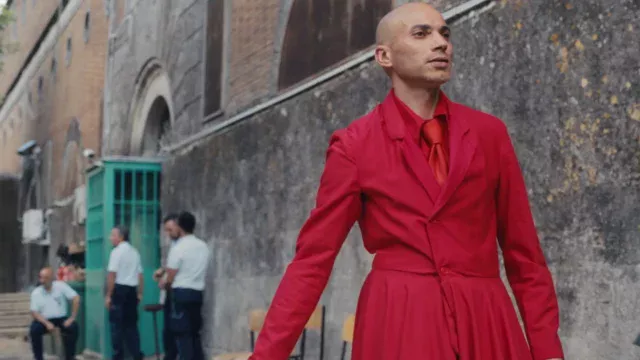
Every day for the past 38 years, theatre director, dramatist and actor Armando Punzo has walked through the doors of Volterra prison in Tuscany to work with the inmates. Together, they form the Compagnia della Fortezza, the first theatre project ever devised inside a prison in Italy, and one which challenges any perceived notion of what theatre can or should be, and by whom it should be performed.
We don’t know why the prisoners within the Volterra jail are serving time. Within the context of the film, their crimes are not relevant. What is pertinent is their dedication to the craft, the complexities of their performance and their supreme regard for director Punzo who guides and directs, all the time emitting calm but absolute authority.
The general public are allowed access into the prison to see the performances, and the company is allowed to perform beyond prison walls, the men free to travel to venues by coach and foot. After Compagnia della Fortezza’s 2023 performance in Venice Biennale, director Armando Punzo was awarded the Golden Lion.
French director Elsa Amiel chronicles this process of sublime performance-making in her feature documentary Dentro, a film that is in equal parts thrilling, tender and life-affirming, a phrase I am generally hesitant to use. As we see, the practice of theatre has become part of the DNA of the prison, and the process of transformation that we witness among the inmates is nothing short of astonishing.
“When I first heard about the performances in the prison of Volterra, I didn’t go there with the intention of making a film — I went there out of curiosity,” Amiel tells Business Doc Europe. “How could a place of total deprivation become a place of total expression? That intrigued me. The desire to make a film was born on the spot as I attended a performance within the prison walls. At that moment, I had an intuition — a feeling for a film — without immediately being able to define a clear narrative line. I wanted to understand what was at work in that place, by what kind of ‘magic’ Punzo and his company managed to make such a proposition, what their creative process was.”
Amiel did not set out to make your standard doc – far from it. We don’t hear the back stories of the prisoners, nor meet the partners they left behind. There are no talking heads, whether to congratulate Punzo on his efforts or to question the wisdom of such a venture. “Like Borges — and like Punzo — we didn’t want to tell a story with a beginning, middle, and end, but to create a visual labyrinth, rich in meaning, allowing viewers simply to surrender to the pleasure of language and of the theatrical proposition,” Amiel tells BDE. “The idea was that the world of the company might seep into and ‘contaminate’ our own, with the red thread of the film being precisely this process — the gradual transformation of these men.”
“My approach was fully immersive; I let myself be permeated by the rhythm of the prison and everything that developed there,” she further clarifies. “Even though the aesthetic of the performances themselves is striking, I knew I couldn’t rely solely on that shock of beauty. What was happening in Volterra was much deeper. I wanted to capture the atmosphere of the prison — a place once known as one of Italy’s worst, transformed through theatre into a place of avant-garde creation. The possibility of dreaming, of staging another reality inside such a rigid environment, creates a form of freedom that becomes an inner state.”
Amiel underlines how, from the beginning of the process, the idea was never to report on how the prison system operates. Nor was it a film designed to demonstrate the process of preparation before the big show.
“The film needed to follow and embody what Punzo himself is striving for,” she says. These men are prisoners, defined by their past and their actions. But very soon, a question arises: is a man merely the sum of his actions? Filming them to underline their crimes made no sense to me. My aim was to film them not as men overdetermined by what they had done, but as individuals — as mirrors of ourselves — posing the question of the human condition that concerns us all. To achieve that, it was necessary to grasp the way Armando looks at them — a different gaze, one that holds them and restores dignity and self-esteem. The very form of the film had to match that gaze, sometimes follow it, sometimes precede it.”
“I wanted to get closer to them, to stage their words, to film their faces — the space gradually fading away in favour of the men who inhabit it,” Amiel adds. “Once the film was finished, we organized a screening inside the prison. There was a wonderful silence, laughter, tears — but above all, recognition. They saw themselves in it. Armando said that the film resembled them. That was the most beautiful compliment I could receive.”
The director refers to Punzo as a “total artist,” but one whose trust she had to win. “It was something very intimate for him to accept the camera’s gaze upon his times of doubt, of thought — and being accepted over time was not a given. Paradoxically, it was precisely my continuous presence that built trust,” she explains. “He saw that I wasn’t after a superficial view of his work, but that I wanted to delve deeply into the detail of his method and thought. I think it was from that point that he accepted the camera. Watching him work — how he draws each person out, nourishes them while drawing nourishment from them — is fascinating.”
“Anyone who sees him work, think, and embody ideas through the bodies of others — it’s an education,” Amiel emphasises. “What’s most striking is his daily commitment: this man has gone every single day to the prison for over 38 years. There is in him a complete coherence — between his ethics as a creator and thinker, as a director, and as a human being.”
She further underlines what she terms “the Punzo miracle.” Volterra is high-security prison where isolation and control are watchwords, and whose long-term inmates never knew privilege, nor were ever exposed to culture. “Armando gives them the means to surpass themselves, to metamorphose, to transfigure. His method gives them confidence. He plants ideas that grow through their shared research, nourishing them in turn.”
“The men of the Compagnia della Fortezza are fully inhabited by this [sense],” she continues. “It goes beyond the idea of a redemptive theatre. These men are not ‘redeeming themselves’ — it’s no longer about morality. It’s much deeper. By belonging to the company, they develop belief in another possible world.”
“One prisoner once told me: ‘I had to live within these walls to realize that the world is beautiful.’ That sentence says it all: this man found within himself a source, a fire he can feed alone. Armando Punzo places theatre and thought at the very heart of these men’s lives, giving them a new kind of freedom — the freedom of imagination,” Amiel ends.
Dentro is produced by Eugénie Michel-Villette and Lionel Baier of Swiss production company Bande à part Films.





