Montreal-based filmmaker Marlene Edoyan is a much-travelled figure. She has Armenian roots which she explored in her first feature doc, Figure of Armen (2012) but she grew up in Lebanon (the setting of her 2019 film The Sea Between Us), and now lives in Canada.
“I think that is the core of everything I do: my background. I am really inspired by my experiences,” she says. “I am a second-generation Armenian raised in Beirut but due to the civil war we moved first to California and then, after many back and forths, from Beirut to the US, we finally decided Canada was our home. I’ve been living here for over two decades now…I am more of a Montrealer than anything else but, of course, I am very attached to my roots.”
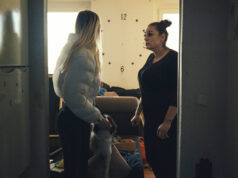
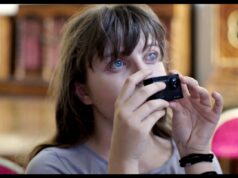
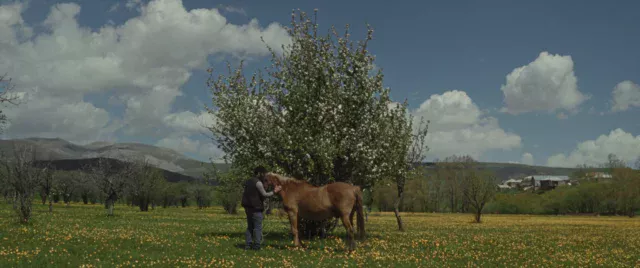
A Fire There (screening in the international feature competition at Visions Du Réel and sold by Filmotor) sees Edoyan venturing to the remote village of Gandzani, a predominantly Armenian enclave within southern Georgia. Edoyan is producer as well as a director, working with Dominique Dussault of Nemesis Films. The film is sold by Filmotor.
“It was like finding a part of my past almost,” Edoyan tells BDE. “I came across a group of people [and] recognised something very familiar, maybe a fragment of my story of displacement. It felt like a connection to a type of place that was embedded in my unconscious memory.”
Her three main characters are young men on the cusp of adulthood and facing familiar decisions about their future. Should they stay at home or look to build new lives elsewhere? Henrikh has the chance to go to university in Tbilisi; Karlen takes his family responsibilities very seriously, Hagop is asking probing questions about tradition, patriarchy and the structures of village life.
Gandzani may be a remote rural community but the village has a museum dedicated to one of Armenia’s greatest poets, Vahan Teryan. Locals have a passionate interest in literature. Edoyan remembers visiting there early on and sitting down with the villagers “to talk about art, philosophy and history. I thought I was in a time capsule. That’s when I fell in love with this landscape and the people, and I knew I had to come back.”
Making the documentary was a painstaking process. Edoyan realised she would need to spend a lot of time with the community, winning the trust of the villagers.
“I had some families I could rely on. I really built these relationships. I really got to know them. Sometimes, I would go back three times in a year…they had to gain my trust as well. They are very closed off because they are living in a very isolated region.”
The community is fiercely protective of its traditions and identity. Family values are considered very important. Edoyan realised that even if she spoke the language and shared the same ancestry, she was still an outsider, coming from the west. She was determined not to impose her views but to allow her characters to express themselves in their own way.
Research for the documentary began in 2018. Covid interrupted preparations. “I lost some of the earlier characters I had because I wanted it to be a coming of age film,” the director remembers how a few of her potential protagonists outgrew the project, marrying or leaving the village.
“2020. That was when I first met the three boys. Through them, I knew I had something really special.”
Shooting began in earnest in July 2022 and the last shooting sessions were in the autumn of 2024. “But we went back on several occasions making sure we had all the seasons [covered] and were there for the major points in the characters’ lives.”
Edoyan realised early on that Henrikh, the aspiring university student, was bright and precocious. He introduced her to his friends. “We would take walks on those landscapes. They would show me the places where they were hanging out. They could tell me what their routine looked like; what they were interested in, what they didn’t like and what they wanted. Through them, I got to know their families – their sisters, their mothers, their grandmothers, their aunts.”
The idea was to follow the characters over three years and to chart the particular challenges they faced. She was dealing with delicate moments in their young lives, heartbreak, familial tension and the questions they faced about identity and tradition as Armenians living inside Georgia.
“It’s any young person at the start of their life, deciding what is my path, what is my inner fire, what do I want to do with my life,” the director suggests their dilemmas will be recognised everywhere.
The young men feel ambivalent about Russia. At times, they express a nostalgia for the certainties of the Soviet era and a desire to find work in Russia.
“The film is heavy on symbols,” Edoyan explains how’s she uses light, fire and water to give the documentary a fable-like quality. She includes poetry and paintings as well as fly on the wall footage of the three young men’s lives.
She has been watching films from the great Armenian director Sergei Parajanov (Shadows Of Forgotten Ancestors, The Colour Of Pomegranates) and acknowledges him as an influence. Working together with cinematographer, Étienne Roussy, she “followed the cycle of nature,” and tried to ensure there was no sense of stress or “hurry” in the storytelling.
“We really took our time. We have a lot of pans in the film. We wanted to make sure that we captured the markers of time.”
It was a small crew, just the director, Roussy and a local sound technician. “It was an extremely beautiful experience…a beautiful place to be in,” the director says of her time filming in the community. “I really do feel I have a second family in the village.”