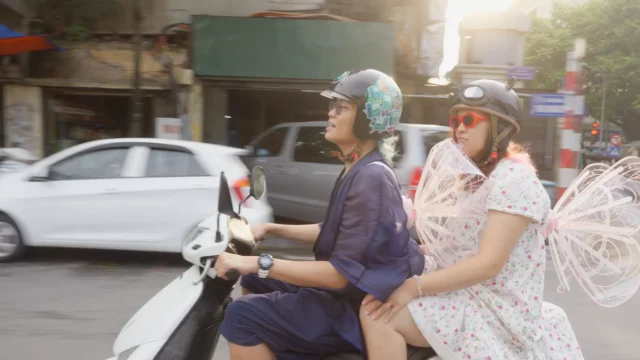
While video-calling his long-distance boyfriend, the film’s director and protagonist Nông Nhật Quang interrupts himself, turns to his camera, which he has put on a stand, and says, exasperatedly: “It’s hard being a movie director, making a film about your family, and dealing with your own emotions, so I’m sorry if I’m not being ethical. I hide behind the camera, that’s my power, because how else do I navigate through this?!”
This is a positive, of course. Nobody’s perfect and acknowledging you’ve been unethical is always the first step. But it can’t end there. Acknowledging unethical behaviour doesn’t excuse, solve, or heal anything. You also have to change that behaviour. Otherwise, saying you’re sorry is just a hollow gesture.
Consider a footballer who is continuously taunted by an opponent during a high-stakes match, losing their cool and committing a brutal foul. To the public, such behaviour can be understandable. But that doesn’t make it excusable. It’s still a professional failing.
With this exception: the footballer can’t undo their mistake. But a documentary filmmaker can. The moment you realise you have been acting unethically, using the camera as a weapon, violating people’s privacy – you can still change the edit. Which is a luxury that footballers can only dream of.
I apologise if this is a bit of a rant, but it’s something I’ve noticed happening more often recently; being openly self-conscious about ethical dilemmas simply isn’t enough.
Still, just as with my hypothetical footballer, Nông’s exasperation is entirely understandable. At the beginning of the documentary, he is a closeted queer living his most fabulous life in Hanoi, while dressing down whenever he visits his parents in Lào Cai, a small town on the Sino-Vietnamese border.
It’s a precarious balance, but it seems to work. But when his older sister Mai becomes pregnant and moves in with their parents, her mental health issues become the subject of intense family arguments and starts pulling him back to the small-town life he so desperately tried to escape.
Concerning privacy, some tacit kind of agreement is implied, as the father, who is always present, is never interviewed on camera. It’s only a voice-over comment late in the documentary which reveals that he has actually been calling Nông daily and has been the one, after Nông’s eventual coming out, who has been pushing his mother to accept it. Up until then it seemed as though mom was doing all the mental gymnastics and eventual acceptance of Nông’s breaking with traditional family values.
It’s one of the places where the documentary apparently lacks sufficient video material to tell the full story with proper detail and nuance – possibly due to understandable privacy concerns. But this could have been solved in other ways; his dad’s role, for instance, could have been mentioned in Nông’s recurring voice-over much earlier.
There are other parts of the family story that are missing. We never hear his parents discuss his coming out to each other, nor do we really get an idea of his sister’s reaction. Also, her husband (and father of her baby) is present, but is also taciturn – including when it comes to the arguments surrounding his wife’s conduct.
However, the most questionable portrayal is of his sister’s mental health issues. Although Nông talks to her at length on camera, her supposedly troublesome behaviour is predominantly described through the complaints of others. Mostly by their mom, who in fact, when both are in the scene, seems to be the dominant person, provoking her daughter more than the other way around. Even saying things like: “Ten lifetimes wouldn’t be enough for this misery.” And: “If I could hit or kill her, I would have.”
Then there is the moment when Mai, with her newborn baby, gets annoyed at Nông continuously filming her and tells him to put the camera away and do something useful or “get the fuck out of here”. A completely reasonable reaction, yet which gets framed as an uncontrolled outburst signalling mental instability.
Meanwhile, Nông’s insistence to his sister that she should simply keep the peace and accept their mother’s angry judgements – which she refuses to do – feels especially hypocritical since he himself at that point is still closeted. Cue his coming out and his outrage when his mother doesn’t immediately accept this.
I don’t want to suggest his sister isn’t suffering from mental health issues – there is one particularly heart-wrenching video call (which Nông records and shows, hopefully with his sister’s permission) in which she tearfully shares her fears that her hallucinations might cause her to hurt her child. But there is a portrait painted of her role in the family dynamics which seems questionable to me, compared to how much those family dynamics themselves may have been responsible for destabilising her equilibrium. The way his sister is portrayed feels like a rough, unfinished sketch that does not do justice to the complexities of her situation.
Meanwhile, there is a lively directness to the documentary, with handheld camera work, rough editing, intercut visuals (family photos, letters, diaries, impressionist shots), a guiding voice-over and smoothly flowing music, all of which fit well with Nông’s social media-raised generation. Unfortunately, it also echoes some of that medium’s thorny ethics.
Vietnam/South Korea, 2026, 105 minutes
Director Nông Nhật Quang
Production Flaneur Films, Seesaw Pictures
Producers Trang Đào, Sarah Kang, Heejung Oh
International sales Tommaso Priante
Script Nông Nhật Quang
Cinematography Nông Nhật Quang, Thảo Hoàng, Jirayu Jangwattanapong
Editing Hankyeol Lee, Linh DN
Sound Wiparut Panjawongroj
Music Xinh Xô