

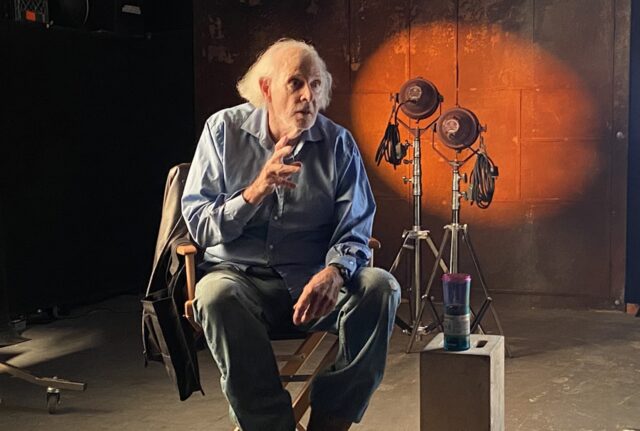
He’s the man who shot John Wayne in the back [in Mark Rydell’s The Cowboys] – and 50 years later, people still give him a hard time for it. In his early career at the Actors’ Studio, he cornered the market in non-speaking roles. In his early days in Hollywood, you’d often see him playing the snarling fifth cowboy on the right. He is Jack Nicholson’s best pal.
When he was cast as Tom Buchanan in the Robert Redford version of The Great Gatsby, he was the only member of the cast who had first-hand experience of the world of East Coat privilege from which Buchanan came. His filmography stretches from roles as varmints in TV westerns to psychos in Roger Corman ‘B’ movies, from a late Alfred Hitchcock thriller to Oscar contenders like Nebraska.
What’s more, Quentin Tarantino loves him.
Now, Bruce Dern has a film all of his own. Dernsie: The Amazing Life Of Bruce Dern, directed by Mike Mendez and sold by UTA, was warmly received in Cannes Classics this week. It’s a project conceived over many breakfast meetings between Dern and Mendez when they would eat pancakes together, and Dern would regale the young filmmaker and editor with what seemed like far-fetched stories about his career.
The title ‘Dernsie’ is a reference to its subject’s endless ability to improvise and spin a yarn. On almost every film, there would be at least one moment when he went off script.
As the documentary underlines, Dern, who is now approaching 90, isn’t only one of American cinema’s most cherished character actors. He is also an obsessive runner who, over the course of his career, has completed countless marathons. When he was in the UK shooting The Great Gatsby, he was staying in Claridges, one of the swankiest hotels in central London, and used to run to work to Pinewood Studios in Buckinghamshire every morning – a journey of some 19 miles – but that would only count as a light jog for him.
Director Mendez has almost as varied a career as Dern. He has directed horror films, edited episodes of Beavis And Butt-Head and has made documentaries.
“The funny thing is that I was never necessarily growing up saying, ‘Oh god, Bruce Dern is my favourite actor – I love that guy.’ He was just one of those perennial actors who has always been with us. You’ve seen him your whole life.”
Mendez remembers first noticing Dern as the creepy tattoo artist in 1981 erotic thriller, Tattoo. “And I remember my brother telling me that guy is really weird…” Since then, Mendez always thought of Dern as “some nut, some crazy guy.”
Years later, there was a project that Mendez was hoping to make with a possible role for Dern. “We were talking about it and he would do stuff from the script, but then he would keep launching into stories about Bette Davis or killing John Wayne,” Mendez remembers.
This was the time when they first started going for breakfasts at IHOP restaurants. (“That’s the International House of Pancakes,” Mendez clarifies]. “That became a monthly tradition for us. Every month, we would get together and he would regale me with stories…it was 100% on a social level.”
Over the course of 50+ pancake sessions, the director recorded their conversations. He was fascinated by them, and also realised that Dern’s wacky stories would be lost to posterity unless someone took the time to preserve them. “And because he has never had a drink and has never done drugs, he has the memory of a steel trap.”
Dern loves an audience and so Mendez would often bring along friends to share the pancakes and listen to the yarns.
As the breakfasts continued, the idea for the documentary evolved. The movie was made hand to mouth. A friend lent Mendez a studio. Then, for eight weeks running, Dern would “sit down once a week and talk all day” as his director filmed him.
“I tried to guide him and stuff. But the funny thing is, trying to direct him, there is a certain challenge to it, especially when he is telling his stories because he speaks in tangents…I would ask him a question and it [Dern’s answer] might resemble what I was asking. Hopefully, at least, it was on the same subject – and it would go off from there.”
Like many directors before him, Mendez realised quickly that Dern was a law unto himself. The best plan, he concluded, was simply to keep recording, “amassing” stuff. Then he could try to make sense of all the stories in the editing room afterwards. He talks of “breaking it all apart into a thousand bits and then putting it all together again to find the coherent flow.”
Mendez eventually decided not to cut the documentary himself. “It was so daunting. It was such a mountain of footage that after three and a half years, when I had finally assembled it into a four and a half-hour shape, I felt the best thing I could do for it actually [was to] get another editor – an editor who was better than me.” Producer Ben Epstein therefore recruited Tom Verrette to cut the film. “He just had a magic touch, just brought emotion to things,” the director says of his new collaborator.
Jack Nicholson is heard on the soundtrack, talking about his friendship with Dern. That recording came from Dern’s 80th birthday. The actor’s daughter Laura Dern shared it. The film also has archival interviews with Roger Corman and Diane Ladd, key figures in the Dern story. The latter was married to him in the 60s. The former gave him his break. Both have died, but Mendez knew their voices needed to be heard.
Ask Mendes what he makes of Dern’s compulsive running and the director can’t provide a glib answer. “He [Dern] claims he doesn’t get a high from it, which is really fascinating. Why else would he do it?” Nonetheless, Dern’s running inspired Mendez. Completing the documentary became his own marathon. The actor never gives up. Confronted with hours and hours of footage, Mendez decided he also needed to show some of the same doggedness to get to the finish line.
It helped that Mendez had Tarantino as one of his main interviewees. “They [Dern and Tarantino] can both spin a yarn. What an honour! I am a self-described movie geek and so having the chance to hang out with Quentin Taranto and talk movies all day is a dream come true.”
No, Mendez didn’t realise at the outset that Dern came from a world of privilege, and that his ancestors were important business tycoons, politicians and poets.
“I don’t know what is the gene pool of the Dern family. I am the child of a Salvadoran family that had a Mexican restaurant. My beginnings are quite humble. It’s quite fascinating to me that Bruce is born into this privilege from birth. It’s not in the movie but Eleanor Roosevelt babysat him!”
“It continues throughout his life. He is always next to greatness. Whether it is Elia Kazan, Alfred Hitchcock or Quentin Tarantino, his entire life, he always rides along greatness…I kind of look at him like a real-life Forrest Gump.”
As far as the financing of the film, Mendez likens that to kicking a can up a hill. He would shoot material with Dern, paying for it himself, and then try to work out how to build the documentary further. Other interviewees, like Dern’s friend Joe Dante or daughter Laura or director Walter Hill also agreed to appear on camera – and that provided an extra boost.
Dern is a producer on the project and most of the archive material came from Dern’s sister in Arizona. Laura Dern also lent her support. It has taken around five years since those first breakfast meetings to complete the documentary.
“I pushed it as far as I could, at least enough to get us a trailer…and then I raised a little more money which helped us kick the can a little further up the hill,” he says. “I really do think this is one of the lowest budget films that has ever been in Cannes. The cost of coming to Cannes nearly doubled the budget.”
Ask Mendez about his favourite Dern performance and he parries the question. His real love is for Dern himself, not for the characters he has played. “I grew up thinking he is some weirdo – and he is to a certain degree, but not in a dangerous way or a creepy way. He’s a weirdo in that he is a fountain of stories…the real person genuinely fascinated me.”
He adds that it’s a “privilege and honour” to have been able to make a film like this – but, no, he and Dern don’t have any immediate plans for more pancake breakfasts.
“Maybe we’ll celebrate something for our birthdays…I will say that, as much as I love Bruce, I know what he has to say.”





