Channelling the overwhelming ‘Odyssey’ vibe that’s in the air right now, Dutch-based Croatian director Tatjana Bozic embarks on her own epic voyage into her geographical and psychological past. Why? To understand better the world she currently inhabits and, as importantly, to question her place within it as a perennial outsider.
Bozic’s feature documentary Fragments of Belonging is produced by LEWA Production sand HBO, and co-produced by Doppelplusultra Film und TV Produktion and Spacedust Productions. Festival distribution is handled by Mokum.
For more than half a century, Bozic has lived a nomadic life. In 1986 she moved to Russia, where she experienced an “uncomfortable” privilege, given the weakness of the Russian rouble against the German Deutsch Marks she was exchanging. The flip-side came in 1996 when she located to London, where she was deemed to be little other than a general “Eastern European,” with all the negative connotations that the term seemed to carry back then in the UK. When she moved back to her home country of Croatia, she was equally considered an outsider, “because I wasn’t there during the war.” After her subsequent move to Amsterdam she entered into a relationship with fellow docmaker Rogier Kappers, with whom she had a son. When they were together, she was thought of as a “charming foreigner,” but when their relationship broke down, she moved out of Amsterdam’s chic centre, now a single mother, to assume her current status of ‘immigrant.’
At the beginning of the film (which is, in equal parts, funny, self-deprecating, melancholy and instructive, both about Dutch society and the wider business of migration) she states that this will be a study of loneliness, but little by little it transforms into a film about belonging. “[It] is an emotional dramedy with a touch of nostalgia for all that is lost when we move, adapt, and belong nowhere entirely,” Bozic summarises. “It explores the loss of roots, community, and identity through the lens of migration and motherhood. As I discovered while making the film, the feeling of not belonging often begins long before we cross borders, it starts within our own families. This film is my attempt to own that story, to turn loss into connection.”
There are, Bozic is happy to admit, two versions of herself evident within the film. What we see on screen is an exaggerated version, the person who “wants to be smarter and good looking, the one who wants to impress.” Then there is Bozic the director who feels “no mercy” for the character she is filming. “Me, the director has to put down ‘me’ the character. What comes out of that is, if the director wins, then it is good for the film. So every time I let go of my ego, the film somehow also becomes better, or maybe funnier.”
We see Tatjana make numerous attempts to make friends with her neighbours, whether buying them cakes or holding soirees, all to no avail. She even opens up her flat to Airbnb guests (who get her son’s room) but this doesn’t elicit much by way of close bonding. When she asks one guy if they are now friends, she gets a polite but definite ‘no.’
Later in the film, she meets a Spanish woman called Blanca who moves in and seems to have loads of friends, and life all of a sudden feels a lot more optimistic, but there is a difference. Blanca’s is not a true integration into Dutch society. “If you come to work to the Netherlands, and your job pays your house, or you’re a really overpaid expert in something, like Blanca is, or was then, you end up in a sort of bubble with other foreigners, and the common language is only English, and they don’t mingle too much with Dutch society.” All of which leads to Bozic’s telling observation that “ex-pats are rich foreigners, and immigrants are poor foreigners.”
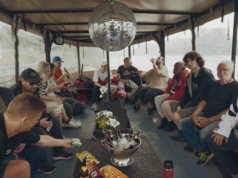
Bozic then turns her introspective lens on her family and Croatian ex-pats (or maybe they are immigrants), some of whom have successfully made the transition towards assimilation (such as two sisters in Stuttgart who refused to teach their kids Serbo-Croat). Others, like the gastarbeiter (guest workers) in a Vienna bar continue to embrace the culture of their former Yugoslavian homeland, singing the songs from their childhood, accompanied by Bozic.
She further cites the life experiences of folk from former Yugoslavia, and how these have shaped their attitude in a way that is totally at odds with their new European neighbours. Bozic’s friend Igor has two MAs and lives in affluent Switzerland, and so everything should be rosy, surely? Not so, it seems. “On [émigré] people’s faces, you see the tiredness, the fear, the [sense] that life is difficult. There is not the ‘what is waiting for me tomorrow’ attitude? What Igor says is, ‘who is going to fuck me over today?’” the director tells SEE NL.
As serious as the film is, it is also very funny and playful in terms of its existential navel-gazing. And although this may not represent comfortable head space for Bozic, it is certainly a productive one, as evidenced by her equally reflective Happily Ever After (2014), the film which HBO’s Hanka Kastelicová was impressed enough by to commission Fragments of Belonging as an HBO Original.
“Like in my previous work, I work with self-irony and a dose of humour that makes painful moments bearable,” Bozicsigns off. “If I manage to make you laugh and break your heart at the same time, I have done my job.”
This article was originally published by SEE NL, a collaboration between EYE Filmmuseum and the Netherlands Film Dund.