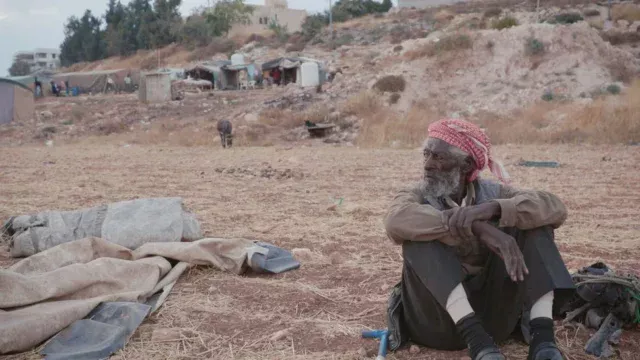
Jordanian Asmahan Bkerat’s feature doc debut tells of the Afro-Palestinian-Bedouin Najar family living on agricultural land on the outskirts of Amman, the Jordan capital, whose bucolic yet fragile existence is severely threatened by plans to construct modern villas in their immediate vicinity.
The Najars comprise three generations, from devout grandparents Abu-Awad and Hakima through to their son, the truck-driving Awad, to teenage grand-daughter Eman who must put up with bullying at school, both for her Bedouin background and her dark skin colour, but who is all the time preparing for a future university education.
Despite the rich simplicity of the lifestyle that the Najars choose, neither the site developers nor the future owners have much sympathy for them, and soon the bull-dozers move in to prepare the land, razing all the ancient olive trees that stand in their path. One tree is saved by the family, its re-planting serving throughout the film as a stark metaphor for the family’s ongoing plight.
The Najars’ tent is slashed, and demands are made for them to sell their animals, perhaps even Hakimi’s pet sheep Badrya, whom the matriarch bejewels with necklaces and whose hair is combed into a centre parting. Such is the stress of the situation and the sense of betrayal felt by grandfather Abu-Awad after the culture-sustaining animals are removed, he leaves the domicile, declaring he has nobody left in life but God.
Painful partings follow, both within a familial sense and in the Najars’ decision once more to uproot. Against such a dire backdrop, can new life, in the form of a baby daughter, rebuild a sense of hope, and bind once more the family during these straitened times?
Before she ever contemplated documentary direction, director Asmahan Bkerat, herself a first-generation Palestinian, came across Hakima and her pet sheep Badrya on the city’s outskirts. The pair would later be the subject of a short film, even as Bkerat was all the time looking at telling the family’s wider story.
“It was such an unusual sight for me, for an old woman to be talking on her phone and a sheep following her around. It was hilarious and that was our first interaction,” the director confirms. “I really loved Hakima and Badrya, and then when I saw where they were living I was really taken aback by how they were situated in the neighbourhood. We visited them just out of love and respect for them. But what started this [feature] film, why we started documenting, was because of the high-level construction that started right next to them, and it was this construction that ended up displacing them.”
Concrete Land, produced by Bkerat and Ban Maraqa, and exec-produced by Jane Mote, deals with both social and racial prejudice. Like his daughter Eman, trucker Awad is dark-skinned. “This tribe doesn’t exist in Jordan. They only come from Palestine so it creates this social prejudice that people don’t think of or they’re not aware of. Most societies would like to think that they’re not racist when they’re the most racist. I feel it’s the same case here, and these micro levels really affect [the family] in a lot of ways.”
Likewise, Concrete Land is far from an overly-romanticised film about nomadism and life on the move. In the film, the business of survival is shown in all of its manifest ugliness.
“Survival doesn’t always end up with them in a good place,” Bkerat confirms to BDE. “The grandfather, for example, couldn’t survive this new reality where they don’t have animals, where they have to move, perhaps maybe into the city. That’s not something he was able to accept, and in the end he just basically died of heartbreak. He died a year after losing his sheep.”
Bkerat herself studied business information systems before being infected by the filmmaking bug (she is also producer on Concrete Land). That said, before going to university, she worked as a fixer for international journalists. “I come from a Palestinian family and I’m a first-generation Palestinian living in Jordan. I’m always drawn to stories about Palestine and how we ended up in Jordan, and that led me to being curious about stories in general.”
“I grew up listening to my father’s stories. He was forcibly displaced from his village in Palestine, his only way of keeping Palestine alive in his memory was to tell us stories of his homeland,” she adds in her notes for the film. “Through his words, I felt his pain, and over time, that pain became my own. In our culture, history is oral, passed down through storytellers like my father, grandmother, and mother. Their narratives shaped my understanding of the world.”
After graduating Bkerat worked in the corporate world, but also attended a film workshop which inspired her to continue the tradition of storytelling (the first example of which would eventually be the short Badrya, named after Hakima’s sheep). Very soon, however, it became obvious that holding down a day job was never going to be compatible with her overwhelming need/desire to be a filmmaker and storyteller.
“I was a normal person doing a nine to five. I used to have a small camera that I kept in my shabby car, and eventually I got fired from my job because I kept disappearing because I was always going to film,” she remembers. ‘Okay, what happened? Is a sheep giving birth? I’m coming.’ And then I would disappear for three hours.”
So, eventually came Concrete Land. “My passion for storytelling is deeply tied to telling stories of my people,” Bkerat further underlines. “Their erasure is my erasure. I wasn’t a filmmaker before meeting the Najars. This film was born out of the threat they faced, the brutality and destruction of the land, a threat that compelled me to pick up a camera, to document what was left of it and them.”
The film’s production has already had a significant impact on the lives of its subjects, Bkerat confirms to BDE. “We showed it to a philanthropist and he has covered all of Eman’s [future] university costs, so she will be the first of her family to receive an education,” the director says. “We got her passport, so now she’s doing her final years of high school and she’s going to go to university next year.”
The production was also able to raise funds to buy sheep for the family. “And now we’re going to do a bigger fundraiser that goes side by side the film to raise money to buy land [to stop] this cycle of moving from one place to another, because now they’re actually going to move again because the same thing is happening,” she adds. The purchase of land will enable the Najars, and other Bedouin families, to produce dairy goods to generate a living income, it is hoped.
The ever-industrious Bkerat is currently “expanding my work in the film space” and is looking to develop a documentary association for her region, as well increase her production output. “I’m not just directing films, I’m also producing a film about a family’s archive in Palestine and another one about farmers in Jordan.”
“But my next project as a director will again be about home and displacement [elsewhere in Jordan], because it’s something I deeply care about. I have been developing it for a year and a half, so that’s going to be my second feature film. It’s already very much in the works,” Bkerat signs off.