

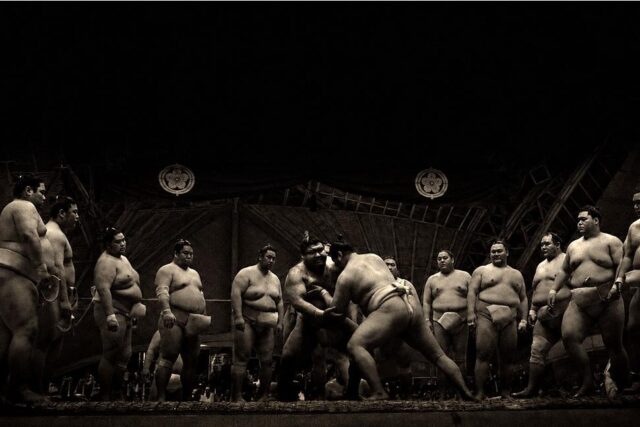
The mysterious, at times secretive, world of sumo is unveiled in Erik Shirai’s elegiac and unapologetically cinematic new feature documentary which world-premieres in Venice, opening the festival’s Spotlight section.
Sumo: Spirit Weighs Nothing, shot in both black & white and colour, follows four fighters (or ‘warriors’ as Shirai prefers to refer to them) at different points in their careers, each committed to the ancient tradition of sumo that dates back over 1500 years.
At the top of the pecking order is Grand Champion Yokozuna Terunofuji, who is chasing an unprecedented 11thchampionship despite harbouring a catalogue of knee injuries and suffering from diabetes that necessitates daily injections. Rising star Hiradoumi fights within the stable run by the Master Sakaigawa. As we see in the film, when the competition arrives in Hiradoumi’s home town of Hirado, the pressure on him to win reaches fever pitch. Meanwhile the highly talented Yonezawaryu is undergoing an existential crisis as he commits to the gruelling regime of dedication and sacrifice to the cause, and especially after he badly injures his best friend in a contest. At the opposite end of the spectrum is the tiny teenager Kosei, who is nicknamed Little Giant, standing a mere 5ft 3 inches and weighing in at a diminutive 150 pounds. But he has the heart of a lion as he battles warriors more than double his weight. His greatest challenge is in consuming enough food to create the bulk he’ll need to compete.
The golden age of sumo, we are told, was in the 1990s when more than 1000 fighters were practising. The number is currently is 600, with Japan’s youth eschewing a tradition that can curtail life expectancy by up to 20 years, given the strain placed on vital bodily organs, a result of the excess weight gained.
That said, there are no weight divisions in sumo – such as in boxing – and bouts can take as little as a few seconds, as the two warriors, resembling powerful silverbacks, seek to slam, throw or slap their opponent towards defeat within a circular dohyō area measuring 15 feet in diameter. Injuries are inevitable, and death in the ring is not unknown. “It could be career-ending, a matter of life or death,” Shirai tells BDE. “Every fighter prepares that they might die.”
“The moment the bout is over, both fighters bow. Not simply to one another, but to something greater than the victory or defeat between them,” he further underlines. Each fighter must possess “the courage to sacrifice [their] body and wrestle with every doubt long before they ever step onto the dohyō.”
What’s more, sumo isn’t a sport, it is a martial art, Shirai further emphasises, and one whose traditions derive from Shinto. It is also a vocation steeped in humility, and only the top divisions (the sekitori) can earn an actual salary. The other fighting ranks exist to serve the sekitori.
For his film, Shirai wanted to describe the entire working life of a sumo fighter. “But I knew that I wasn’t going to be able to follow one character to tell the whole arc. That’s why I chose four characters at different parts of their lives and careers, to tell us the whole lifespan of what a sumo fighter goes through from start to finish.” By concentrating on the characters, he was able to tell his story with more nuance, he points out, all the time eschewing an overtly “Western lens” that was likely to “exotify” sumo.
Shirai initially wanted to shoot the film entirely in black and white, but compromised on a mix of monochrome and colour. He tells BDE that this was one of the biggest challenges during the production, and that he pushed distributor ESPN “to the limits of what they felt comfortable, and I think they pushed me to what I felt was possible and what I wanted to sort of reveal and showcase in the film.”
Rather than focus on the more obvious “surface things” such as the weight and bulk of the fighters, Shirai’s intention was, he tells BDE, “to make the film look a certain way so people can see something that often is invisible, which is the human spirit.”
In so doing, he turned to photos and images from the so-called golden era of sumo, the 1990s, and channelled his nostalgia for “these specific Japanese warriors and Japanese fighters… and there was this texture of how sumo looked.” These were images from an analogue past, recorded on pre-digital devices that are now all but obsolete, and Shirai set out to replicate this aesthetic to generate a “timeless” feel, “something that’s closer, more primitive, more natural, in some ways, more simple, minimal.”
“Two men on a dirt ring trying to fight each other, half naked. There’s nothing more minimal or simpler than that,” Shirai underlines.
As a Japanese-American based between New York and Tokyo, Shirai has spent his life “straddling two worlds, each with its own idea of strength,” he writes, as evidenced within his first feature film, The Birth of Saké, which received the Special Jury Award for Best Documentary Director at the 2015 Tribeca Film Festival, before being acquired by Netflix and broadcast nationally on PBS.
“I think every film I learn something about myself,” he tells BDE. “I think that’s always the case when you make something so personal and close.”
“I think a lot of things in Japanese and Asian culture are misunderstood by the Western world, and sumo is a great example of that. People only see what’s on the surface and often misunderstand and mistake what real strength is,” Shiraiadds.
“In the Western world everything is pounding your chest and saying you’re the best or you’re the greatest. You’re the GOAT, whatever you want to call it,” he continues. “And Japanese people just don’t do that. I think there’s a lot more humility and discipline and sacrifice that goes into the one that doesn’t have to pound their chest.”
He further points out that sumo fighters rarely say outright that they want to become Yokozuna [the highest rank], “because the Yokozuna is considered to be a god, and no human has the right to claim they want to be a god.”
Instead, they say they aspire to become Ozeki, the second-highest rank, which reflects the inherent humility within Japanese culture, in which the ego of the individual is diminished in favour of the collective.
“And I want people to understand the beauty of that,” Shirai signs off.





