

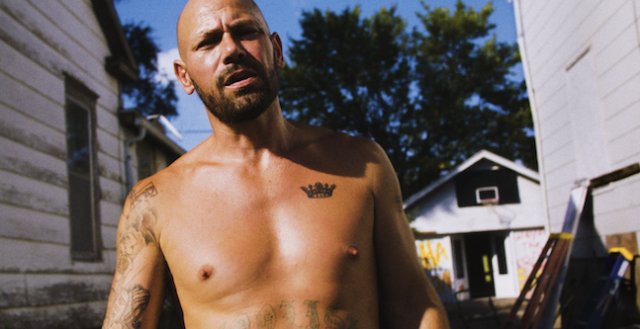
When live-wire Ryan Holliger was a kid, his grandmother told him he had too much sugar. He was loud and brash, with an eye for the ladies, and a tendency to get into fistfights. He served time in prison – four years in total – and he fathered a lot of kids, six to be exact, with five different women. But now he is a settled man…of sorts.
At the beginning of Too Much Sugar, Robert Greene’s aptly-titled feature doc which world premieres in Venice Orizzonti and is sold by Cinetic, we are told that Ryan is a carpenter, a fighter and a father. We also hear about how director Robert Greene first met his subject at a school basketball game. Ryan was being an obnoxious dad, “the loudest parent at the game,” and somebody Greene had no interest in making contact with…until their kids were playing in the same team a year later.
“And then I’m like, well, I love this guy because first of all, he’s actually really kind and sweet and he immediately wants to connect. Within the first couple of conversations, he was like, “yeah, I’ve been in and out of prison. I’m trying to make my life better. I’m trying to do my thing.’ His positive energy is sometimes too much. It’s literally too much sugar. But I was just like, I like this guy and I think he’s a good person and I think he’s got something to say.”
When Greene revealed that he was a filmmaker, Ryan went into overdrive, telling him he wanted to make a film, one called Too Much Sugar, which Greene thought was “honestly maybe my favourite title I’ve ever heard.”
So he agreed to help Ryan in his quest, but what was initially planned as a retelling of the man’s chaotic life to date, and one in which his skills as a father would be placed centre-frame, soon transforms in to a Rashomon-type account of that same life as seen from the POV of his mother, his wife and his six kids, each of whom imagine their own movies, scenes of which will play out in the final reel.
“What we encountered and what we went through together, what the families went through, I think that was totally unexpected and magical and heart-breaking and beautiful altogether,” says Greene, even if we see at least one highly dramatic 180-degree shift in attitude among the cast before the final credits roll.
“At some point, that veneer of his performance of Good Dad reveals the depth of what he’s actually dealing with, which is a lot of loss in his life and incarceration and pain and bad choices – and all these things that are catching up to him,” says Greene. “There’s a tension in what you’re seeing versus what he can be sometimes. But at the core, he’s a good guy who’s trying to be better every day.”
Another core ingredient in the film is Ryan’s best friend Michael ‘AccRite’ Midgyett, a rapper and co-worker, but also a man who suffers a deep melancholy as he struggles to come to terms with the murder of his teenage son DeQ at a party. Greene deploys a process that resembles drama therapy (as he did in his previous film Procession, again using that film’s drama therapist, Monica Phinney) to create an imagined time-slip sequence in which AccRite is able to save his son, as played by his daughter Auveon. “I don’t think you can get closure from the murder of your son, but I do think you can get a sense of control actually, just that you’re not sitting there doing nothing with this pain, that you’re actually being productive and making something,” says Greene.
Too Much Sugar is a blue-collar film, with a lot of heart and a fascinating working-class man at its core, someone who is both emotionally complex yet uncomplicated in his tendency to follow his instincts. Greene confides that in many ways, he and Ryan are “two peas in a pod,” even if their lives took dramatically different turns.
“We both grew up with broken homes. I grew up in a very similar working class [area], in North Carolina mostly, and he was in Missouri. Moms with lots of partners – with all due respect and love to Ryan’s mom Candy, who’s a great mother. And multiple fathers who come into your life and all of them let you down,” the director says.
“But the difference between he and I is he likes to fight, so he punched someone in the face a bunch of times and went to prison. I don’t like to fight. I like to write poetry and make paintings and eventually I made movies, and that’s where our lives diverged. That took me into college and then university. Now I’m a professor and he’s a carpenter and builds houses and still has those four years of incarceration that he’s still working through.”
“I’ve made mistakes in my life, and the fact that he has to pay so much more harshly than I’ve had to pay for the mistakes I’ve made is just such a class thing. I’ve been able to go into this professor/artist class, and he hasn’t been able to change his class, and that’s the story right there.”
Greene admits to being heavily influenced by the great, proletarian films of UK director Mike Leigh. He further tells how he watched the opening scene of Rosetta, by the Belgian Dardennes brothers, “a hundred times” before embarking on Too Much Sugar, “because I just want to be reminded of that feeling I had when I saw it in the cinema and I was like, “my God, this thing just hits you and you’re just off and running.” He also adds the UK stalwart Ken Loach to the equation, citing Kes as one of his favourite films. Documentary makers don’t take on the subject of class quite like their fiction counterparts, he reckons, but “I would like to think that we did an okay job here,” he says of his collaboration with Ryan and AccRite, et al.
What’s more, the business of documentary can be highly transformative for a film’s subjects, Greene opines to Business Doc Europe. “One of the things that I love about making movies like this is my presence and the presence of the camera and the presence of the crew validate them in a way that society is not validating them,” he says, adding how “I don’t know how religious I am, but I do believe in the church of art. I do believe that art can help people.”
Participating in the process of filmmaking, in which a subject can, if they like, choose how they wish to be presented or seen, is potentially liberating, Greene intimates. “They start to think of themselves as like, ‘oh wait, I’m going to be on the big screen and people are going to see my mistakes, so I’d better do a better job.”
“That actually changes their behaviour and then makes them approach life in a new way,” he says. “At least it hopefully does. The real therapeutic goal of the whole thing is just to imagine yourself as the best version of yourself and everyone should have the chance to do that. We’re really happy that we’re able to give these guys and the whole family the chance to do that.”
“And I think you see with this movie that movies can feel like dreams, can feel like aspirational dreams that give families opportunities to be themselves in a bigger way,” Greene ends.





