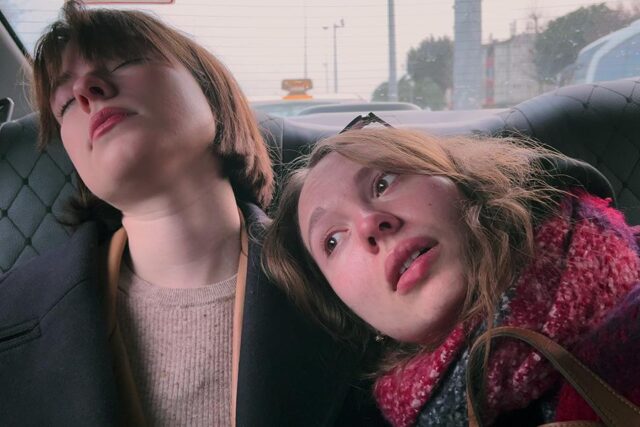
The characters originally portrayed in Julia Loktev’s epic documentary My Undesirable Friends: Part I — Last Air in Moscow (2024) now live in exile. These are the charismatic and often heroic journalists who worked for TV Rain, one of the last independent Russian media outlets in Putin’s Russia. Even before the Russian full-scale invasion of Ukraine in 2022, they had been coming under intense pressure from an authoritarian regime which dubbed many of them ‘foreign agents.’
At the start of the sequel (sold by Cinetic and which screens in Venice Open – Out of Competition), they are shown as they flee abroad.
The new film begins just two days after its predecessor ended, the point at which the last remaining independent media outfits in Russia were shut down. Some of the journalists head to Istanbul, others to Israel or Georgia. Some ended up in Prague or Vienna. They’ve left loved ones back home in Russia, they have very limited financial resources and are travelling light, uncertain of what the future holds. Their indefatigable chronicler Loktev is hot on their heels, filming 10 or so main protagonists, again using her trusty iPhone.
“History happened and I kept shooting directly, when everybody fled Russia. I followed them and I just kept shooting,” she recalls. “I had this incredible opportunity to capture this historic moment as it was happening. There were only a few places they could fly, a few places they could go without a visa. Most of the characters left home at a few hours’ notice with a carry-on suitcase.”
Wherever they travelled, she would follow. “I would fly from New York and then film the same day but, hey, adrenalin does a lot.” It helped that she was on her own, without a big crew. The main logistical challenge was booking plane tickets to the right destinations. (12 different countries feature in the movie).
At the time, the budget for the new documentary was far from complete. She was raising money as she went along, shooting and editing while also trying to arrange the distribution for the first film (which was nominated for an Oscar and won several prizes).
In the new documentary, the Russian journalists often find themselves in an invidious position. At great personal risk, they have defied Putin and left their homeland. Sometimes, their own families think they are traitors. As the paranoia mounts, one jokes that she often feels she is appearing in a low budget spy movie. The journalists are stalked, intimidated and threatened by the Russian regime, which even tries to poison some of them, and yet certain Ukrainians still regard them with extreme suspicion and hostility. They get into trouble in Latvia, where they’ve set up offices, when loose language on air (a broadcaster referring to the Russian forces as “our army”) provokes fury in the local media and among politicians.
Loktev points out that her film has an “incredible” Ukrainian character in Nataliya Gumenyuk, the fearless author and journalist married to former TV Rain host, Peter Ruzavin. (He is Russian and grew up in Moscow, had a glittering journalistic career, but has now joined the Ukrainian army).
She never expected Ukrainians to be interested in My Undesirable Friends and adds that she understands the backlash against the TV Rain journalists. “I really think that Ukrainian audiences have better things to do than watch this movie. I think Russia has caused so much incredible suffering in Ukraine that it is very natural to direct your anger towards the people who will hear you. The people who are actually causing the war don’t care. If you criticise the Russian opposition, you at least have the satisfaction that your pain is being heard.”
There are many dark moments. For example, we see the grief-stricken journalists, now based in Amsterdam, reporting on the killing of inspirational opposition leader Alexei Navalny in a prison camp in the Arctic. Even so, the new documentary, like its predecessor, comes laced with plenty of humour. The idealistic young journalists are having romances and chasing stories, just like reporters in old Hollywood movies like The Front Page or His Girl Friday.
“Bizarrely, this film has a lot of comedy which you wouldn’t expect. It has a lot of newsroom banter,” Loktev agrees. “I think that when people hear ok, here is this almost six-hour movie about journalists, that doesn’t sound like the most attractive sell, but then people watch it and they say ‘oh my god I couldn’t stop.’ It’s about people and it has very human characters and stories that you can connect with.”
Loktev captures some delicate moments between couples, for example a long car journey from Warsaw to Vienna during which Nataliya and Peter are joking and flirting together like lovestruck teenagers on a first date, or journalist Elena Kostyuchenko (“Lena”) and her partner Yana Kuchina baring their souls.
We are also given insights into how sudden exile feels for Anna Nemzer’s 10-year-old daughter who has had to leave her beloved pet chinchilla behind in Moscow.
“There is so much love in the film and so much affection, not only romantic love but I think friendship, love between people. I don’t know how I captured it. That’s a strange answer but from the get-go, people seemed to be incredibly open with me. It’s not like I am doing anything. Mostly, I am just keeping quiet…and I smile a lot,” she says. “I am interested in emotions and characters. And people living through history is really made up of all the daily details.”
The director has spent four and a half years chronicling her characters. She now regards them as friends but even in the early part of shooting, when they didn’t know her especially well, they were already prepared to let her into their world. For example, she had never met young journalist Valeria Ratnikova (“Lera”) before she started filming her just after she had left Russia. Lera is shown looking for accommodation at a hostel in Istanbul. She is tired, anxious and at her most vulnerable and yet, like every other protagonist in the documentary, she gives Loktev access to all areas of her life.
“I think you have just not to get in the way. I think the fact that I am there alone and that there is no crew helps tremendously,” the director explains how her simple method of being friendly and unobtrusive has yielded such magical results.
Both documentaries were acquired by global streaming service Mubi earlier this year. To the relief of its director, Exile will have a theatrical run following its festival roll-put. Like Part 1 it is likely to be available for audiences to watch in one sitting, or over separate nights if they prefer to see it in more manageable chunks.
“It’s a film about community. You can watch it in your pyjamas in bed, as many people do, but there’s something about seeing it in a theatre,” the director states. “It’s a film very much about images, sounds and faces. It’s about information but you are really living through it in the way you would in a fiction film. I think it can be experienced both ways. I do recommend you see it in a theatre but, if you don’t, see it on streaming. It’s great that Mubi has been able to bring it to audiences worldwide – that is super important to me.
Will there be another film? Loktev isn’t shooting one yet but doesn’t rule out the possibility. “We really do hope to turn it into a trilogy but that will be when Putin dies, the political situation changes and when it becomes safe for these characters to go back to Russia. But that’s a really big when – really it is an if,” she admits.