

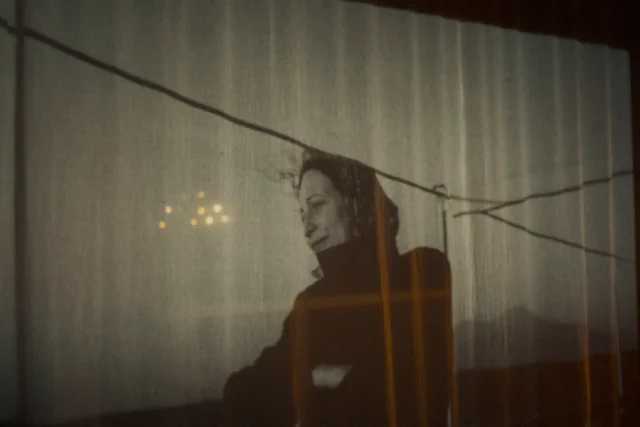
With precious little source material to work with – a mere 5 seconds of footage, a few photos and a handful of letters – how do you make a documentary about a woman who headed up one of Italy’s leading galleries, had a towering intellect and displayed uncommon wartime bravery, and whose influence over the culture and politics of post-WW2 Italy was substantial?
This was the question that filmmakers Francesco Clerici and Mattia Colombo grappled with as they embarked upon their Anatomy of a Portrait, the story of Fernanda Wittgens who, as director of Milan’s revered Brera Museum, oversaw its reconstruction after the city was razed by Allied bombs. Some years prior to this, she was imprisoned by the Italian authorities for helping Jewish families and persecuted individuals flee the Fascist regime.
But such was Wittgens’ desire (and ability) to escape the limelight, neither Clerici nor Colombo had ever heard of her, like most other Italians. They were alerted to the story by producer Marco Malfi Chindemi who heard a radio interview with Giovanna Ginex, the art historian, talking about Fernanda.
“He completely fell in love with the character of Fernanda, this powerful, incredible woman. It’s very weird, because nobody, also in Italy, knows anything about her. She’s not famous at all,” co-director Colombo tells BDE.
So the pair set about developing a feature doc, all the time trying to find the entry point, but it wasn’t until they met Ginex that they began to see how the film should be framed. “During our interview, we completely understood that she could be the key of this film, because she knows everything about Fernanda,” adds Clerici. “She studied her for 40 years – the letters, the documents, everything. She’s the only one. If we know of Fernanda now, it is all thanks to Giovanna.”
“We believe that the film was born at exactly that moment,” the pair add in their film notes of this auspicious meeting with Ginex. “From that day on, we began to realize that the film wasn’t just about Fernanda’s life story. It wasn’t just about her. It was about the deep bond that one woman had forged with another woman she had never met, and the way in which that bond, incredibly, managed to make her present.”
But how could that story ably manifest itself, especially within a film directed by two men who continually questioned whether they should be the ones telling it. It seemed obvious that the documentary needed another dimension.
“So we arrived at this idea of making a process together with Giovanna as the main guide of a young actress [Sara Drago], who would use her body, her face and her voice to help the evocation, not the reconstruction, but the evocation of Fernanda,” says Colombo.
The two male co-directors were determined to be guided through the process of telling the story, which was itself propelled forward by a female subject, two core on-screen female protagonists, and two female editors, whom Clerici describes as “two feminist activists from different generations.”
“We were not really deciding where it was going, but following and listening and trying to get the best out of it. We, as men, want to be involved in the feminist battle, and in the feminist search for a balance,” says Colombo.
“Day after day, the relationship between Sara and Giovanna grew before our eyes,” the filmmakers add. “Until we had the beautiful—and in some ways unexpected—feeling of having been almost left out of it. Sara and Giovanna had found a balance all their own. They no longer needed us to continue that dialogue. Perhaps they had never needed us at all.”
In the film, Drago reads the letters of Wittgens, many of them to Paola della Pergola, director of the Galeria Borghese in Rome, and somebody who understood what it was like to assume a leadership role within a world governed by men. Drago never got to see any of the letters or texts before the 5-day shoot, and so she experiences their force and authority just as we do, without preparation.
“I decided I would be courageous by performing acts of courage…and it took a great deal of courage,” Drago describes Wittgens’ harbouring of Jews during the war. “It would be too easy to be an intellectual in peaceful times, and then become a coward or simply remain neutral when danger comes,” she later reads. Wittgens talks of the challenges of running a vast and august institution such as the Brera. “A leader can only be alone,” Drago voices her words, and then we are told of what seems like a bitter-sweet secret romance. “An hour that had to be awaited in silence and renunciation…but it was a perfect hour…”
Historian Ginex, who also wrote a first-person novel about Wittgens, concedes in the film that her subject’s life contains gaps that “deserve to be respected.” While actress Drago doesn’t seem convinced by this assertion, directors Clerici and Colombo are very much in agreement. They are not making a biopic they underline. Rather, this film represents a “requiem for the biopic.”
“The biopic pretends there is no holes, no lacking part of the history of anything,” says Clerici. “They try to explain everything. Like [Picasso] had the blue period because he was sad, you know, something stupid like this. And in reality, there is a lot of lacking parts in the life of a person, any person.”
“This mechanism allows us to show how impossible it is and how important it is to respect the holes that are inside the life of someone where we don’t know what she thought, or we don’t know why she did something, or how she did something,” he adds of the film that relies upon such limited documentation to drive it forward. “Giovanna said very clearly that we need to respect the lacking parts. And I think that’s a very important sentence.”
Colombo adds that this is, in many ways, a guiding principle within the pair’s attitudes towards docmaking. “Yeah, it’s our approach. We are looking for a balance between knowledge, imagination, and an ethical approach. The absence was not something that worried us, something that we felt we had to cover. And we know how important it is to feel what is off-screen, not just what is inside the shot, but what is outside the shot…The main protagonist [Wittgens] is a constantly off-screen presence, but she is the one that is guiding all the process.”
In many ways the film is reminiscent of Bianca Stigter’s Three Minutes: A Lengthening, in which three minutes of pre-WW2 home footage, showing the Jewish inhabitants of a Polish town, are analysed, re-analysed and analysed again in order to piece together the lives of some of the townsfolk we see on camera. The filmmakers watched Stigter’s film on the advice of co-editor Ilaria Fraioli, who promoted it as a sublime example of what can be achieved with very little archive.
In 2023, Colombo co-directed, with Valentina Cicogna, the deeply moving Pure Unknown, which follows Cristina Cattaneo, a forensic pathologist who has dedicated her life to identifying the anonymous dead, whom she calls the Pure Unknowns, comprising homeless, sex workers, runaway teenagers and, latterly, refugees and migrants. The majority will have left behind families who are desperate to know the fate of their loved ones, make sense of their own sense of loss and to find closure.
The two works deal in traces of a life, and involve a search for something fundamental. “And both films are, of course, about women whose work is driven by profound public responsibility…They live all day thinking about their work and their ethical approach and their position in the world. They know that they are aware of their role in the system, in the world, and they try to make a difference.”
In their notes for Anatomy of a Portrait, the filmmakers further marshal their thoughts on what they have achieved. “We realize that the film contains much more than we initially imagined. There is Fernanda’s portrait, of course. But there is also Giovanna, and the imaginary—or rather, imagined—dialogue with her. And then there is Sara, who embraces that dialogue and lets it flow through her own body and voice. And, along with them, there is the desire—and perhaps even the impossibility—of truly portraying a person who is no longer with us.”





