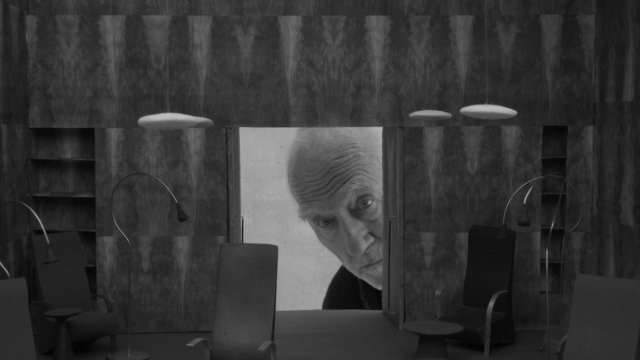
Wim Wenders has never spent so much time on a single movie. His new 3D feature documentary From Inside Out – The Architecture of Peter Zumthor (screening in Venice Open – Out of Competition and sold by London-based Hanway) has taken a full 14 years to complete.
“It is by far the longest and I don’t intend to repeat that,” the 81-year-old German filmmaking legend behind Wings of Desire and Paris, Texas declares. “I knew it was going to be long, but I had no idea it was going to be that long. I think I planned on five or six years. Fourteen was unexpected.”
There are obvious reasons for the extended timeframe, including the nature of the subject matter. Architecture is a slow business. Wenders had already gone “far into the film” when Swiss architect Zumthor began work on the Los Angeles County Museum of Art (LACMA), one of his flagship commissions.
“Then I said to Peter ‘this is going to be your biggest building. If we finish the film before [you do it], I am going to look really stupid, and so we put in a longer break and then we cooperated with the LACMA from beginning to end.”
Wenders has finished four other movies since he started work on From Inside Out – and one of them, the award-winning Tokyo-set Perfect Days (2023) was shot in around two weeks.
He constructed his Zumthor documentary in “10 or 11 shooting blocks,” editing in-between. “The film slowly came together,” he sighs. “It was a long learning process.”
As a kid growing up in the ruins of post-war Germany, Wenders became obsessed by architecture and considered it as a potential profession. He was hugely excited to hear about Oscar Niemeyer’s futuristic designs for Brasilia and, as a youngster, collected pictures of them. “My boyhood room was an Oscar Niemeyer temple. I knew everything about the project. I followed it. I was an ardent admirer.”
His father was a doctor and Wenders himself studied medicine before switching to philosophy, dropping out, heading to Paris to become an artist, and eventually switching to film. Architecture for him is still “the road not taken.” By telling Zumthor’s story, he has been able to explore what an architect’s life and career might have looked like.
Many architects will design a building and then walk away from it. Zumthor isn’t one of them. He wants to be involved in the construction and the afterlife.
Zumthor, Wenders explains, regards the building process as an opportunity to refine the design. “He only leaves when it is complete. He is onto every detail, not only to have it as good as possible, but also to see if it opens paths to improvement.”
The parallels with filmmaking are obvious. Wenders works in a similar way to Zumthor. “I don’t think the movie is remotely there when you have a script. Actually, I don’t think it is there at all. It is only in the shooting process that the film takes shape.”
Wenders adds that his films tend to begin “with a place and then look for a story. The story and place belong together in a way that the story could not happen anywhere else. That is my desire and aim – and that is exactly Peter’s ambition, that the house that he builds belongs to the place as if it has always been there.”
A house, the director believes, “is a story.” In a film, each shot can be regarded as “a brick in time” out of which scenes and then entire movies are built.
There have been examples in his own work, for example his 2017 romantic thriller, Submergence, in which he has started the storytelling in one style but then has then “deconstructed” and rethought the script mid-stream.
“There are prefabricated houses and there are prefabricated movies,” he says of the surprising amount of work in both fields done by rote – something neither he nor Zumthor would ever consider. He agrees that both he and the architect are “stubborn” when it comes to their work.
Zumthor will quit a job if clients don’t allow him to implement changes he thinks are necessary. “That happened a couple of times.”
He is not a ‘star architect” but rather “a hard-working man with a small office who oversees everything. He is perfectionist. If everything is not done well, he gets angry…really angry!”
For his own part, Wenders realised that the only films he can do are those “driven by curiosity and where I am not following a plan.”
Wenders didn’t want just to impose his own vision of Zumthor on audiences. That is why the film has a number of ‘protagonists’ looking at, living in and experiencing Zumthor’s buildings, among them both residents and such-well known visitors as novelist Siri Hustvedt and filmmakers Werner Herzog and Ava DuVernay.
“In the end, I thought it would be best not to use the camera abstractly but always to link it to somebody’s view. I doubted the approach a couple of times but overall, when I edited it, I thought it was right, to give it a human connection.”
Midway through the interview, Wenders admits that he is relieved to be talking about architecture, aesthetics and filmmaking. Earlier this year, he was in the eye of the storm while serving as president of the jury at the Berlin festival. He suggested filmmakers should “stay out of politics” and his remarks provoked a furious backlash.
Since then, Wenders has been asked about politics all the time.
“There is nothing that escapes politics these days, but it is great to be talking about the film for once,” the German acknowledges. He adds that he doesn’t want to “go back over territory that has already experienced an overdose” and prefers to “bypass” any further discussion of that controversy. Instead, he continues to rhapsodise about the aesthetic possibilities of 3D. He says he first used the format out of “necessity” when making his Pina Bausch dance documentary (Pina, 2011).
“I discovered 3D when it was almost impossible and most people asked me if I was out of my mind.”
Fortunately, after the release of James Cameron’s Avatar, attitudes quickly changed and cinemas became equipped to show films in 3D. From Inside Out is his tenth 3D film (including shorts as well as features).
“I don’t look at it as a technical challenge. I look at it as a story challenge. I know what it can do and I am quite comfortable with it,” he says of 3D. “I must say that apart from dance, there has been nothing I have shot where it has been more necessary because architects create structures and space is their medium.”
Wenders is also a pragmatist and took “great care” in making a 2D cut of his film. He accepts that more viewers will watch this version than will see the Zumthor doc in cinemas.
Does he have a favourite Zumthor building? Wenders nominates the Kolumba Museum in Cologne which he visits often. “It’s a strange place because you might go in and have the blues and not be in good spirits but you always come out and you are healed…”