When he was three or four years old, growing up in the Soviet Union in the early 1960s, Victor Kossakovsky was shown a leaf by his mother. She explained how trees are complex and sensitive organisms.
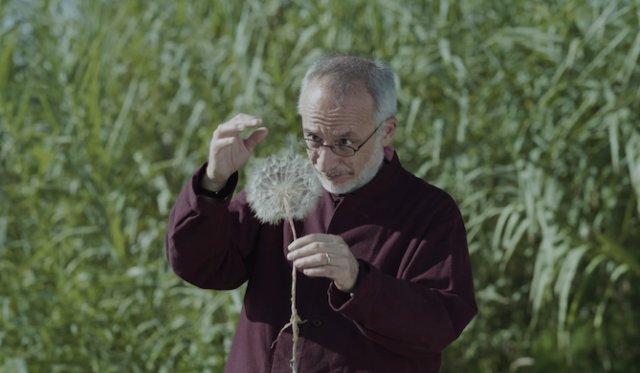
In his new feature documentary Holy Wood Dust, made in Italy and sold by Rai Cinema International Distribution, Kossakovsky is trying to capture that sense of wonder he felt about the forests all those years ago. Together with botanist Stefano Mancuso, he ventures deep into the Dolomites where violent storms and tiny insects have ravaged the beautiful fir trees. The film had its world premiere this week in Venice Open – Out of Competition.
“It is my first memory of myself,” Kossakovsky says of this early nature lesson. A few months later, he was to leave St Petersburg. His father was in hospital after a car crash. His mother couldn’t look after him.
Both his parents had endured tough times. “My mum wasn’t an artist. She was born in 1928. That means when she was 11, the war started. She didn’t even finish her education and she started to work in a factory making uniforms for soldiers.”
Kossakovsky’s father was born in 1932. When the war started, he was only nine and he too missed out on a full education. Both of his grandfathers had been in the Gulag. It wasn’t a typical background for a future artist and filmmaker but the director’s mother was brilliant at languages, inventive and very funny – and she implanted her son with a love of nature.
Little Victor was also given his first camera as a six-year-old. The relatives all chipped in to buy it for him. “It was a proper camera, with one lens only.” He began by taking pictures of flowers, butterflies and frogs. Once, he went into the freezing water to film baby beavers and ended up catching pneumonia.
As a teenager, he had a close friend, Sergei Ivanov, also a photographer, with whom he would make bike trips outside the city to explore the natural world. Ivanov decided to become a forester while Kossakovsky pursued a career in film.
All these experiences from long ago have influenced Holy Wood Dust. “This interest in the trees, the forest and everything around was, for me, essential.”
Kossakovsky left Russia in 2008 but returned shortly afterwards when he flew to Siberia during research for his 2011 feature, Vivan Las Antipodas. He was travelling across the frozen wilderness in a helicopter that developed technical problems and had to make an emergency descent.
“Suddenly the pilot said we have to land. He found a little piece of land where he could stop and then spent maybe two hours trying to fix something.”
The director used the time the helicopter was being repaired to look around. He realised that he was over 350km from any human civilisation. “That means in the place we were, no-one had ever been there.”
That gave Kossakovsky the idea of approaching IMAX and proposing a special project. “If I was to put a camera there four times a year, in the middle of this Siberian forest which no-one had seen before, and I went there winter, spring, summer, autumn, with a huge IMAX camera, I would have a film that no-one has ever seen,” he suggests. “If you live in Tokyo, or New York, and you see a poster that says Forest, IMAX, Atmos, and the size of the trees on screen are almost the size of the actual trees, that would be a real good film.”
The Siberian IMAX project never happened but Holy Wood Dust picks up on several of the same ideas.
In the new documentary, we discover the danger of having “a monoculture” of just firs, although these are magnificent trees whose ‘Stradivari’ wood is used for violins and furniture. In a memorable sequence, we see a massive fir being transported all the way to Rome in time for Christmas.
Kossakovsky describes Holy Wood Dust as a “family” film. As he has shown in earlier works from Gunda to Trillion, he has very strong opinions about meat production, deforestation and the evils of factory farming. However, in this documentary, he wanted to reach viewers who don’t necessarily share his ideas.
“If I was to be direct and say, ‘you’re fucking bastards, you are fucking killers,’ no-one would listen to me. I want people who have different opinions to me still to watch the film.”
The insects that devour the firs are themselves beautiful. The director points out that they’re not responsible for the trees falling. Nor are the devastating storms. Inevitably, it’s the humans who are at fault.
“The reason that Storm Vaia killed 15 million trees [in October 2018] is simple. It was not a real forest. It was a plantation,” Kossakovsky frowns. There were too many of the same kind of shallow-rooted trees being grown for commercial purposes. The forest therefore had no resistance to the savage winds.
The director is usually coy about his future projects but says he will be working again with producer Joslyn Barnes of Louverture Films and with Anita Rehoff Larsen of Norwegian outfit Sant & Usant on the final part of his “empathy trilogy” that also includes Gunda and Trillion. Movie star Joaquin Phoenix is also expected to executive produce.
“It’s going to happen with the same people,” he says, but won’t give away any further details other than that the new project might have an urban dimension, and that it won’t have any words.
Kossakovsky continues to fight for his work to be seen in cinemas. He hopes that an accessible family documentary like Holy Wood Dust, if popular, will help give the more abstract and challenging Trillion (which premiered at IDFA last year) a second life on the big screen.