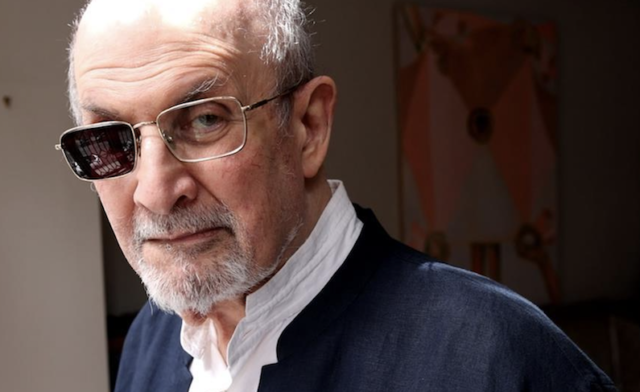
It’s just over four years since novelist Salman Rushdie was rushed at on stage at the Chautauqua Institution in New York in August 2022. His assailant was a knife-wielding zealot called Hadi Matar. The 24-year-old was responding very belatedly to the 1989 Fatwa against him issued by Ayatollah Khomeini, Supreme Leader of Iran, after the publication of Rushdie’s novel, The Satanic Verses. Matar stabbed the novelist multiple times including in the eye (“the cruellest blow” as Rushdie later called it) and very nearly killed him.
Prolific US director Alex Gibney has now made a documentary about the incident. The film, sold by UTA Independent Film Group and Anonymous Content, premiered in Sundance. Abramorama are releasing it in North America on September 17 and Altitude will release in the UK on September 30.
Early on, Knife includes an astonishingly perceptive archive interview given by the late Palestinian academic and author, Edward Said, who predicted many years ago just how and why an attack like this on Rushdie might occur.
Gibney is executive producer on Maiken Baird’s Edward Said: Beyond Words (2026), a world premiere at the Toronto International Film Festival. The filmmakers behind that documentary had collected a massive database of Said’s media appearances. Gibney asked if Said had ever commented on Rushdie – and that was how the clip used in Knife was discovered.
“We were absolutely gobsmacked at the fact that Said had been so precisely prophetic. It was in a pile of Edward Said quotes about Salman Rushdie but when we saw that one, it was like ‘oh my god!’ He just nailed it.”
Gibney is a fan of Rushdie’s writing. He had read books like Midnight’s Children (Rushdie’s Booker prize winner), and The Satanic Verses as well as his essays and short stories. “My perception of him was as a great novelist and also as a great avatar of free speech. Both those things were in my head.”
Even so, this was a project which came to Gibney, not one he chased. Rushdie’s wife, Rachel Eliza Griffiths, had been filming the novelist’s recovery and rehabilitation. She and Rushdie were looking for someone to make a movie about the stabbing and its aftermath.
Gibney had already met Rushdie briefly through a shared friend, the author and polemicist, Christopher Hitchens (who died in 2011).“I had done a film for the Hitchens memorial,” the director remembers. When he first spoke to Griffiths and the novelist about a potential film, his main question was why they didn’t make it themselves. After all, “the hospital footage and all the recovery footage was shot by Eliza.” He then pitched them an idea. He was a big fan of the BBC drama series The Singing Detective, scripted by Dennis Potter and about a hospital patient recovering from a horrific case of psoriasis. Along the way, the patient (played by Michael Gambon) hallucinates, recalls moments from his childhood and wrestles with thoughts about his own mortality.
Gibney wanted Knife to be a documentary equivalent to that series, full of its own playful digressions. (It includes clips of multiple films, everything from The Seventh Seal to West Side Story to Roman Polanski’s Polish-language Knife In The Water).
“That seemed an interesting way to reckon with this material. There is a simple story which is that Salman is nearly killed and he physically recovers. But along the way, he has to psychically recover. Through a kind of free association, you jump back to moments in his life that were important.”
At the time Gibney was making the movie, Rushdie was working on his own memoir about the stabbing, Knife: Meditations After An Attempted Murder, published in 2024.
The film “ended up leaning in” on what Rushdie had written in the memoir. Gibney realised that both projects were part of the author’s attempts at “getting back to where he was pre-attack by going through it. By doing that, exploring it and seeing what it meant, he could get to the other side.”
The director was in awe at Rushdie’s stoicism both in the face of the Fatwa and in how he dealt with his injuries.
“He comes out of all of this learning all sorts of life lessons and not being mired in bitterness, resentment and hate,” Gibney observes. “He was certainly haunted and debilitated mentally by the attack, and he had to get that strength back. The only way he knew to do it was to push through.”
Gibney also pays tribute to Rushdie’s wife, Griffiths, a poet, photographer and artist. “Her footage is extraordinary. She has a great eye and a great sense, like the best cinema verité photographers, of when to intrude and when not to. Of course, she is married to Salman and so he shares access to a certain intimacy that other people wouldn’t, but it takes a certain amount of courage to move in closely on a Frankenstein-like wound in the neck and to find ways of shooting him in those moments of vulnerability. I felt she did a magnificent job.”
Rushdie never refers to his attacker by name, instead calling him the “A.” Gibney did try to interview Hadi Matar, now 28, but the would-be assassin didn’t want to talk.
“As Salman points out, he wasn’t even born when The Satanic Verses was published,” Gibney says of Matar. He speculates that Rushdie’s assailant was “seduced by an ideology that gives you a sense of purpose” and that coming after the author (whose work he had barely read and about whom he knew very little) made him feel important. He may also have felt he was protecting his religion.
“It starts from a pure-hearted place and goes to a place of terror. You see that over and over again particularly with these lonely converts who somehow become invested in a religion and then become zealots. Once they become zealots, the end always justifies the means.”
The film culminates in shocking fashion with the venue’s footage of the actual attack.
Why was it important to include such grisly material? “Well, that is part of what happened,” the director says. He had to fight hard to get the footage which had been “seconded” by the court and which the Chautauqua Institution wasn’t initially keen to share.
“I had no idea I was going to get four angles. I put it where I put it because that was the moment Salman himself was going back to visit the scene of the crime.”
The footage reveals that Hadi Matar walked calmly down to the edge of the stage before breaking into a run.
Gibney believes it was cathartic for Rushdie to “push through” these events again and that audiences who’ve sat through the film will also be ready to watch the attack. “Emotionally, it was important to put it at the end,” the director continues. “Now, we are prepared for it. We are able to reckon with it in a way that we wouldn’t have been at the beginning of the film.”
In the wake of the attack, Rushdie received exemplary healthcare. “Salman remarks about that too. If you have good insurance and resources, the healthcare you can get in the United States is jaw-droppingly good. The healthcare is great – and it also reveals the extraordinary resilience of the human body. It was really inspiring to see the doctors, the decisions they had to make about his eye and the way they stitched and stapled him together. Also, the woman who was pushing him on rehab…all of that!”
Knife cuts through on many different levels: as a true crime documentary, as a story about love, injury and recovery, as a biographical study of a leading novelist, and as a film about free speech and how hard it can be to safeguard.
“I hope young kids come to see it. We live in a moment where irresponsible political characters are saying and doing things that are leading to a level of either state-sponsored or state-encouraged violence…to that extent, it is a poignant film.”
Gibney has made films about many formidable characters, everybody from cyclist Lance Armstrong to tennis player Boris Becker, from exiled Russian business tycoon Mikhail Khodorkovsky to Elon Musk (the subject of his latest documentary).
“Very often I am in the position where I am charmed by somebody but then have to check myself afterwards because my job is not to be hoodwinked. My job is to serve the audience. At the same time, I can’t help but feel what I feel,” the director reflects.
Rushdie, though, was one of his easier subjects to admire. “He likes the limelight and he likes to be in and around people. He is not one of those reclusive novelists, holed up in some garret. He likes to get out and experience life. He is an extraordinarily strong and resilient person – and very funny I might add.”