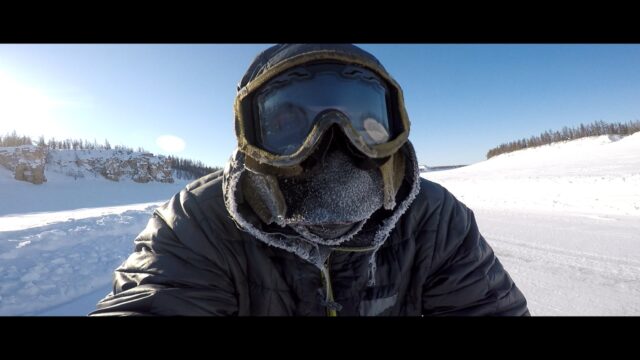
From cycling across Africa to negotiating Siberian rivers in temperatures as low as -60°C, Italian explorer Lorenzo Barone has spent much of his adult life seeking out places where survival depends on his own decisions. But the people waiting for him at home are just as central to Extreme Land Solo, a completed 54-minute documentary by Filippo Lupini that will be presented in the Italians Doc It Better showcase at Rome’s MIA, running October 19–23, 2026.
The Italy–UK co-production, made by JOK Produzioni and SyZyGy Creatives, is being sold internationally by Rai Com.
The picture traces Barone’s expeditions across some of the world’s most unforgiving terrain while exploring the uncertainty and emotional strain that accompany his repeated departures. Since setting off on solo bicycle journeys at the age of 18, he has covered more than 100,000 kilometres across over 40 countries, according to the producers. His achievements include a 12,000-kilometre bicycle crossing of Africa from south to north, winter journeys along the frozen rivers of Yakutia, in eastern Siberia, and a more recent solo Atlantic crossing by rowing boat.
Yet Lupini’s principal interest lies beyond the geography, or the record of physical endurance. The documentary places Barone’s relationship with his wife, Aigul, at the centre of the story, alongside the perspective of his mother, Donatella Cara. Their accounts bring the experience of absence into a narrative otherwise dominated by spectacular landscapes and individual achievement. The result, the filmmakers suggest, is intended to question what drives someone towards repeated encounters with danger, and what it takes to return to ordinary life afterwards.
The film’s approach grew out of a substantial collection of footage recorded by Barone himself during years of travelling alone. With no accompanying crew on those expeditions, the explorer became his own cameraman, documenting both the surrounding environment and his responses to isolation. Lupini and co-writer Matteo Ceccarelli had to turn images made in changing conditions, on different equipment and without a conventional shooting plan into a coherent cinematic narrative.
Rather than recreate the journeys with a larger production unit, the team built a second strand around Barone’s everyday life in the countryside with Aigul and the physical preparation required for his expeditions. This includes training with kayak instructor Federico Paperini. Interviews with Cara and with writer and mountaineer Erri De Luca provide further perspectives, allowing the documentary to move between Barone’s first-person record of extreme conditions and the relationships that give those journeys a wider emotional context.
Lupini describes the project as an attempt to reconcile two seemingly opposing experiences: the intensity of the solitary expedition and the quiet routines of home. For the visual treatment, the team cites the natural light and domestic intimacy of Nomadland alongside the suspense associated with adventure documentaries Free Solo and 14 Peaks. The comparison is less about reproducing their scale than about finding a rhythm in which moments of exposure, fear and exhaustion carry weight alongside scenes of affection and everyday life.
“Lorenzo is pure inspiration. Beyond the athletic achievement, his story is a vital message for younger generations: it reminds us that you don’t need superpowers to make your dreams come true – you just need the courage to take the first step and truly chase them,” states Lupini, who has previously directed documentaries and short films and received a Best Director award at Warsaw’s Grand OFF – World Independent Short Film Awards.
The creative challenge, according to the production notes, was chiefly one of structure and tone. Years of self-shot material offered remarkable proximity to Barone’s experiences, but also required careful selection to avoid building the film as a succession of feats.
By juxtaposing the expeditions with intimate footage of the people closest to him, the filmmakers aim to present adventure not as an escape from human connections but as an experience shaped by them. The documentary is co-written by Lupini and Ceccarelli and produced by Daniele Foconi, Andrea Pennesi, Ceccarelli, Lupini and Mattia Ippoliti.
The film also lists Schwalbe and Energy Solutions among its sponsors. It has received support from a range of Italian cycling, canoeing, rafting, hiking and outdoor organisations, including FIAB, the Italian Cycling Federation and the Italian Alpine Club’s Terni section. The budget has not been disclosed, and no broadcaster has yet been attached.
Its MIA submission/selection therefore marks a move from production towards audience-building and release. Alongside international distributor Rai Com, the team is seeking broadcasters and streaming platforms in Italy and overseas, hoping to capitalise on Barone’s substantial online following without limiting the film to an existing adventure-sports audience. Festival, television and digital release plans remain open and will be shaped by the conversations held at the Italian market.