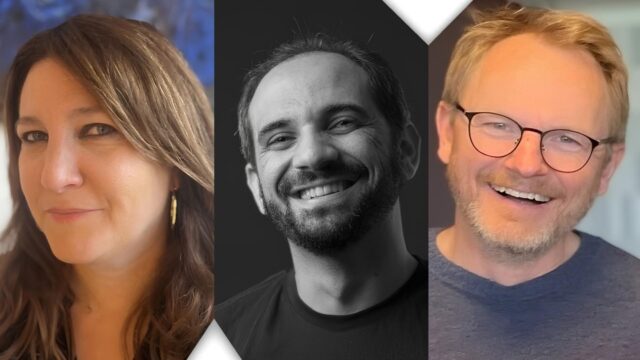
With changing viewing habits reshaping documentary commissioning, representatives of BBC Storyville, Sweden’s SVT and Al Jazeera Documentary told producers at MIA 2026 that opportunities remain, but financing, rights and the way films reach audiences increasingly demand a different approach. The discussion took place at the Rome market on Oct. 21 during the panel titled “International Broadcasters: Beyond the Co-Production Deal,” introduced by Doc Co-Production Market head Ben Pace and moderated by Canadian producer and broadcaster Rudy Buttignol, president of NXT.
Buttignol distilled the concern shared by many producers in the room into a single question: “Do you have money for my project?” The answers revealed an industry not simply short of resources, but struggling to adapt to how those resources are deployed.
Perhaps the most unexpected admission came from Muhammad Refaat, film commissioner at Al Jazeera Documentary. The Doha-based broadcaster, he said, still had around half its annual budget unspent because the projects being submitted were conceived primarily for traditional television, rather than the digital environment in which they must now compete.
Al Jazeera Documentary has distributed its films freely on YouTube alongside television broadcast since its launch in 2006. Yet Refaat questioned whether treating the video platform as an archive still makes sense. Films considered to be editorially exceptional can attract little attention, while ostensibly less promising subjects generate millions of views. The channel has temporarily suspended a submissions call, for the first time, while reconsidering its strategy. “We have the same kind of confusion and hesitation in the market,” he acknowledged.
That uncertainty is not confined to newer digital adopters. Veteran Mikael Österby, head of factual acquisition at SVT, said the Swedish public broadcaster has moved away from defining audiences through demographic groups and is instead commissioning around viewing needs. “We work with needs, not with target groups,” he explained. While understanding the world remains a public-service priority, viewers also seek inspiration and escapism – needs he suggested factual programming has not always addressed effectively.
Österby insisted that the battle for attention begins before an audience presses play. He looks first at a pitch’s title and key art, expects a convincing account of its opening and ending, and may ask for a one- or two-page breakdown into three or five acts. “If you can’t tell me the story in ten seconds, you don’t know your story,” he warned. Filmmakers also need to demonstrate why a project matters to Swedish audiences, and approach the appropriate SVT commissioner rather than assuming every buyer covers every genre.
For Nevine Mabro, who joined BBC Storyville in January after working at Channel 4, the challenge remains to preserve a distinctive space for ambitious, independently-produced cinema documentaries while competing for audiences accustomed to digital choice. “We can’t take the audience for granted anymore,” she noted, adding that a film’s opening is increasingly vital to keeping viewers engaged.
Mabro maintained that public service broadcasters and independent backers can support political and social stories that commercial streamers often overlook. Storyville is also changing how it allocates its own funding. Rather than spreading smaller contributions across more than 20 films annually, she has begun committing larger amounts to individual projects, with a modest reduction in the overall number supported. The strand can board projects early, provide finishing finance or acquire completed films, and welcomes trailers, decks and rough cuts.
It is also expanding into shorter work. The new Storyville Shorts strand will launch with two 40-minute documentaries, including Allies in Exile, about two Syrian filmmakers navigating the UK asylum system. Mabro argued that shorts offer a home to accomplished filmmakers whose work can struggle to secure traditional television support. “They don’t care if they’re 70 minutes or 20 minutes,” she said of audiences. “They just want to see good films.”
But shortening a film is not necessarily enough to find viewers online. Mabro recalled how, at Channel 4, promotional teams increasingly developed platform-specific assets with producers from the outset, rather than simply cutting a two-minute trailer from a finished documentary. SVT, meanwhile, is exploring companion microseries comprising ten or 15 episodes of approximately 60 seconds each, although Österby said its present platform infrastructure is not yet ready to distribute them as intended.
Audience outcomes remain unpredictable. Refaat cited a documentary about Arab intellectual Michel Aflaq which unexpectedly drew millions of YouTube views, in contrast to a film about Palestinian football history whose strong archive and topical relevance failed to translate into comparable results. Mabro held up Oscar-winning Mr Nobody Against Putin as an example of a personal story illuminating wider political realities. From the floor, Dutch commissioner Barbara Truyen said exchanges among European Broadcasting Union documentary specialists suggested that recognisable personalities and major current affairs stories were outperforming smaller social documentaries in several markets.
Questions about rights produced some of the session’s most concrete advice. Österby said SVT generally seeks rights for Sweden, while Mabro explained that Storyville typically takes UK rights with at least one year of exclusivity. Al Jazeera Documentary, Refaat revealed, normally licenses exclusive Arabic-language rights in the Middle East and North Africa, although increasing demand for digital rights is complicating long-established arrangements.
Refaat also outlined how producers might secure separate agreements with different parts of the Al Jazeera network. As an illustrative scenario, he suggested a documentary might earn $20,000–$25,000 from Al Jazeera Documentary, $45,000–$60,000 from Al Jazeera English and another $30,000–$40,000 through a digital deal, potentially generating around $100,000–$120,000 while leaving other language and territorial rights available. These were examples of possible deal structures, not standard fees or guaranteed offers.
On international co-productions, Mabro pointed to growing collaboration between public broadcasters and private foundations, particularly in the US, to help finance socially and politically-engaged films. She described commissioners sharing promising projects with colleagues in other territories to help assemble difficult financing plans. Österby warned, however, that broadcasters’ demands for local relevance can make international partnerships harder: the strongest co-production prospects often pair a specific personal story with themes that travel across borders.
Refaat touched on additional financing opportunities in the Middle East and North Africa, including regional funds, while acknowledging that the sector is more competitive and that even commissioners are still searching for workable answers. His closing assessment offered a qualified note of optimism: “The money is there but you just have to understand the new environment – and we ourselves have to understand it as well.”