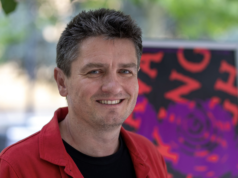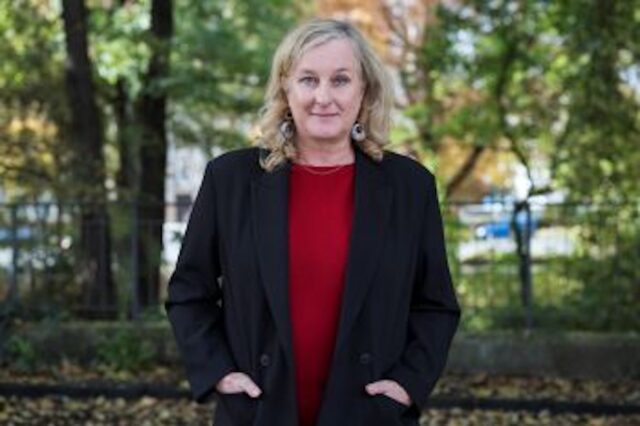
DOK Leipzig’s incoming festival director (she has been prepping for her inaugural festival in charge for some nine months) knows she has big boots to fill, following the departure of Christoph Terhechte whose last edition in charge was in 2025.
“I have huge respect for the festival and for Christoph, also for Lena Pasanen, Claas Danielsen and the other directors from the past.” Staszel tells Business Doc Europe. “It’s the oldest documentary film festival in the world, established in 1955. So of course, it has a huge tradition – but a very complicated one,” she adds.
In short, before the Wall came down in 1989, the festival programme was subject to systematic GDR control, whereby rigid ideological requirements had to be met. Yet, as the festival itself stresses in the history it publishes online, “at the same time, creative freedom and spaces for international debate on the aesthetics and social role of documentary film continually emerged. The festival gained global recognition for its commitment to films from developing countries and for providing them with an important platform.”
The festival suffered a slump following the tumultuous events of the early 1990s, but took on a more recognisable shape after 1995, boosted by the introduction of an animation competition, and its international reputation was further consolidated following the inaugural DOK Industry in 2005.
But right now, with Germany facing political turmoil with the rise of the AfD, and prominent voices (such as Magnus Brechtken, deputy director of the Institut für Zeitgeschichte in Munich) suggesting that west Germans have “had enough,” based on an assumption
that east Germans voted for right wing-parties out of spite towards the west, DOK Leipzig has taken on an even greater poignancy. Before 1989, Leipzig may have been one of the furthermost outposts of the Soviet bloc, but since reunification it is solidly in the heart of Germany. If there is a question of identity to be addressed, or clarified, Staszel is determined to do so, and emphasises therefore the “importance of us [the festival] being here and giving the voices to the people from both East and West, not just European-wise, but within the country.”
This is reflected in the new section titled Fokus Ost (Eastern Focus) section, designed to bolster eastern German perspectives in documentary filmmaking. Eight of the ten selected documentaries will have their world premieres at the 69th edition of the festival, including this year’s opening film, Ina Borrmann’s Good Evening, Beautiful.
Born in Poland, but a resident of Berlin for many years, Staszel was former director of the German-Polish-Czech Neisse Film Festival, where she was responsible for documentaries, feature films and management. She studied film and literature as well as European studies at the Universities of Wrocław and Aachen, and previously founded and directed The Rolling Movies, a festival of mobile cinema.
“I grew up with Polish documentaries,” she tells Business Doc Europe of her deep appreciation of the form. “As a very young person, I was really touched and moved by Kieślowski and by Łoziński, you know. So, in my early age, I realised what it means to create films about people telling universal stories. That’s why I think it’s crucial to show, to create, to discuss documentaries, because they’re really life-changing. You see small slides or pieces of reality and you realise, okay, life’s so big.”
“It [documentary] is never about answering easy questions,” she adds. “It’s about giving you space to create your own thoughts or create new links to reality, but also to ask ‘what does it mean?’”
Staszel tells BDE that she is particularly impressed this year by the quality of films this year in German Competition. “I was very pleased to see they are taking care about German realities, because in the past few years, I had the feeling the filmmakers go everywhere, but not look at what’s going on here in the country.”
She references films such as My Brilliant Father by Tete Hoffmann, in which the director follows her writer-father who is suffering from dementia and therefore losing access to his precious words; Last Round by Janis Westphal, in which a Berlin housing project for homeless men follows a different approach, that of acceptance, support, dignity instead of forced abstinence; and Child’s Mother by Konrad Schlaich, which follows Anne, who lives a life of chaos, and her daughter Leonie (14) who is also at risk of sliding into drug addiction.
Staszel is also delighted by the selection of a German film in International Competition, 1,5°C Pyropolitics and the New World by Lukas Marxt, described as a wordless observation of wildfires and firefighters in L.A. 2025 that nevertheless speaks volumes.
Away from the German output in evidence, Staszel expresses her satisfaction at Letters of a Silenced Country (Poland) by Andrei Kutsila and The Nights by Anna Bovin (Argentina), both of which are also in International Competition. “Andrei is a very blessed filmmaker, based in Poland for many years. He lives in exile,” she says of the Belarusian filmmaker whose film tells of the sacrifice, solidarity and human cost of resistance, as evidenced by the letters sent from Belarusian prisons. The Nights introduces us to the irrepressible Buenos Aires-based La Pichi tells stories of relationships, family, body issues and class. “This is wow, this is power,” exclaims Staszel.
October is a mad time for docfests, with DOK Leipzig and Czech-based Ji.hlava IDFF, two core European docfests and markets, running concurrently. That said, even with many films from CEE in her programme, Staszel doesn’t feel that the two festivals are in competition.
“We are in very close contact with Ji.hlava guys, and I used to visit both festivals in the past, so I know how it feels,” she says. When Staszel checked the Ji.hlava programme, she saw little by way of cross-over of titles, which pleased her. “That means there are so many excellent films out there, which is, you know, a good very thing for all of us,” she signs off on the profusion of excellent docs on offer over the Autumn season. “I think it’s a great time to watch documentaries.”