Young German filmmaker Konrad Schlaich, whose debut feature The Child’s Mother screens in German Competition Documentary Film (Fokus Ost), has a friend who lives in the town of Halle and had been struggling with meth addiction. It was when he visited this friend that he first met Anne, who was to become the subject of his film.
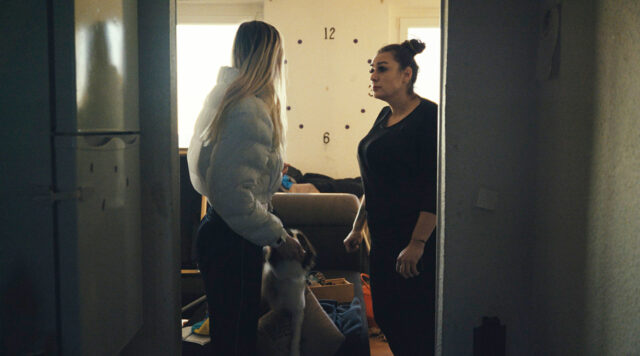
To say that Anne has a tough life would be to understate it. She is an impoverished single mother in her mid 30s who has a history of addiction and whose teenage daughter, Leonie, 14, is already in trouble, missing school and slipping into drug dependency too. Anne’s other two younger children have already been taken into custody by the authorities.
“At first, I was judging Anne as a very bad mother, but then I ended up talking to her and I was very surprised how much she shared about her past,” the director remembers. “I wanted to know more and I felt very intrigued about making a portrait of her.”
Anne herself was keen for Schlaich’s documentary to provide an honest account of her situation as a mother. She felt she was being unfairly stigmatised and that the odds were stacked against her. “She never felt that anybody listened to her from outside of her bubble.” And so the collaboration began.
The director (who studied at Film University Babelsberg KONRAD WOLF and whose previous credits include 2025 short Pockets of Happiness) was very curious about his subject. When he compared his own relatively privileged childhood to that of Leonie, he realised ‘they couldn’t have been more different.” His initial goal in making the film was to “dig deeper into child poverty in Germany, something which in my opinion is rarely talked about.”
Schlaich shot the film over a period of around two and a half years – and this was a time of considerable upheaval for mother and daughter. “The film became almost like a diary for both of them, looking back at a very troubled period of their life. I am glad I was able to give that to them!”
Although the film is dark and disturbing at times, that is only one part of the picture. Anne is a likeable and often humorous and resilient figure.
“There was no way for me to know when they would end up when I started the project. I hoped the best for them but I wasn’t any influence. Me and Anna, we became friends in a way, but it was also important for me not to be too involved emotionally. I felt that she wanted me to be an outsider, listening.”
Occasional light relief comes courtesy of the family dog. He seems happy enough, even when the humans’ lives are in turmoil.
Anne’s formidable grandmother features in the film (“she’s an amazing person’). One paradox quickly becomes apparent. Although the social services may regard Anne as an unfit mother, she and her family maintain very close ties, and are as supportive of each other as they can be.
Schlaich was working with cinematographer Pablo Sahin. “I recorded the sound. Pablo was with me all the time and his communication skills were very important. We were talking to Anne as friends when the camera was off, but we managed to be quiet when we were filming.”
During shooting, they would spend up to 10 hours every day in Anne’s apartment. After a while, she seemed hardly even to notice that the camera was there.
It was easy enough to win her trust but some of her friends were intensely suspicious about this camera crew that had suddenly turned up in their midst. Several had had bad experiences with the media before, when TV crews had turned up for a short period and had broadcast superficial and exploitative reports about their lives of drug-filled poverty.
“They asked us many times if we were part of this television station RTL,” Schlaich remembers the hostile questions the crew often received.
One storytelling device that the director uses is periodically to show the soulless and bureaucratic texts written about Anne and her family by the authorities.
“Anne was sharing her thoughts a lot with me about how she was being treated by the authorities. What struck me was the way the German language becomes a very big barrier for non-academic people. It can be very dehumanising. It was a way to include the outsider’s view on Anne’s family. It’s only a very specific view…but it reminded me of how I was looking at this whole topic before I started the film. I didn’t know the emotional world of a ‘failed’ mother. I only knew the outsider’s perspective.”
The milieu that the documentary portrays is one largely without positive male role models. Leonie’s father has been “imprisoned almost all of her life.” He was recently released from prison but he has a very long criminal record and was never supportive to Anne.
“The absence of men in care work and the upbringing of children really struck me,” the director acknowledges. “When I heard Anne’s story, I was just really disappointed in all the men…”
Anne’s current partner does appear briefly on camera. She met him in prison. He is now “clean,” is rebuilding his life and is supportive of her.
Halle seems a difficult town for addicts. At times, you get the sense that if Anne was able to move elsewhere, her situation might improve. “Of course, Halle used to be, and still is, a magnet for people affected by unemployment and structural problems in the region,” the director says, but adds: “in my view, the film is about their very personal surrounding in Halle, not the city in general.”
Child poverty and addictions aren’t obvious box office topics. This explains why the documentary wasn’t easy to finance. “Only very late in the post-production did we get funds,” the director remembers. Financiers were wary partly because they “weren’t sure where this movie would go.” Schlaich was determined to protect his subjects and made it clear that he wouldn’t want the film in circulation if “things had got worse for Leonie, for example.” He wasn’t prepared to distribute it without her approval. Anne will be at the DOK Leipzig premiere and will take part in a Q&A.
The film was produced by Friedemann Hottenbacher and Gregor Streiber (inselfilm production). It eventually received support from NDR. The aim is to have a small theatrical release in Germany. After Leipzig, the filmmakers will also be looking to secure an international premiere.
Schlaich has two new projects on the boil. He is currently shooting Frischlinge, a fictional short about the experiences of young men in the Bundeswehr (the German army) and how the military is using gaming and VR in its training. He is also preparing a new feature documentary, War Games, which will explore some of the same themes.