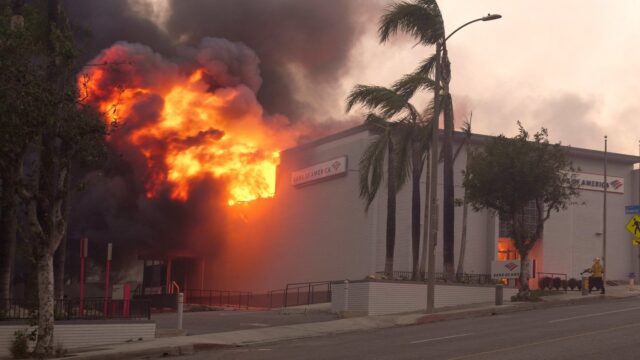
Lukas Marxt had been in southern California close to the Mexican border researching another project during the period the Los Angeles fires broke out in late 2024 and early 2025. That is how he came to make >1,5°C Pyropolitics and the New World (a world premiere in the DOK Leipzig International Competition).
“All of a sudden, it was all over the news. Friends of friends were having to evacuate,” he remembers. After the fires started, he and fellow cameraman Carson Davis Brown quickly changed plans and resolved to film them.
They were based in El Sereno, not far from where the fires were burning. “We couldn’t follow any more our research work. We said let’s start filming, let’s start documenting. We don’t have to do anything with it.”
From his conversations with firefighters, Marxt had heard that “fires are burning two or three times faster.” He didn’t know exactly what that meant, but they explained that dried up vegetation and “wind events” were combining to make fires spread at massive speed.
When he and Brown started filming the fires, one concern was that they would get in the way of emergency services or residents whose homes were caught up in the blaze. “That was why we didn’t go to certain fire zones.” He gives the example of the Palisade fire where trucks were trying to get into the canyons and other drivers could easily get in their way. “You definitely don’t want to disturb this work.”
For some of the time, Marxt was shooting in Altadena. “With our press passes, we could enter the [fire] zone and then, on foot, we were filming there and talking with the firefighters, checking it was OK to film. There were a couple of other journalists and photographers around.”
The Austrian filmmaker and artist begins the documentary with the ominous noise of fire crackling on the soundtrack and a lengthy quote from philosopher Michael Marder about the underside of geopolitics, what Marder calls “pyropolitics or the politics of fire” in his 2014 book, Pyropolitics: When the World is Ablaze.
Marxt has been in touch with Marder, sending him an early cut of the film and discussing his ideas with the academic.
>1,5°C Pyropolitics and the New Worlds was made through s u n³b°u°r°s°t FILM, Marxt’s company. This was a low budget project made on the hoof. What’s more, it is an observational documentary without commentary or inter titles. The idea was to start with “a spark” and then follow the story of the fires right through to their aftermath, when parts of LA had been left looking like a bombed-out war zone.
Mainstream news media would “stand in front of the most dramatic looking fire” but Marxt and Brown took a different approach. They weren’t trying to get too close to the flames, instead keeping a safe distance. “We didn’t go so close that you could feel the heat of the fire,” the director remembers. He adds that he and Brown were helped by the professional firefighters who warned them to “watch for falling materials, one of the biggest traps.”
Alongside the images of the conflagration, the documentary also includes footage shot inside the shelters for those forced to leave their homes. The filmmakers trained their cameras on panicked pet dogs being calmed by medical volunteers at the animal hospital. “For us, it was important to show the effort of the community, how they are, at this moment, holding together.”
Much of the footage was shot at night. “It is very difficult to describe the mix of feelings you have. Obviously, fire always brings a certain kind of beauty – but there is no beauty in this destruction where people are really losing everything they have, and partially their future.”
Altadena was a mixed community which had been built up over many generations. “It is very, very difficult to re-build, also with all the regulations, if you don’t have the money.”
It is now nearly two years since the fires but many of the residents remain uprooted. Insurance companies have been reluctant to pay out and “a very crazy pool of real estate sharks” have moved into the area, looking to take advantage of the problems the locals face in rebuilding their lives. Marxt talks of the “constant fear” felt by residents. “Is the tree hanging too much over the roof? Is the water poisoned by lead still? Are there too many toxins?” He lists some of the questions eating away at them. Their kids’ schools may no longer be open. Previously stable lives have been thrown into chaos.
“It’s a very complicated aftermath,” Marxt suggests. “You don’t see this in the film but it is very important to think about…for some people, it is unfortunately not possible to go back there even if they had a house which had no damage.”
“You cannot believe the scale – how many thousands of structures have been destroyed and also the tragedy which comes with it.”
Toward the end of the film, Marxt includes chilling imagery of burned out cars and the husks of homes that have been destroyed. It as if we are watching a post-apocalyptic sci-fi film, not a documentary about a natural disaster.
Marxt isn’t generally a doomsayer but can’t help saying that “at the moment, it does not look too good” for the displaced families. There has also been considerable ecological damage. “I doubt it will [grow] back and I think we will see more of these events.”
The director comes from a fine arts background and is known for his experimental work. In his films, he is always looking “to break conventional ideas of narrating.” His film, which is just over 70 minutes long, includes only part of what was shot.
When Marxt held a preview in Los Angeles, he couldn’t help but notice the emotional reaction of the audience. “Literally everybody in the city was affected by the fire…”
After its Leipzig premiere, the film will also show at Viennale and then at IDFA, among other events.