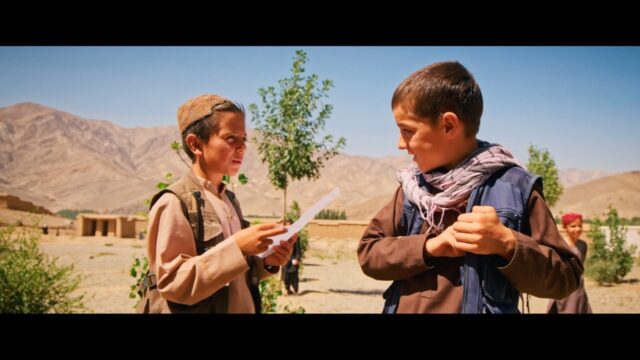
Oscar-nominated US director James Longley’s new feature Mohabat (produced by Alex Gibney and Mohammad Sharif Hotak) gives audiences a far more intimate view of modern-day Afghanistan than any other recent western-made film. The new feature, premiering in Ji.hlava and at DOC NYC, focuses on a 12-year-old boy. Mohabat is precocious and hard-working. His father was killed by a US drone and he is now in an orphanage alongside other sons of “martyrs,” undergoing a strict religious education.
This isn’t the film Longley originally intended to make. He had approached a well-known “intergovernmental children’s organisation” with offices all over Afghanistan with the idea of portraying their female employees in a documentary. They were keen and the director then pitched the project to a major US streamer – but the streamer passed.
“But Alex Gibney was interested and he was ready to put up some money from HBO that he had access to in order to send me over there,” the director remembers.
Gibney had seen and admired Longley’s previous film on Afghanistan, Angels Are Made of Light. “I believe he trusted me on that basis. When I approached him about making a documentary in Afghanistan, he agreed immediately. I can’t think of another producer alive who would have taken on a project with so many inherent risks. Without an Alex Gibney, films like this – where the path is rocky and the outcome is initially uncertain – will stop being made.”
Longley was beginning work on the project not long after the Taliban swept back to power in 2021.
“Nobody knew what was going to happen with these Taliban people,” acknowledges the director, who had lived in Kabul when he was making Angels Are Made of Light. “I was quite paranoid about the Taliban myself and frightened of them. Nonetheless, I forced myself onto the plane and went to Afghanistan at the beginning of 2022.”
By then, the children’s organisation had “got cold feet,” partly because the documentary seemed risky to them. That left Longley in Afghanistan with a budget but not sure exactly what film he would now be making.
“I thought what subject will the Taliban likely approve but will also give me the opportunity to make a good film, but nobody will get in trouble because of it” Longley explains the criteria he set himself. He knew that he couldn’t make a documentary in secret and that he also couldn’t risk antagonising the Afghan authorities by proposing one idea and then doing something different.
Several of the principal characters in the documentary support the Taliban. “The Americans had killed their father,” Longley explains why Mohabat and many of the other orphans are behind the regime that had forced the US out of their homeland.
“We recorded interviews with a lot of the kids and we recognised pretty soon that Mohabat was really something special, but we were filming him and several his friends for a two-year period.”
Mohabat was a shy and modest child who didn’t want to be singled out “as the film boy” but he also “really wanted to be in the film. It was clear he was interested in what we were doing.” Mohabat regarded the film as potentially a way to remember and honour his father.
Longley’s producer Mohammad Sharif Hotak was his guide through modern-day Afghanistan. “He also recorded all the sound. We were like the Maysles brothers out there as a team,” the director quips about his collaborator.
The bureaucracy they faced was often daunting. The filmmakers had to deal with multiple ministries including the Ministry of Labour (in charge of orphanages), the Ministry of Education and the Ministry of Health – to name just a few. “Probably a third of our work was making sure we had our papers in order all the time from all these different ministries.” Nonetheless, within certain obvious constraints, the filmmakers had freedom to travel and film.
“Now, Afghanistan is quite secure and if you have permission to be there, then you can drive all over the country,” Longley notes.
Early on, he didn’t know much about Mohabat’s background. Although some of the boy’s brothers feature in the film, other family members don’t. “I never saw his mother the whole time we were there, not even her shadow.”
The director knew he had to accept this. “I am an American man and I really can’t get permission right now to make a film about Afghan women. From their point of view, that is a completely ridiculous proposition.”
Women are therefore largely absent from the documentary. The filmmakers were careful not to film them, Longley noticed that women working in the fields, who weren’t wearing burkas, would turn away whenever a car passed so that a stranger wouldn’t have the chance to look at their faces.
“That’s the tradition and I know I am not going to change it. On the other hand, I know there are Afghan women making films secretly on their iPhones. Those are the people who will show you a woman’s point of view in Afghanistan. But I don’t have that ability – and so I didn’t try.”
Longley makes it very clear then that “this film is not about the issue of women’s rights in Afghanistan.” He also argues that “the most practical thing the west can do for Afghanistan if they want to improve the lives of people is to remove sanctions and normalise relations.”
He is no fan of the Taliban but having “seen them up close and talked with a lot of them,” he doesn’t regard them as “crazy people, at least not most of them. I think they are quite practical. It could be said they are running the country like a Mafia but they are an organised group. They have the country pretty much under their thumb and there is no chance that they are suddenly going to magically disappear and some western-style liberal democracy is suddenly going to emerge – that is just not going to happen.”
Afghanistan, he continues, has systems of social support that “are largely invisible to the west….it is quite rare for people in Afghanistan to starve on the streets or something like that. For sure, there are people who fall between the cracks of society but, in general, Afghans take care of each other and that is how they survive in a harsh situation, through hardship and war for all of these years.”
He believes this is “quite a misunderstood country, quite a demonised country. All of the media images we have of it tend to be ones that makes of us think of war and violence but the truth is that the Afghan people themselves, when you really live there, are some of the peaceful people, most generous and kind people you have ever met.”
Longley used certain ruses while making the documentary. He knew that the authorities wouldn’t want him to focus on a single character. He therefore filmed all the boys in the orphanage – but then just used the footage of Mohabat.
“We would do these general shots of whatever it was, a cricket game or a classroom, and then we would go in and do all these close-ups of the kids – and we wouldn’t do any more close-ups of him than we would of anyone else – and so I now have these hard drives full of portraits of Afghan children.”
The director hopes his film will enable western audiences to “dip their toe into Afghanistan and to begin to really feel the way the people are, the way the place is, at this human scale. That’s what we never get. We don’t get normal life. We get these extreme cases, ‘Afghanistan as war movie’ or the genre that is most popular which is what I call ‘escape from Afghanistan.’ They’re always films when somebody has escaped from Afghanistan and now they are telling their story…these are all good films, many made by Afghans, but it is this self-selecting perspective where it’s people who’ve left the country who tell the story. I really wanted to make films where everybody in the film stays in the country.”
Longley touches on some dark subjects – addiction, death, the scars of war – but he also celebrates aspects of Afghan life that are often ignored: the colours, the beauty of the countryside, rural life and the generosity and kindness of the locals.
“To the people of the valley where we filmed, I want to express deep thanks for the hospitality they gave us. I believe I was the first foreign filmmaker they had ever seen. It speaks to their tolerance and patience that they took the idea in stride and allowed us to film in their villages for so long, so soon after a long and painful war. I love them,” he concludes.