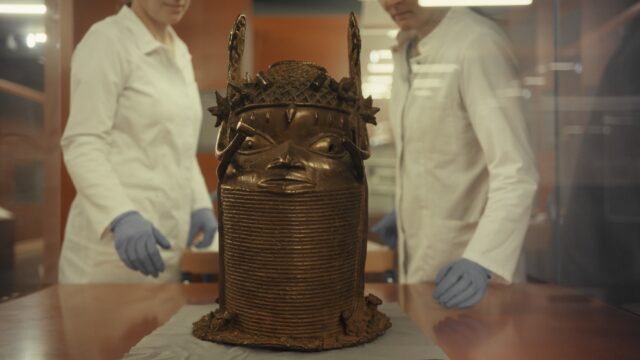
Simone Unger’s debut feature project, completed and set for release in 2027, tells an urgent and poignant story, that of the unjustifiable and illogical “safeguarding” of precious and sometimes sacred objects within western museums.
“The film helps to bridge the abstract debate of restitution by focusing on three specific objects, originally from Nigeria, Brasil and India,” says German producer Alexander Tanz of Lumalenscape. “All of them share a similar fate. They are kept in the museum for more than a hundred years and share a colonial background.”
That museum is the GRASSI Museum for Völkerkunde in Leipzig, which houses one of the largest collections in Europe, including human remains that were “turned into inventory numbers,” Tanz bemoans. “The film follows their process of a rehumanisation, allowing the audience to experience the urgency of returning these ancestors to their homelands.”
2027 marks 130 years since the British invasion of Benin City, and a campaign of looting that delivered thousands of objects into European collections. 259 such objects remain in the museum in Leipzig, and one of the Benin Bronzes serves as the starting point for Unger’s film.
“The idea for my first feature-length documentary emerged from my research,” says debutant director Unger. “Since studying ethnology and cultural studies, I have been preoccupied with the colonial past and how we deal with its consequences. I am also fascinated by the human obsession with collecting. Why is it so important for us to preserve things for eternity?”
“I have conducted research in museums, participated in ceremonial repatriations, and travelled to Benin to learn how people there are responding to the return of art looted during the colonial period,” she continues. “Throughout this research, I noticed that media coverage often left many questions unanswered. I therefore began searching for a cinematic form that could do justice to this complex discourse while allowing audiences to experience it on a sensory level.”
DOK Preview Germany represents an “important milestone” for producer Tanz, being the first opportunity to present Matter and Spirits to the international industry, and to give a sense of the film’s cinematic approach through selected scenes.
“[It] combines an attentive perspective with a poetic, essayistic approach,” he underlines. “While following the transformation of the museum and its encounters with origin community representatives, the film offers a rare look inside the institution. Rather than observing from the outside, the camera adopts an interior gaze. The objects are given room to resonate, reframing the museum space from a site of preservation into an archive of confinement. Atmospheric soundscapes and faint memories recall the objects’ origins.”
“These essayistic sequences are woven into the documentary, creating a cinematic language that moves between reality and imagination. The film offers an artistic consideration of how the space might be experienced by the objects within it,” he adds. “Matter and Spirits invites audiences to look beyond the displays and consider the objects as carriers of memory and spiritual meaning.”
With the film already completed, Tanz and his team are now looking for partners to support its international release, particularly festival programmers, world sales agents, broadcasters and distributors. “Our goal is an international festival premiere and further distribution in 2027, including a theatrical release,” he confirms.
Leipzig’s GRASSI Museum of Ethnology is currently rethinking its approach to colonial collections, a radical transformation that provides the backdrop for a story about the objects’ past and the question of what their future might look like.
“What makes Matter and Spirits special is its unusual shift in perspective,” Tanz continues. “The film presents a museum in a way we aren’t usually used to seeing it. It allows viewers to connect with the objects and understand why it is crucial to keep reflecting on their fate, both inside and outside of museums.”
“A Benin Bronze from Nigeria, a doll from Brazil and a spirit repeller from India represent three different fates connected by colonial history,” he adds. “For more than a century, these objects have been preserved, studied and categorised in European collections. What memories do they carry? What does it mean to be physically preserved while being separated from one’s original cultural context?”