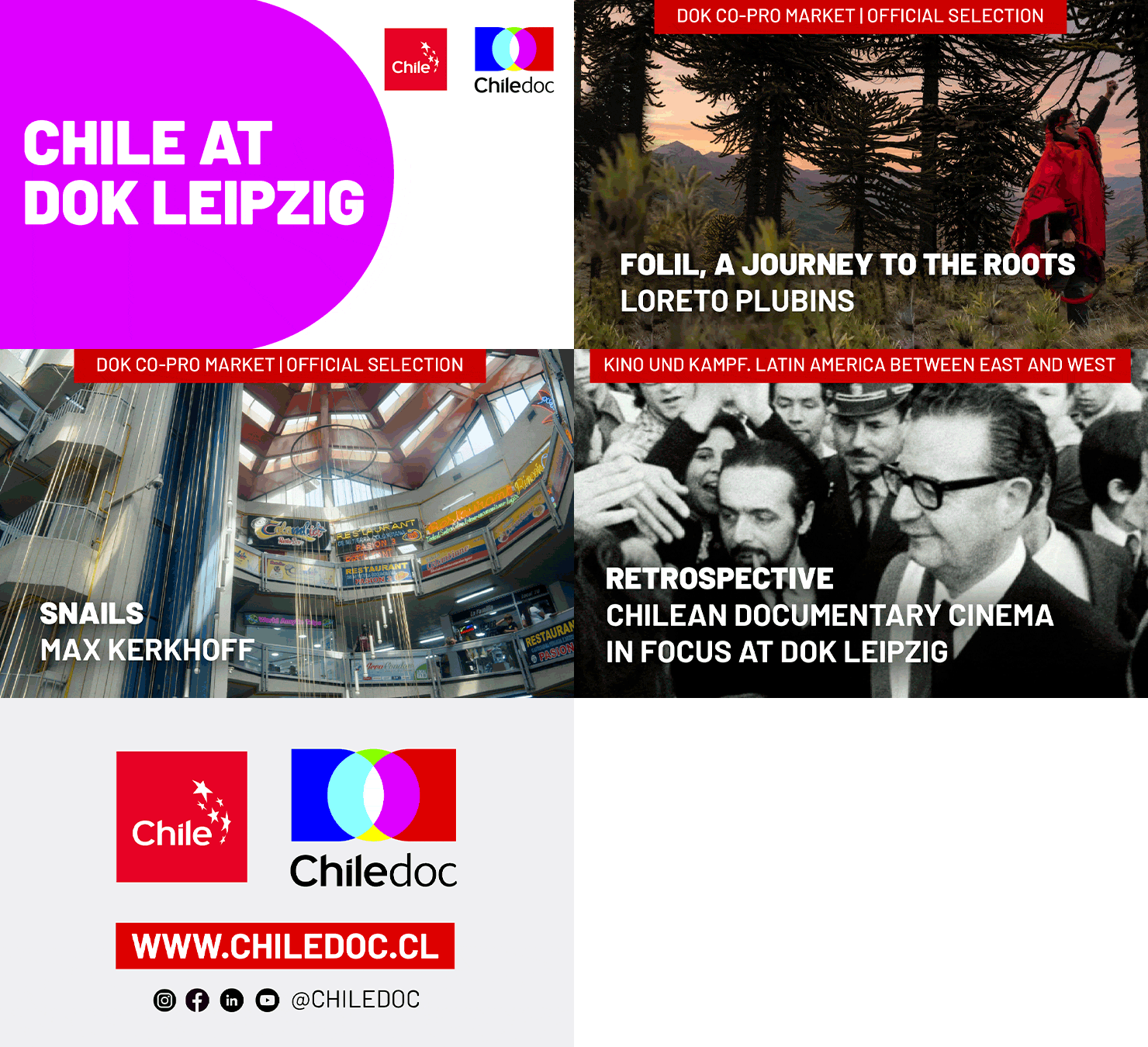
Chile is well represented at the 69th DOK Leipzig with two projects – Folil, A Journey to the Roots by Loreto Plubins, and Snails, directed by Max Kerkhoff – in DOK Co-Pro Market, and a curated selection of films related to Chile’s political and cinematic history in the festival’s ‘Kino und Kampf: Latin America between East and West’ retrospective.
In addition to the projects in official selection, Chiledoc will promote five further Chilean projects from the catalogue of the Chilean delegation. Together with the Goethe-Institut, Chiledoc will also host a Get Together on October 27 for the international documentary community in attendance in Leipzig.
Diego Pino Anguita, Deputy Director of Chiledoc and the organisation’s representative at the event, comments: “DOK Leipzig is the oldest documentary film festival in the world, and Chilean cinema has historically had a very important presence there. The fact that a Latin American retrospective now includes major historical films from Chile shows how highly our cinema is valued, both in Germany and by the festival itself. In addition, having two Chilean projects selected for the market confirms that there is interest not only in our cinematic history, but also in the future of the films we are creating in Chile.”
Adds Francisco Undurraga, Chile’s Minister of Cultures, Arts and Heritage: “Documentary filmmaking is one of the ways Chile reflects on itself and presents itself to the world. The presence of stories from Magallanes and Santiago at DOK Leipzig, two projects selected for its co-production market, and Chilean films in its retrospective confirms that Chilean cinema has its own voice in the international conversation. As a Ministry, we will continue to support its international visibility.”
Two Projects Selected for the DOK Co-Pro Market
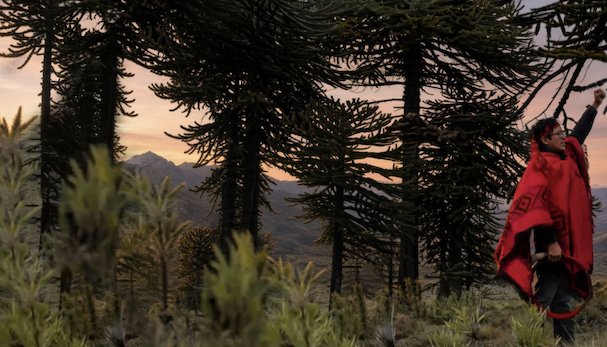
- Folil, A Journey to the Roots by Loreto Plubins. Produced by Carola Fuentes and Rafael Valdeavellano of La Ventana Cine. The feature-length documentary, currently in development, is set in the Andean foothills of La Araucanía, where the lonco, or traditional leader, of a Pewenche community dies without naming a successor. His children, Adán, María and José, must put aside their differences and join forces to prevent the felling of 96 ancient araucaria trees. This event marks the beginning of a personal and family journey that will reconnect them with their roots.
- Snails by Max Kerkhoff. Produced by Diego Pino Anguita, Zorana Mušikić and May Odeh of Cangrejo Films and Mayana Films. The documentary is a co-production between Chile and Germany. The film takes as its starting point the shopping centres known as caracoles, spiral-shaped buildings that represented a promise of economic progress during the Chilean dictatorship. Fifty years later, these spaces bring together migrants, older adults, fortune tellers and people seeking new opportunities. Through their stories, the documentary reflects on the spaces and people left behind by changes in the market.
Chilean Cinema in the ‘Kino und Kampf: Latin America between East and West’ retrospective
This year’s retrospective will explore Latin American political cinema from the 1960s and 1970s, its circulation between East and West Germany, and the circumstances that made it possible to preserve these films. The programme includes Chilean documentaries such as El primer año (1972),by Patricio Guzmán, which documents the first year of Salvador Allende’s government; Herminda de la Victoria (1969) by Douglas Hübner; Abastecimiento (1973) by Raúl Ruiz; Pintando con el pueblo (1971) by Leonardo Céspedes; and Somos + (1985), by Pablo Salas and Pedro Chaskel.
The retrospective also brings together films made in other countries that explore Chile’s history, international solidarity following the 1973 coup d’état, and the experiences of Chilean exile in East Germany. These include Chile lebt (1976), by Juan Forch and Michael Börner; Eine chilenische Hochzeit (1977), by Rainer Ackermann and Valentin Milanow; Eine Minute Dunkel macht uns nicht blind (1976) by Walter Heynowski, Gerhard Scheumann and Peter Hellmich; and Illapu – Lied von Freiheit und Liebe (1984) by Carlos Puccio, about the Chilean musical group’s presence in East Berlin.
The selection further includes El tigre saltó y mató, pero morirá… morirá… (1973), by Cuban filmmaker Santiago Álvarez, a tribute to Chilean musician Víctor Jara. “The retrospective will offer an opportunity to revisit both Chilean filmmaking from this period and the international networks of circulation and solidarity that developed around it,” writes Chiledoc.
In addition to the officially selected projects, Chiledoc will promote five more projects to the international documentary community in Leipzig:
- The Chile–Netherlands co-production I Will Die Chilean (Moriré chileno), directed by Rafael Valdeavellano and produced by Carola Fuentes and Sasja Opdam of La Ventana Cine and Submarine Productions, reconstructs the final three months in the life of Chilean diplomat Orlando Letelier, who was assassinated in Washington in 1976, from the perspectives of his four children.
- Two projects directed by Lorena Giachino will also be presented. Cannon Fodder (Carne de cañón), produced by Maximiliano Scheleff of Pajareza Films and GiachinoFilmes, tells the story of Aldo Marín, a young Chilean revolutionary who died in 1977 following a bomb explosion in Turin, Italy.
- Res Judicata (Cosa juzgada), also produced by Maximiliano Scheleff and Lorena Giachino, explores the life of judge Carlos Cerda, who investigated cases of enforced disappearance during the Chilean dictatorship. The documentary draws on the personal relationship the director established with him two decades ago.
- Widows (Viudas) is directed by Tatiana Lorca Campos and produced by Cristian Valle Celedón and Tatiana Lorca Campos of Wolf Producciones and Arándano Producciones. The documentary revisits footage filmed more than a decade ago of four women whose husbands were executed in retaliation for the assassination attempt on Augusto Pinochet. Through their stories, the film explores the lasting effects of grief and how memory changes over time.
- Completing the selection is The Weight of Snow (El peso de la nieve), directed by Matías Bolla and produced by Cristian Valle Celedón and Carolina Sorensen of Wolf Producciones and People Productions. A co-production between Australia and Chile, the documentary is set in Chilean Patagonia and follows elderly gauchos living on isolated ranches as they face drought, physical decline and uncertainty about the future of their way of life.