Tete Hoffmann’s “brilliant” father was the Berlin-based author, Jan Christ (1934-2025) whose real name was Christian Hoffmann. His novels included Anna Wentscher (1995) and Dissolution (1995) and he was winner of the Hamburg Literature prize in 1986.
Hoffmann’s documentary (which had its world premiere this week in the German Competition at DOK Leipzig) portrays her father in the final years of his life, when he was dealing with his Alzheimer’s diagnosis. She started shooting it nine years ago in 2017, when the first symptoms of his condition began to show. At the time, she was studying social sciences.
“I wasn’t a filmmaker and I didn’t know if I wanted to be one. But this was a moment when I knew my dad and I had to deal with some kind of ending. I had this impulse to use the camera as a tool, as a medium to get in conversation with him, and also in a playful way.”
The project started as a very private affair but she showed some early footage to a friend who was immediately intrigued and told her “it could be a movie. It doesn’t need to be for just the two of you.”
Her father may be having moments of forgetfulness but, at least at first, he is still writing and still experimenting with language. He is a humorous, mischievous figure, staying in his own apartment and in charge of his own life. The dementia takes hold only very slowly.
“I was glad that the process was so long,” Tete says of his gradual deterioration. Most of the material in the film comes from the earlier years – although a shot of their hands was done just a few months before he died. She wanted to show how her relationship with her father became “more gentle” as “language disappeared” and they began to rely on touch to communicate.
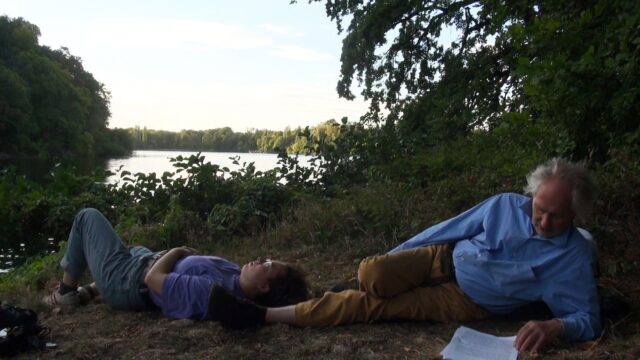
This is surely one of the only movies you’ll ever see in which the director films herself pulling down her trousers and peeing in the undergrowth. The scene comes when she’s out in the countryside having a picnic with her father. It’s an intimate and funny moment which, she suggests, foreshadows later parts of the film where her father is seen in an equally exposed situation when his trousers might fall down because he doesn’t have a belt or he’ll need to rely on her to dress himself.
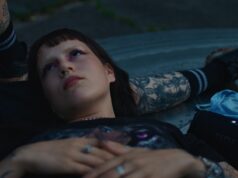
Tete herself is often seen in the frame in a film in which she is director, cinematographer, producer and editor. There was no other crew. She would put the camera on a tripod or on a shelf as she and her father carried on with their lives in front of it. “It [the camera] really was running hours and hours. It was a companion. Especially in the first three years, it was always there.”
My Brilliant Father doesn’t have a linear structure. Reflecting the father’s condition, it jumps back and forth in time.
There are also cutaways to street scenes in Berlin in which we notice lone foxes roaming across snow-filled night-time streets. “The film is very challenging in a way. There is a lot of talking and it’s a lot about language. I knew I needed to have moments in-between, where there was no talking and a moment to breathe,” she explains why she included such images.
At one stage, her father likens her to a fox – and so that seemed an appropriate symbol to introduce into the documentary.
Often, when children make films about brilliant, high achieving parents, the resentment is palpable. The kids feel that they’ve been abandoned – sacrificed on the altars of their parents’ careers. That’s not so much the case with Tete. “No, he didn’t ignore me. That is also what the film is about, being a parent as an artist – and how much priority do you give to your art and how much to being a parent.”
There were certainly times growing up when Tete felt neglected, but her father didn’t “ignore” her. He was funny and open. “What made our relationship very special was that it was possible for me to talk to him about these things, also sometimes in an angry way. He gave me the possibility to confront him. That was very special. I am very grateful, also to be able to do that with the film.”
After starting work on the documentary, Tete switched from social science and began to study art and media at the Berlin University of the Arts (UdK) under Thomas Arslan. (She used part of the film in her application).
Tete used to have an ambivalent attitude toward her father’s books. “I had some kind of jealousy about them because I thought they were more important than me. Especially when I was younger, I had a problem with these books because I knew they were his passion.”
Making the film gave her the chance to show him she was interested in his writing. “He had a very, very creative way of playing with language. You really feel this in the books and it’s very powerful. Also, he always invented new words. What was always interesting was that he wrote a lot of autobiographical things even he was fictionalising them.”
She wanted her documentary to have the same inventive approach to storytelling found in her father’s fiction. He had led an extraordinary life, growing up in the Nazi era, then living in the GDR during the communist period before heading to West Germany. He was a bookseller, an actor and a teacher before he found fame as a writer. “He lived in a lot of different social systems and had a lot of different occupations. To the end of his life, he was always so curious and was always meeting new people. He always knew he wanted to be a writer and told me he wrote his little first novels when he was 10.”
She sums up her father as joyful and “very unconventional.” For a long period after his dementia diagnosis, he kept his zest for life.
Having premiered in Leipzig, Tete’s documentary has now been chosen for the Duisburg Film Week in early November. This is a prestigious event where films are not only screened but are then discussed and debated at great length.
The director is now looking for partners to help with the distribution and world sales of the documentary. “I’ve done it so far all alone. It’s my first feature and I am also learning how this business works!”