Three professionals from Switzerland will be taking part in IDFAcademy, the intensive and interactive training program for emerging documentary filmmakers and producers, running November 12 to 15 2026 in Amsterdam’s De Balie, for many still the spiritual home of IDFA.
The program offers a blend of talks that create space for a diverse range of filmmakers and perspectives to engage with one another, from in-depth conversations with directors about their process to discussions on co-producing and the craft of editing. It also boasts a series of interactive sessions and round tables, providing a platform for industry professionals from across the board to exchange their experiences and expertise on financing, (co)-producing, festival strategies, and more.
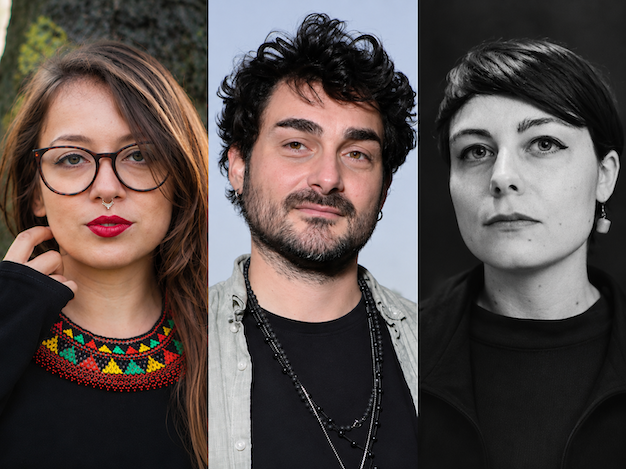
The Swiss contingent in 2026 comprises Celina Escher, who is working on her second feature animation-documentary, Amada Libertad; Elisa Baccolo, who is bringing Echoes of the Free Night, a feature documentary she is co-directing with Arianna Tedesco; and Ben Donateo, who is developing his first feature documentary, La Mattanza (The Slaughter), under the mentorship of filmmaker Tala Hadid.
How does each filmmaker describe their approach to their craft, and what are the unique properties of the project they are working on?
Celina Escher’s Amada Libertad concerns a young poet and freedom fighter, Leyla Quintana, who fought against the military dictatorship during the civil war in El Salvador in the 1980s. “I have been researching [the film] for many years and have access to her poems, archival material, and eyewitness accounts. I am working with my producer Sereina Gabathuler – the producer of Chris the Swiss (Cannes 2018) – and we have successfully completed the development phase. We are now looking for a distribution partner.”
“My approach is first a deep research about the topic and person I will portray,” Escher tells Business Doc Europe. “I’m interested in working on a more eye-to-eye work relationship, to include the protagonist into the process and to work in a collaborative way with the filmmaking team. I have a clear vision on what and how I want to tell the story, but there is room for exploration and experimentation.”
“In each phase of the filmmaking, I have the opportunity to collaborate with great artists, filmmaking professionals, cinematographers, sound crew, animators, composers; each one of them contributes to the filmmaking process, each person is specialized in their own craft and together we create a film that hopefully will move hearts and bring human stories to the cinema,” she adds. “I believe that cinema is a collaborative art, which is made in a collaborative artistic process; to create an art form which dialogues with other artistic expressions, such as photography, theater, music, painting, poetry, architecture. I see film as a Gesamtkunstwerk.”
Elisa Baccolo’s Echoes of the Free Night is a feature documentary she is co-directing with Arianna Tedesco about illegal free-party culture in the Italian Swiss Alps. The film explores these gatherings not simply as parties, but as temporary attempts to build a community around “freedom, care and collective experience.” One of the questions at its centre is how a space can remain “radically open while also protecting safety, consent and shared values, without turning protection into exclusion or gatekeeping,” she tells BDE.
“I am a director in form, a researcher in method, and a philosopher in the nature of the questions I ask,” she further explains her modus operandi. “My films often begin with a theoretical, political or scientific question, but I am not interested in using cinema to illustrate something I already know. For me, documentary is a form of knowledge in itself: a way of thinking through images, sound, bodies, relationships and everything unexpected that emerges during the process.”
“Research gives me a ground from which to start, but reality has to be able to resist my assumptions,” Baccolo adds. “If a film ends by confirming exactly what I thought at the beginning, I tend to feel that the encounter has not really happened. So I look for structures that are rigorous but porous enough to be transformed by the people, places and events I encounter.”
“This also influences how I think about the business of documentary,” she continues. “I am increasingly interested in building production relationships that can protect this kind of process. Research, experimentation and long-term relationships need time, trust and sustainable working conditions.”
Ben Donateo tells how his project La Mattanza has been “part of my life for several years.” Set on the western coast of Sicily, the film follows three parallel stories: an ageing treasure hunter haunted by his relationship with his father, a rebellious teenager struggling to escape the environment in which he grew up, and two very young mothers trying to protect their children while confronting their own traumatic pasts. Their lives unfold against the memory of the mattanza, the ancient Mediterranean ritual of tuna slaughter.
“For me, this ritual is much more than a historical reference,” he says. “It becomes a metaphor for inherited trauma, for the invisible nets in which people can remain trapped, sometimes repeating the same patterns across generations. Like the tuna.”
“Formally, I’m interested in exploring the space between observational documentary and a more poetic, almost fictional language. The film gradually moves from a raw, intimate observation of everyday life towards something more suspended and symbolic. Repetition is central to both its narrative and visual structure.”
From a business perspective, Donateo is learning how “to reconcile artistic freedom with the realities of independent filmmaking. Developing a feature documentary takes years, and sustaining yourself financially while remaining committed to a personal vision can be incredibly challenging. I believe the right collaborators are those who understand not only what a film is about, but also why it needs to exist in a particular form and time.”
Naturally, the Swiss trio are eager to get cracking at IDFA, and each has specific goals and wishes to fulfil over the coming days. “I’m looking forward to the masterclass and films of Tatiana Huezo, the guest of honor of IDFA,” says Escher. “Her work and approach to cinema are very inspiring. I’m happy to reconnect with IDFA, meet documentary filmmakers from all over the world, expand my artistic and professional development as a young director, and hopefully forge new collaborations.”
Donateo assesses the coming days from an existential perspective. “What I hope to find at IDFA Academy is not simply professional advice or potential financing opportunities, although those are certainly important. I’m looking for conversations that challenge my way of thinking, encounters with filmmakers who approach cinema differently, and relationships that might continue long after the festival ends.”
“Documentary filmmaking can be a very solitary process, especially during development. You spend years carrying a project, questioning its direction, trying to understand whether what you’re doing makes sense,” he stresses. “Being able to share those doubts with people who understand the process is invaluable.”
Baccolo tells BDE that she arrives at IDFAcademy at a moment of transition, and is orienting herself towards, longer, more complex projects that necessitate more collaborative ways of working. “I would like to use this time to question some of the assumptions I have developed along the way. One subject that concerns me increasingly is authorship: how can a filmmaker have a precise cinematic vision without allowing that vision to dominate the people and reality the film encounters? I am interested in thinking of documentary less as an individual act of authorship and more as a collective process of inquiry.”
“But my ideal takeaway is not only practical,” she further underlines. “Some of the experiences that have changed me most as a filmmaker came from encountering people whose ways of thinking were very different from mine. I hope IDFAcademy can create that kind of space: one where I can build lasting relationships, have my ideas challenged, and return to my work with questions I did not have before.”