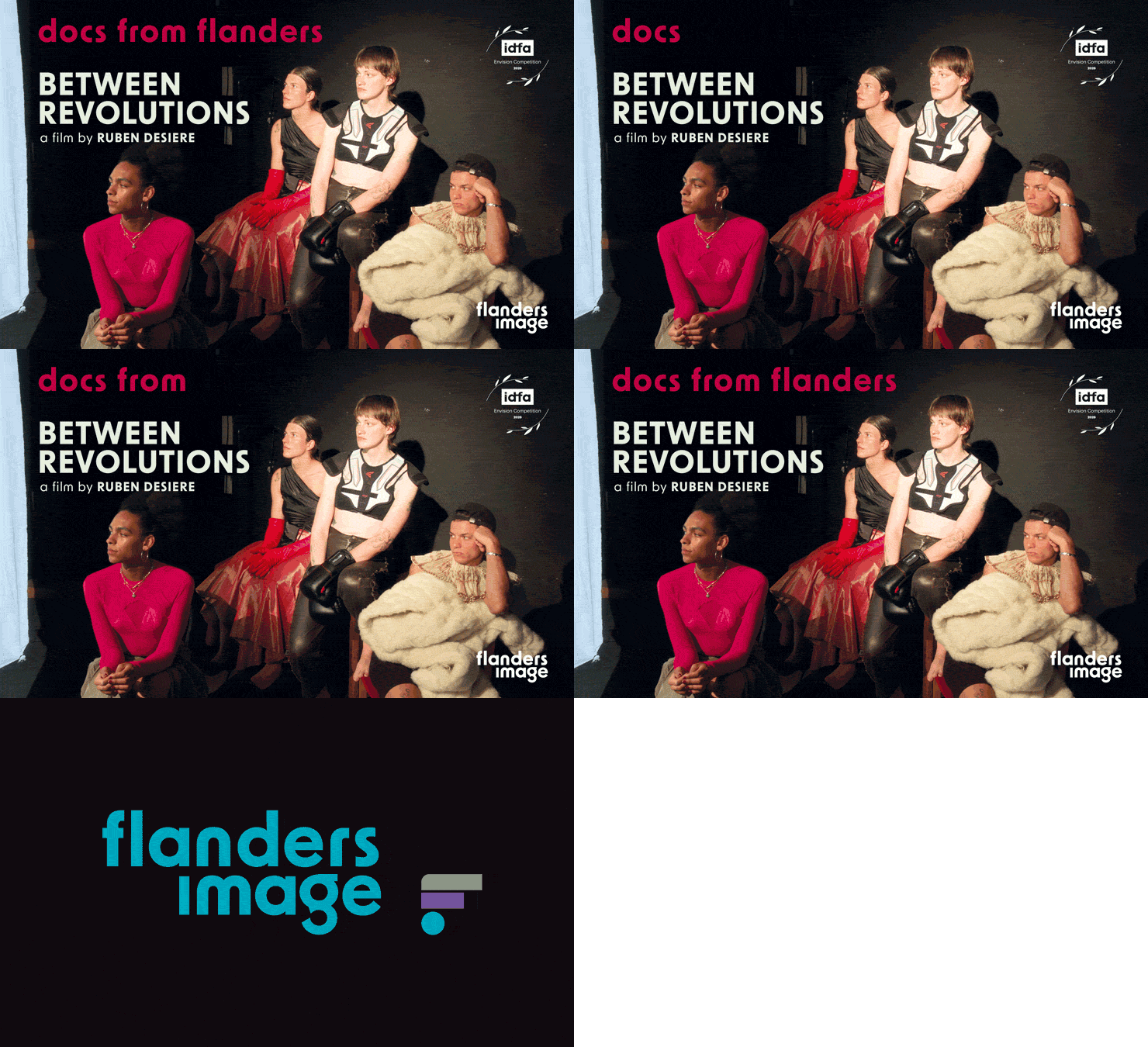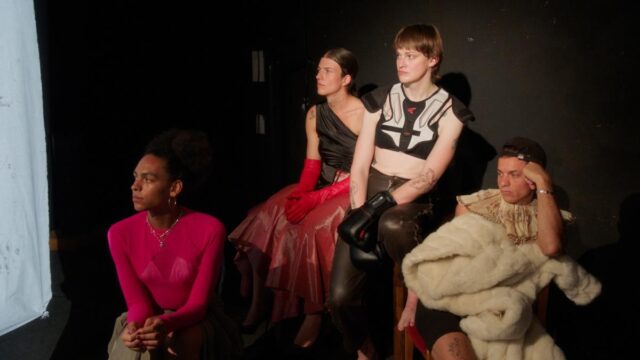
In his new feature Between Revolutions (a world premiere in IDFA’s Envision competition) Belgian director Ruben Desiere follows a group of Berlin-based queer activists using performance to voice opposition both to the violence in Gaza and intimidatory police tactics in Germany.
“I had a slightly different plan initially,” the director recalls the beginnings of the project. He had originally travelled across France, Belgium and Germany researching “different occupations…I wanted to make something about temporary resistance movements.”
At one of the occupations, some activists told him about Larry Mitchell’s ground-breaking 1977 book ‘The Faggots & Their Friends Between Revolutions,’ described as “a queer utopian manifesto in the form of a fable.”
“It was then, quite some time after, that through friends I came in touch with Kasz Wlaszczyk and Nomi Sladko, the two activists that are really at the core of the film. I proposed to them to work with this book and construct a film based on their political interests – their opposition to the complicity of the German state in the genocide in Gaza, and also about how oppressively the German state was reacting against any kind of opposing voice.”
It was very clear from the outset that this wasn’t going to be a traditional observational documentary. Instead, the main characters “were going to play roles.”
“Kasz and Nomi helped find the people you see in the film. Kasz and Nomi themselves play the roles of Jack and Leila in the film. Five other people that we found together play other roles. They form this theatre group. Outside of the theatre rehearsals, they play scenes related to the book, their activism and the repression.”
The German authorities have been very heavy-handed in trying to suppress demonstrations drawing attention to the situation in Gaza. There has been police violence. Demonstrators have faced fines for simply taking part in protests or chanting slogans. Some activists have even faced deportation.
Not every member of the group that Desiere assembled knew each other in advance. However, as they rehearsed, the text they were using, and their own real-life experiences of being threatened and silenced during demonstrations, began to echo each other.
At times, bureaucracy became baffling and matters took on a surreal Kafkaesque hue. One young woman who had been chanting pro-Palestine slogans was arrested and received a “white letter.” This, we discover, means that the state wants you to answer more questions – but you are under no legal obligation to do so. Next, though, you may receive a yellow letter which will summon you to court to defend what you did.
Desiere emphasises that he and the activists never thought about them playing versions of themselves. “To organise the shoot, I had a call with all of them. I asked them what kind of moments they wanted to have in the film. But these were not personal memories, and it was not important that they played something they had lived. All these ideas could circulate within the group…They don’t re-enact – they imagine what could have happened.”
Between Revolutions is produced through Elisa Heene’s Brussels-based production company, Mirage. “I have known Elisa for a very long time. We were in high school together. At some point, I was producing the film myself but then, because of funding rules, it had to move producers…at some point, it was passed on to her. It was very nice to work with Elisa and also to share the film with a little bit of a bigger group.”
Heene’s sister Anna Eva worked on the project as a line producer. “She went with me to Berlin,” says Desiere. The crew there was kept deliberately small, only four people, and they shot for 10 days. “It was a very intense, very short shoot…”
Larry Mitchell’s book is now almost 50 years old but Desiere talks of how “relevant and fresh” it still seems. “And it is also a very playful form that Larry Mitchell had chosen for this book. It was intended as a children’s book and then became something else, but it has this fragmented structure which I really liked and that became part of the film. Then there are the illustrations of Ned Asta that we also tried to give a place in the film. These I found very beautiful.”
The director’s production company, Accattone Films, founded in 2014, is named after a Pier Paolo Pasolini film from the 1960s. The new movie is inspired by a 1970s book. Desiere acknowledges his debt to radical predecessors while making Between Revolutions. One particular inspiration was French New Wave director Jacques Rivette’s experimental 13-hour epic, Out 1 (1971).
“I had certain images from different sources I wanted to have in the film. If you speak of the 1970s, Out 1 was definitely something I returned to because of its form and its playfulness. This is also what I admire in Pasolini – it’s cinema that is very alive and in motion.”
Although the director and his team were shooting “many scenes in a day,” they never felt they were “really rushed.”
“We would try a scene. If it didn’t work, we would try it one more time. Then, if it didn’t work, we just gave up. We had a loose script and there was nothing we had to have [in the final cut], and so we worked quite freely, which I really enjoyed.”
One of Desiere’s main hopes now is that Between Revolutions will be screened in Germany. “I really hope that we find a German distributor. We will do our very best.”
Dutch outfit Family Affair is on board as a co-producer and Avila Film is handling the Belgian distribution. Desiere is already co-directing a new project, titled Firelines.
Ask him to sum up the ethos at Accattone Films and the director says that he is interested in creating works “that very often don’t start from writing, but that are created while making the film, and where shooting, editing and writing go on simultaneously.”
“It’s often about helping each other out, whether on set or editing, and trying to construct these films in the best possible way,” he signs off.