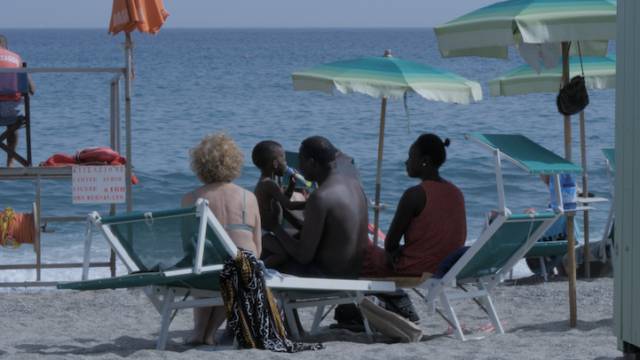
In his new film The Middle Room (an international premiere in IDFA Luminous following its premiere in Rome Film Fest), Italian director Enrico Maisto embeds himself in the home of a family friend, Mietta, a retired juvenile court judge in Milan. She is not living on her own. Also in the household is Ibu, a Senegalese immigrant whom Mietta had first met in Sardinia, and he is joined by his partner Bousso, who is pregnant.
To fit everyone in, the retired judge buys a bigger apartment and she dotes on the doe-eyed Khadim, treating the couple’s very young child with a grandmotherly love and affection.
“I’ve known her since I was a kid,” director Maisto says of the judge, who is now 78. “I come from a family of judges, both my parents are judges. My father when he began his career was a juvenile court judge, and so he was a colleague of Mietta. She was a presence attending my house when I was a kid. I used to caller her ‘auntie.’”
Mietta, who lives in an upmarket part of Milan, doesn’t disclose precisely why she wanted to set up her household in this way. “She perhaps had some desire for motherhood,” the director speculates. He also conjectures that she enjoyed having people around.
“There’s a very understandable human desire to have someone to take care of you when you are getting old.”
Inevitably, the unconventional living arrangement has a political dimension too, in a country where anti-migrant feeling remains high.
“Especially in Italy, we have this propaganda against migrants,” Maisto observes. Mietta and her friends, though, are building their own family unit in which nationality, class, colour and economic circumstances seem meaningless. All that matters is the affection they have for one another.
The director spent seven years shooting the documentary. “There were many times I was about to abandon the project actually because it was very hard to find a point of view,” he admits. He wanted to keep a distance from his characters and was well aware that the film could “very easily become controversial and provocative beyond my intentions – and the intentions of the characters themselves.”
Of all the characters, Bousso was the easiest one to deal with. “She was probably the most generous character in the film. We also are almost the same age. She is 34 now and I’m 38. It’s probably easier to relate on a generational side…while Ibu and Mietta tend to hide their actual feelings, she [Bousso] is much more straightforward. When you scratch the surface, it takes very little to get to the heart of what she feels.”
Although he was there to document life in the household, Maisto couldn’t help but get close to his subjects. “It’s an important question. I would say that I have never been a fly on the wall. The moment I decided to abandon the formal purity of pure observation and started to interact with the people in front of the camera, I stepped out from the place I was hiding…for sure, we spent a lot of time together even outside the framework of the film.”
The director and his girlfriend sometimes found themselves looking after little Khadim, taking him to the movies and attending his birthday parties. There were many occasions when he and the other subjects would go out and have dinner together. “For sure, there is a relationship that goes on.”
There were also some moments when “important things happened” and he wasn’t there to capture them on camera. In such cases, he would sometimes “provoke reality,” as he puts it, to “build a story.” That didn’t mean he used reconstructions, more that he put the characters in situations where they might behave in a certain way. “That is part of the documentary process for me.”
Maisto may have done the filming on his own but he did have producers. He was working with Riccardo Annoni and Francesca Riccardi of Milan-based production and post-production outfit, Start. The same company has produced almost all of the director’s previous films. Rai Cinema came on board the film as co-producer and will eventually show it on TV. OpenDDB will handle the Italian theatrical release which is set for January.
“I did a lot of things myself but not the editing,” the director pays tribute to Enrica Gatto and Veronica Scotti who helped him cut the material into shape. “The editing phase was very long. We began editing in 2024, so there was a process of rewriting things and going back shooting.”
The judge, Ibu and Bousso have all now seen The Middle Room. “I think it is very, very difficult for people who are involved in these kinds of documentaries to have the right distance actually to understand what the film is about,” the director mulls over their responses. “It takes many viewings…for now, it is more about the impact of seeing on the screen seven years of your life condensed into 80 minutes – which is kind of shocking! They told me they were happy with what they saw. Mietta was kind of upset by the final scene because it represents the deepest fears she has. When she sees them leaving, she never knows whether they will come back or not, and that is something that scares her a lot. But it was also very interesting to see how Ibu and Bousso tried to reassure her that she is part of their family now. They will never abandon her!”
Khadim may be too young to make much sense of the film but one of the director’s goals was to provide the boy with “a film that he could look at [in later years] without feeling upset…in the end, he is the one who will have to deal with the decision that his parents and Mietta made. This is going to be tough for him and was a very, very delicate matter for me.”.