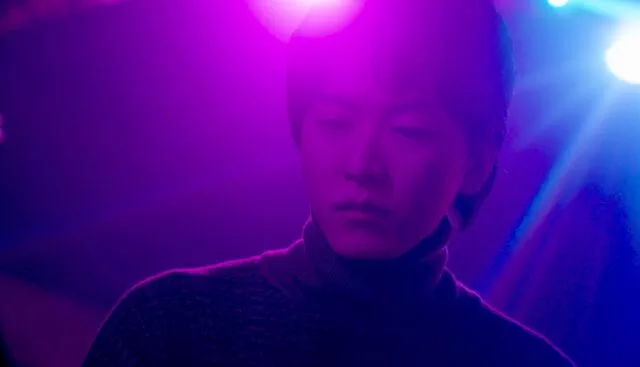
Love comes at a price in Fernando Souza’s feature doc about host clubs in Tokyo’s Kabukicho red light district. The partly-fictionalised film focusses on Hikaru, a seductive charmer by night, and a bespectacled computer nerd by day, with a girlfriend as well as a strong desire to have kids.
We see him plying his trade in Club Classy, together with other male escorts whose job it is to make women fall in love with them – and spend a lot of money in the process. He ranks as one of Tokyo’s top hosts, and within the confines of this world, he is considered a real catch for women who are willing, or feel the need, to be charmed, seduced or swept away. For many clients, Hikaru is totally irresistible, despite the transactional basis of any future liason.
But, in daylight hours, he has a girlfriend, whose parents he wants to impress. Yet for partner Hana, whom we see in their domestic setting, the time is never quite right. Also, Hikaru is not his real name. That is Takahito and, as we see in the film, he has a moving back story which is revealed, little by little.
Spanish director Souza, who was himself a host – not in Japan but in Singapore and Thailand – first broached the subject in The Floating World, selected for Tallinn Black Nights in 2021. The protagonist of that film was a transgender man who longed to be a host as a way of acquiring the masculine identity that he’d been denied all his life, Souza tells BDE. But the director felt, for ethical reasons, that he could not return to film somebody who was, at that time in their life, very vulnerable.
At first, Souza wanted to shoot the feature Tonight is Forever as an observational documentary, but finding the right characters continued to prove ever more difficult, at which point French producer Quentin Laurent from Les Films de l’œil sauvage suggested that they partly fictionalise the endeavour.
Souza eventually agreed to this proposal…and then he came across Hikaru.
“We were incredibly lucky,” the director tells BDE. “The protagonist that we found is a legend of Kabukicho, the red light district. He’s been working there for 15 years and he immediately trusted me and he told me his story…So I went back to Spain and I spent a year working on [it]. I wrote an eight page-treatment that he [Hikaru] approved and that we shared with his community, and based on this, we shot the film, but everything was improvised. It was just the bare bones idea for each scene. And then we workshopped everything with the cast and they shared their ideas, and we shot chronologically to give them the space to adapt to the story and to make it easy for them to follow it.”
“It’s very strange, but we ended up getting much closer to reality by fictionalising it than by shooting the real thing,” Souza continues. “I tried for many, many years to shoot it as an observational documentary. It was impossible.”
“The clients are all actresses, or most of them are actresses,” he adds. “Before starting to work on this final version of the film, we shot with many real clients, but it was always that they just don’t want to appear, because there’s such a huge stigma associated to going to host clubs.”
Many of the workers and clients who gravitate towards Kabuchiko are fractured in some way, suggests Souza, or come from broken family backgrounds, or have experienced profound difficulties in their personal relationships.
“This whole neighbourhood of Tokyo, and every host club, is just a fascinating stage where incredible stories take place. I mean, just amazing, amazing human relationships based on things that we can understand even though some people might have never stepped into a host club,” Souza tells BDE.
“We understand this [female] desire for connection and we understand that the men also need the clients,” he continues. “They need this job to heal from wounds in their past – all of the men. And so they aspire to be number one hosts. For them, it’s the most important thing because their selfhood depends on this.”
That said, the subject of Kabuchiko and host clubs is very much taboo in Japan, and local news is full of scandalous stories of clients being forced into prostitution to repay escalating debts, or worse. While many of these stories are true, Souza takes an altogether more sympathetic approach to the folks who occupy this world, both hosts and clients, who often develop strong and lasting bonds.
“It’s a very delicate thing to talk about because I see the darkness in this industry, but I can’t say that everything is dark or that all the exchanges and all the connections are unreal,” he says. “Because that would mean that the [female] clients are not considered people with autonomy, and people that cannot make decisions for themselves…It also dehumanises the host themselves.”
“The system actually works in the way that when the women end up spending this money on the men, the men often are very touched by these gestures, because they understand the sacrifices that the women have to make to do this,” Souza adds. “There can be a real connection between the host and the client. That’s why it’s so interesting because in the end, the hosts are also human and are not impervious to what happens between them and the clients. It’s very often that the host, when they retire, marries their best client.”
Souza admits to a deep admiration, even a “love” for his main subject Hikaru. “In reality, he is a very charming, very charismatic, incredibly generous person that agreed to work for the film full time for the two months that we were shooting, and he gave everything. We would shoot before the club opened for sometimes eight hours, and then when he was working at the club, and sometimes we would be shooting after the club closed… He trusted me fully and I’m in awe of Hikaru. He’s one of the most intelligent people I’ve ever met and, yeah, he’s incredible.”
But there’s a flip-side, which Souza acknowledges. “I realised as we were making the film that I was another client for him, because in a way he cannot treat most people as anything else but a client, because he’s been in Kabukicho for such a long time that he has a difficulty switching off and showing who he really is,” he tells BDE. “This is the thesis of the film…I don’t want to say that this is who he is, but…he has been in a way devoured by the character that he had to create to become successful.”
Tonight Is Forever is exec-produced by Eric Nayari from Ceneric Creative, who produced the Oscar-nominated Black Box Diaries and Instruments of a Beating Heart (both set in Japan and released in 2024). Souza is hopeful that this connection will open Japanese cinema doors for the film.
“I don’t know how possible it will be but I would sacrifice showing the film anywhere else if I could show it in Japan,” he admits. “I owe it to the cast for their tremendous dedication, and I hope that it can help challenge some of the ideas that are so present in Japanese society, and add nuance to them.”