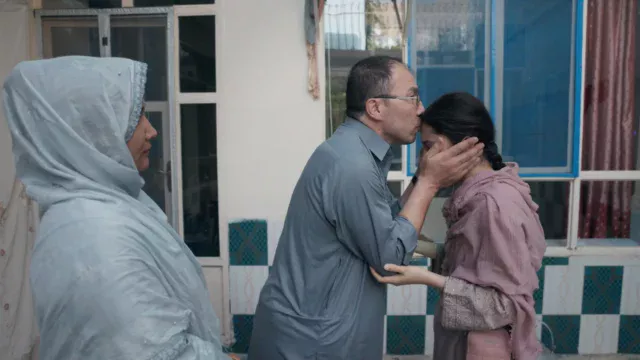
What does home represent? Khadim Dai’s understated, poetic and magical documentary about his Afghan family in Pakistan shows that it is more than just a place.
Hazara Town is as delicate as it is profound, just like the traditional embroidery on which the women in the film work in their unperturbed way, all the time, even during the most dramatic of situations and conversations.
Most of Dai’s deeply personal documentary was filmed in the house in Pakistan, in Hazara Town, so named because of the large number of Afghan Hazaras who live there. This ethnic group is persecuted in their homeland because of their ethnicity and religion, and in Pakistan too they are targeted by religious terrorist groups such as ISIS and the Taliban.
The film is a carefully woven document comprising beautifully filmed outdoor scenes, heart-warming footage of family life, touching archive material and poetic audiovisual reflections on Dai’s own flight and his memories of murdered classmates, linked by a soundtrack of domestic and ambient sounds, music, songs and voices.
Dai, who fled the country six years ago, returns to the house where his sister-in-law lives with her two daughters and their grandparents. They are all eagerly awaiting news about their asylum requests for Canada, where his brother, and the father of the children, now lives.
The filmmaker’s love for everything and everyone he points his camera at is unmistakable: he films his family going about their daily lives, which takes on a deeper meaning because of the way he does it: he follows the matriarch (his sister-in-law) in the morning as she ritually cleans the house with a tray of glowing coals, lovingly watches as his grandfather trims his granddaughter Mitra’s fringe, walks alongside his teenage niece Machid down the street on her way to school, and zooms in on his grandmother’s strong hands as she threads a needle. And he closely watches everyone during the recurring, sometimes heartbreaking video talks with the absent father, in which we find out much about everything that has led up to the current situation.
He alternates these images of the family with those of the ever-expanding local cemetery, an enchanted magical place full of white gravestones and fluttering flags, the sound of which, together with those of the stonemason and the gravediggers, forms an important part of the soundtrack. This is where people gather to mourn when yet another group of Hazaras has fallen victim to religious hatred, but it is also a place where children naturally play, dance and sing.
Throughout the long period during which Hazara Town was filmed, farewells and reunions form the defining moments: the departure of the filmmaker himself, that of the grandparents, the long-awaited arrival of the father who after years in Canada, has finally been granted permanent residence, and Machid’s journey to the United States, where she has been awarded a scholarship to a university.
Those unwillingly left behind cling to hope, love and traditions, embodied in a recurring ritual: every time a car carrying a family member sets off, a jug of water is thrown against the rear window to ensure a safe journey.
Despite all the personal, implicitly political events that enfold (during the filmmaking, the school that the girls attend is taken over by the Taliban, which means the separation of boys and girls) and its melancholic undertones, Hazara Town is not a sombre film. The imagery is too beautiful, the characters are too resilient, and the love they have for one another and their heritage is just too strong for that. What lingers in the mind is the warmth with which the increasingly emptying house is continuously replenished with people, and thus continues to be a home.
Belgium/Australia/Germany, 2026, 103 mins
Writer-Director Khadim Dai
Cinematography and sound recording Khadim Dai
Editing Joëlle AlexysMusic Atena Eshtiaghi
Sound Design Felix Roggel
Producer Ilyas Yourish, Khadim Dai
World sales Filmotor