

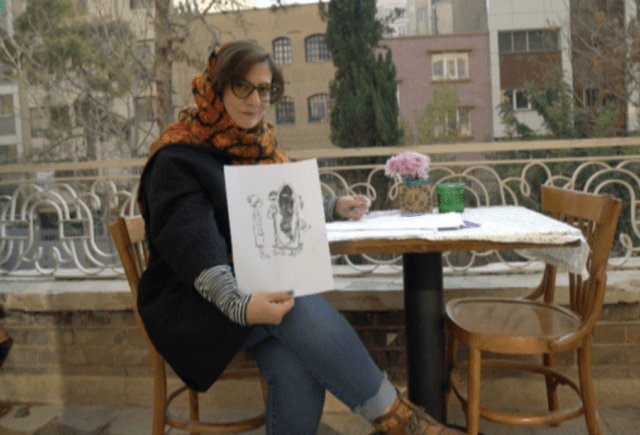
Hanne Phlypo’s Clin d’Oeil Films is handling no fewer than five documentary projects at RE>CONNEXT, the Flemish forum for new audiovisual works, including an ambitious new series entitled Draw for Change!, directed by six leading international female docmakers and which goes next to IDFA Forum.
In Draw for Change!, selected for IDFA Forum and picked up for international sales by Autlook, female cartoonists and their drawings offer a glimpse into some of the most pressing issues women face today, says Clin d’Oeil Films’ Hanne Phlypo. The series will shoot in India, Russia, Syria, Brazil, Mexico, Egypt, the US and the UK, and will engage the considerable directing talent of auteurs Nada Riyadh, Anna Moiseenko, Sama Pana, Karen Vázquez Guadarrama, Kim Longinotto and Laura Nix.
“It’s an anthology series in which we portrait a female cartoonist in each country and she takes us on a trip to meet the characters she is drawing in real life,” stresses Phlypo. “It’s a hybrid documentary, live action verité and animation based on the drawings of the cartoonists, and each episode talks about another topic linked to female rights, for example in Egypt we talk about the position of women in public spaces.” In Russia, the series features Victoria Lomasko who creates cartoons about how state violence pushes Russian men towards domestic violence.
The 8 x 52-minute series is budgeted at just over €3 million with 46% of the finance in place. Co-production partners are Les Films du Balibari (FR), a_Bahn (LU) and Submarine (NL). At RE>CONNEXT the team is looking for pre-sales, distributors, festivals, streamers and broadcasters. The series is co-written and show-run by two Belgian directors, Guillaume Vandenberghe and Vincent Coen.
“I have to say that I wasn’t a strong feminist before, but by hearing all the stories of the people, and by researching it [it is obvious] there is a real need to do something in the world,” admits Phlypo. “It is one of the most ambitious projects that we are doing, but also a project that has changed me in a very profound way.”
The company is presenting three docs-in-progress during RE>CONNEXT. Brussels-based Moldovan filmmaker Otilia Babara’s Love is Not an Orange tells of the communications between migrant mothers and their families back home in Moldova after the collapse of the Soviet Union.
“The project is based on archive material from videos sent home,” says Phlypo, underlining that within the patriarchal post-Soviet Moldova, women were the first to lose their jobs. “Throughout this video archive we are constructing this memory of the Moldovan people. The film follows the people who are sending messages to each other, and is told with the personal voice of the director who also tells the story of what it means to be a migrant.”
Co-produced with Alegria Productions (FR), Basalt Film (NL), 78% of the film’s €201,620 budget is in place. “Otilia is doing associative editing which means that not everything is edited in a chronological way,” the producer adds. “Which means that she needs to find a red line to connect the characters. And what is interesting is that you actually get to see the evolution of filming [methods]. We go from video format to I-phone format… It’s super interesting to see how the world has evolved.”
Another work-in-progress is Vida Dena’s My Paper Life, which also tackles the subject of migration. In the film, traumatised by her flight from war-torn Syria, teenager Rima has difficulties in mastering French and integrating in Brussels. Together with the director, herself an Iranian immigrant, Rima expresses herself through drawings that come to life as stop-motion animations.
Delivery on the Brussels-located film is set for Autumn 2021. Budgeted at €380,769, of which 71% is secured, co-pro partners are Atelier Graphoui (BE) and Les Films du Bilboquet (FR).
Producer Phlypo stresses how Rima still suffers the trauma of her flight from Syria and finds herself adrift between “the modernity of our culture and the traditions of her own culture.” What’s more, as Rima starts to integrate, she refuses to accept an arranged marriage. “We follow the interaction between the filmmaker and the adolescent who draws the memories of what they lived through. It is a very special documentary in which the drawings become animations. And it is a very participatory documentary in that the children [Rima’s siblings] really participate in the narration of the film.”
Celebrated Syrian singer Noma Omran will interpret texts written by Rima and create songs that will be performed throughout the film.
Pieter Van Eecke’s The Falling Sky tells of a Brazilian shaman (Davi) within the Yanomami community who has fought all his life both for his people and the Brazilian rain forest. But Bolsonaro has come to power and is opening up the rain forest for gold prospectors. What’s more, his son Dario is wrestling with the idea of taking on his father’s battles in the future. And the lure of wealth is proving too attractive for many of the Yanomami youth. Can Davi stave off the metaphorical falling of the sky?
“We follow the man in the fight for his people but also in the fight for the rain forest and, by extension, our planet,” says Phlypo .“Because if the rain forest disappears then stopping climate change will be a lot more difficult.”
Shooting locations on the €475k film are Brazil, France, Sweden and UK, and delivery is slated for Autumn 2021. Co-pro partners are Een van de Jongens (NL), Les Films de l’Oeil Sauvage (FR).
“I think this is a very special film because Peter also plays around with magical realism,” adds Phlypo. “The Yanomami believe that our sky will fall if the balance is interrupted and also that the earth we are walking on is a sky that fell before. The metaphor is very beautiful and we will use it. It is a very poetic film, but at the same time there is an urgency to tell this story.”
The company’s junior producer Evelien De Graef is producing Marching in the Dark, about Indian widow Sanjeevani who, following the suicide of her farmer husband whose land was rendered unusable after chemically-induced soil depletion, vows to change matters. Together with 14 other widow farmers, she takes a pledge with psychologist and activist Dr Potdar to make sure what they went through shouldn’t happen to anyone else. “It’s a very positive story in a very sad context,” comments Phlypo.
The project is in pre-production and the producer expects to deliver Autumn 2022. With 24% of the €420,000 in place, co-pro partners are NoCut Film Collective (IN), Basalt Film (NL) and Les Films du Balibari (FR). The producer describes the look of the film: “Wide shots of the region and cinema verité in the counselling sessions, and then a theatre play in which the women re-enact their own stories will be very much part of the film in a very organic way.”
Phlypo further describes the sense of vocation she feels as a documentary producer: “If I hadn’t have done that I would have worked in an NGO or would have worked as a doctor or in some kind of way bringing a better society… It’s more than just a job. It’s the whole life that is built around it.”
“The economic reality of being a doc-maker is not so easy in terms of finding the time to dive deeply into people’s lives and to also find stories that go beyond clichés and stereotypes in order to create empathy and characters that are complex and layered – so you have to take a deep breath. But it is really a wonderful job and I wouldn’t do anything else,” she concludes.





