

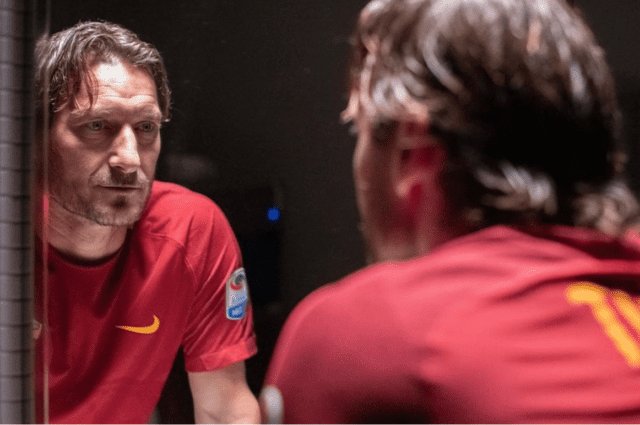
In recent years the lives of footballing geniuses Cruyff, Ibrahimović and Maradona have been given the full cinematic treatment, courtesy of leading European auteurs. Now it is the turn of Italian Francesco Totti, the one-team World Cup-winning neo-god from the Eternal City where, appropriately, Alex Infascelli’s new film word-premiered this week.
My Name is Francesco Totti is such a loving and insightful portrait of a modern day footballing icon that it had to be made by a die-hard and knowledgeable fan. Actually not, admits director Alex Infascelli. Before shooting his film, he had been to the Roma stadium (home to the infamous Curva Sud) just three times in his life. Yes, he followed the beautiful game during global events like the World Cup, but in reality, “I wasn’t bitten by the spider of football,” he says.
Between his debut as a 16-year old in 1993 and retirement at the ripe old age of 41, Francesco Totti played his whole career for Roma FC. An inspirational captain and a prolific goal scorer, he set record after record for club and country alike, and lifted the World Cup in 2006. His final appearances for Roma saw him come on as a late substitute to almost single-handedly grab victory form the jaws of defeat in a series of make or break games.
Yes, Totti might be at the core of Infascelli’s doc, but it is a film as much about the Italian capital as about the city’s footballing talisman.
“I immediately saw the opportunity to make a film about Rome first, and about Rome’s relationship with football, which is a very strong one,” says Infascelli. “And I wanted to tell a love story. As in S for Stanley (2015, about Stanley Kubrick’s bond with his personal driver) I guess what really concerns me in making a documentary is the relationship between two characters. Here it was Francesco and Roma. And as well the Roman fans and Francesco.”
“Maybe they thought that after Kubrick I could handle Totti,” he adds, as an aside, of his choice as helmer. “And it seems that somehow I managed.”
In the film Totti himself is rarely out of the frame, whether in scoring, assisting or celebrating, and we see many of the great goals and the subsequent expressions of delight by him, fellow players and fans.
But given that every ascent towards greatness is preceded by a descent into the abyss, we also see his despair as rivals Lazio win the Serie A title and when he suffers a career-threatening injury prior to the 2006 World Cup. He also played at a time when discontent on the terraces was expressed violently, which is very much brought home in the doc. What’s more, director Infascelli isn’t shy of showing the notorious spitting incident at the 2004 Euros after which Totti was effectively banned for the rest of the tournament.
Infascelli says that Totti is a down to earth guy, but one with an alpha aura, as evidenced by him leading his players to celebrate a league victory in Rome’s epic Circus Maximus. “Francesco is a very strong presence. When he arrives in a room, the molecules of the air change. Really, you feel that he is there. But he has a way of adjusting to that and making you part of that movement that [in turn] adjusts to his personality, that all of a sudden you are the icon as well with him. He embraces everybody.”
The director underlines two other themes within the work, those of time and family. Totti may have spent a quarter century at the club, but in relative terms this a mere blink within the history of an Eternal City. But in footballing terms it is an astonishing longevity. “I wanted to tell a tale where time was a main character, time that fucks you, time that heals you, and the right time to do things, which is something that Francesco has a gift for. To know when is the good time to be still and shut up, and when it’s a good time to move and say what you think.” Most of the time, as the documentary makes evident, Totti’s eloquence was expressed on the pitch.
The concept of family is equally paramount in the film, and Infascelli argues that the doc would not have been possible (at least not in this edit) had it not been for the collaboration of the Totti clan.
“I made it really clear with Francesco’s family, go into your basements, go into your attics, the drawers, the shoe boxes and see what you can find, photographs and videos – and this tribe responded to me,” he says of the treasure trove of archive he had at his disposal, from family holidays in Porto San Gorgio in 1977 to Totti’s progress as a footballer from pre-pubescence to his final game as a teenager in the reserves. One delicious sequence mirrors the master’s sublime skills as an adult with moves of astonishing precision, elegance and physicality performed some 30 years before as a child.
“I made the film around him [Totti],” says Infascelli. “Really, I felt like a tailor. I wasn’t trying to fit him into something that I created. I basically created something on his body that would fit. Because I said to Francesco at the very beginning, I promise you something. I am going to make something that will make you proud, that will make your family proud and something that will remain for years.”
Infascelli further likens Totti to another icon with whom he worked in the past, Kurt Cobain, in the early 1990s. “I was an assistant director at the time for Propaganda Films and I met Kurt, and I remember the same material that their souls were made of. Whereas in Kurt’s life it was dark, in Francesco’s life it is light. It is exactly the same power.”
Prod companies: The Apartment, Wildside with Capri Entertainment, Fremantle Media, Vision Distribution, Rai Cinema in association with Sky, Amazon Prime Video
Cast: Francesco Totti
Director: Alex Infascelli
Screenwriters: Alex Infascelli, Vincenzo Scuccimarra, based on a book by Francesco Totti, Paolo Condo
Producers: Mario Gianani, Lorenzo Mieli, Virginia Valsecchi
Executive producers: Elena Recchia, Martina Veltroni
Director of photography: Marco Graziaplena
Production and costume designer: Eugenia F. Di Napoli
Editors: Alex Infascelli, Emanuele Svezia





