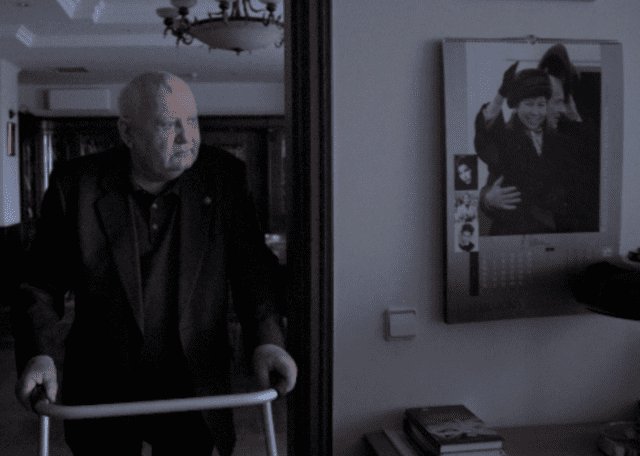
Don’t expect any shocking revelations about the political past within the former Soviet Union. Or the role of former Secretary-General Mikhail Gorbachev in driving tumultuous changes during the time of Perestroika. Instead Gorbachev. Heaven shows a vulnerable, yet proud and quietly cunning old man, stuck in time, with nothing to lose.
It is almost 20 years since the award-winning filmmaker Vitaliy Mansky made his first documentary on Gorbachev as part of a trilogy on Russian leaders – Gorbachev. After Empire (2001). It becomes clear almost immediately that the former Secretary-General feels quite comfortable around the director. And Mansky seems at home in Gorbachev’s villa, which the latter explains was gifted to him by the government, a fact transports you back to the bleak, colourless years of the communist regime.
The film starts with a peaceful introduction to the place: a cat calmy sits on the parquet. A clock is ticking. The four telephones on a desk remain silent. An old man, filmed from behind, watches an item on on glasnost and perestroika on a computer screen. The hour strikes and a cuckoo starts calling.
Mansky retains a calm pace, taking his time before eventually presenting Gorbachev as he is now, both physically (the octogenarian has difficulty walking and getting up) and mentally (Gorbachev formulates slowly and sometimes seems to get lost in his thoughts and memories). We follow his painstakingly slow rise from a chair and descent down three steps.
The director also presents a few indispensable pieces of information, to bring the younger audience up to speed on who we’re actually watching and why. It makes sense for Mansky to challenge Gorbachev occasionally on political matters, trying to get him to open up about what happened when he relinquished power (after Yeltsin’s de facto coup d’etat). And he questions the former leader’s ideological integrity, as Gorbachev had been unable to keep the Soviet Union together.
But these are not the most interesting scenes to watch, although you have to give Mansky credit for not being thrown off the scent by Gorbachev’s overly diplomatic and essentially meaningless answers – although he does call Yeltsin a ‘durak’ (fool) and a madcap.
Gorbachev really comes to life when he talks about his personal past – his mother and the poems she taught him – one of which is referenced by the doc’s title. His eyes begin to shine as he recites the poems and he even breaks out into a song. He lightens up when he talks about his deceased wife Raisa, who meant everything to him. For him, life is meaningless without her, he decidedly states. ‘What can be higher than the feeling of being in love with and being loved by a woman?’ he replies when Mansky insists there must be more to life than simply love.
It is a quiet pleasure to listen to Gorbachev’s anecdotes, both political and personal, even as you realise you may have to take them with a pinch of salt. As it is to see him grow a bit taller when a theatre director and two actors come to learn more about him for a stageplay – a development Mansky also uses to his advantage; it gives him the opportunity to let others add to the picture he is painting.
During most of the interviews, Mansky cleverly keeps a television screen in frame, where Putin is presenting his views. The current leader is always there, lurking in the background, preventing people from speaking their minds about democracy and freedom, two words that Gorbachev has held dear throughout his leadership. He’s not prepared to discuss the current lack of freedom in Russia, even insisting that this film is evidence that people are free to say and do what they want.
In essence, we are left none the wiser on Gorbachev’s political past. But you do get the sense you have visited an intelligent and honourable man, who values his family and friendships – as the touching scene at his personal assistant’s home shows, where Gorbachev celebrates the start of 2020. Time is not dripping, but floating, he observes. As is this documentary of an aged man whose ultimate influence on global politics is as yet to be determined.
Director: Vitaly Mansky
Country: Russia, 2020, 100 mins
Production: Natalia Manskaia for Vertov, Vít Klusák for Hypermarket Film, Filip Remunda for Hypermarket Film
International sales: D
eckert Distribution